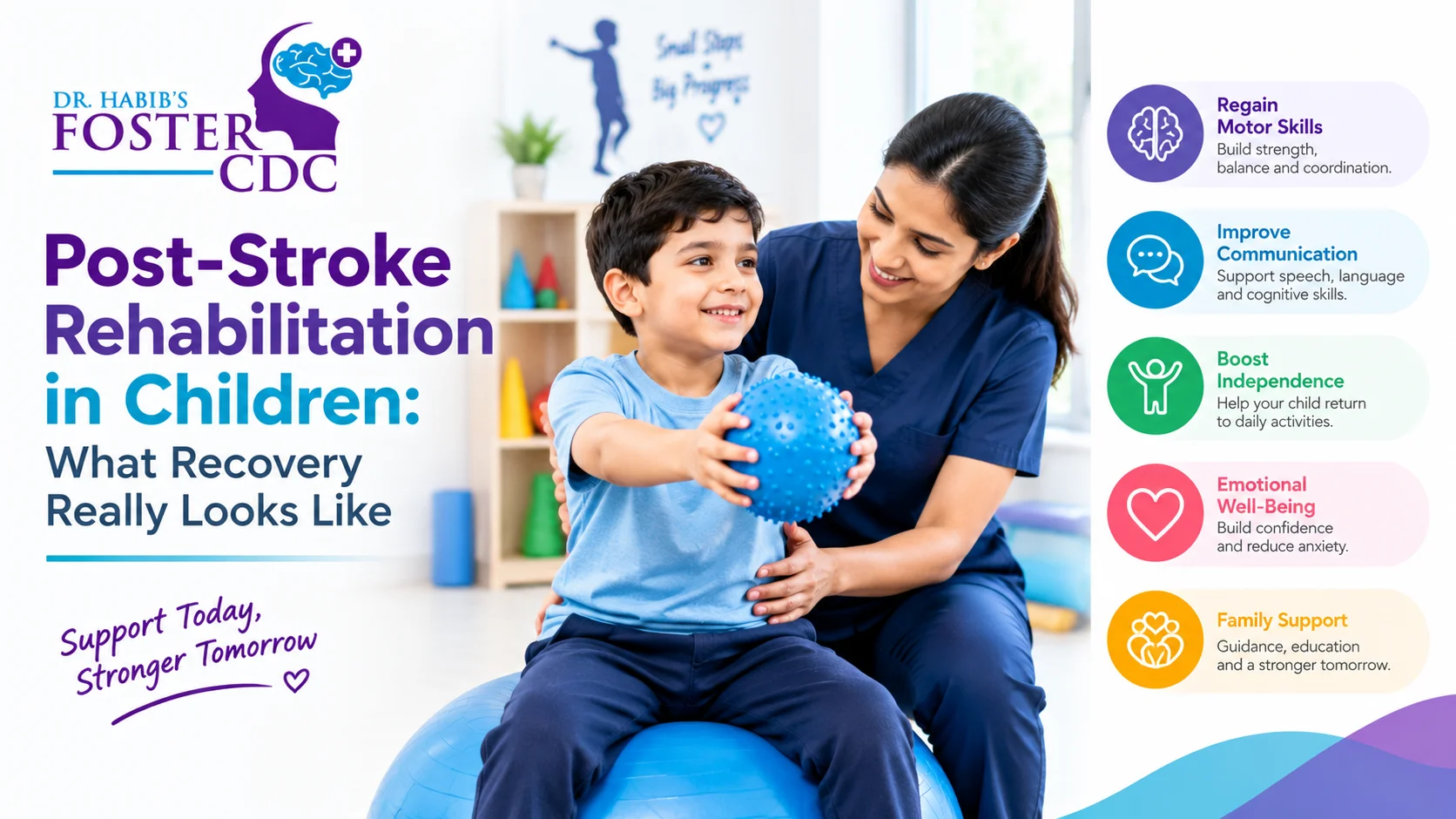
Post-Stroke Rehabilitation in Children: What Recovery Really Looks Like
The hospital part is over. The emergency has passed, the scans are done, and your child is stable. And then, usually somewhere around the second or third day at home, a different question arrives, quieter but heavier: what happens now?
If you’re a parent standing in that moment, here is the honest answer. Recovery after a childhood stroke is not a single event. It is a long, uneven, often surprising process, and the child’s own brain is the most powerful part of it. Your job, and your therapy team’s job, is to give that brain the right kind of practice at the right time.
This guide walks through how that actually works, what therapy involves, and how to tell whether your child is on track.
Neuroplasticity: How Young Brains Rewire After Stroke
Neuroplasticity simply means the brain’s ability to change its wiring in response to experience. After a stroke, some brain cells in the affected area are lost. But the surrounding and connected regions can, with enough of the right input, take on some of the work.
Children have real advantages here. Their brains are still building connections, they are naturally motivated to practice through play, and they have years of development ahead in which new pathways can form.
A caution worth stating plainly, though: you may hear that “children always recover better than adults.” That’s too simple. Research increasingly shows that a young brain is flexible, not immune. Some skills recover well, while others, particularly complex learning and attention skills, can show their difficulties later, as the demands of school and life grow. This is exactly why rehabilitation shouldn’t stop when the visible problems improve.
What drives plasticity is not rest. It is repetition, challenge, and meaning:
- Repetition: Hundreds of purposeful attempts at a movement or word, not a handful
- Challenge: Tasks just hard enough to need effort, but not so hard they cause frustration
- Meaning: Activities that matter to the child, such as feeding a toy, kicking a ball, or asking for a favorite snack
That last point is why good pediatric therapy looks more like play than exercise.
Multidisciplinary Therapy Pillars: PT, OT, and Speech
No single therapist rebuilds a child after stroke. The best outcomes come from a coordinated team working toward shared goals, usually built around what the child needs to do in daily life.
Physical therapy (PT) focuses on movement, strength, balance, and walking. Therapists work on trunk control, weight-bearing through the weaker side, gait training, and coordination, often through games, obstacle courses, and functional tasks rather than repetitive drills.
Occupational therapy (OT) focuses on hand use and everyday independence: grasping, dressing, self-feeding, handwriting, and play. It also addresses sensory and visual-perceptual difficulties that can quietly affect learning. For a deeper look at what OT sessions involve, see our complete guide to occupational therapy for children in Hyderabad.
Speech and language therapy supports understanding, word-finding, clear articulation, and, when needed, safe swallowing. Some children lose words they once had, while others have slurred or effortful speech because the muscles used for talking are weak. If your child is older and was previously talking, therapy often focuses on rebuilding language; if the stroke happened in infancy, the focus may be on helping speech develop in the first place. Our article on speech and language delay in children explains many of the underlying communication skills therapists build.
Parents often ask about child stroke recovery exercises they can do at home. The best ones are the ones your therapist chooses for your child, since the right activity depends on which side is affected, the child’s age, and current ability. As a general rule, home practice works best when it is short, frequent, and folded into routines. For ideas that support overall development, see 10 everyday activities to support your child’s development at home.
Overcoming Post-Stroke Hemiplegia and Spasticity
Many children are left with weakness on one side of the body, called hemiplegia, and some develop spasticity, where muscles become tight and stiff and resist movement. Left unaddressed, this can lead to fixed tightness, changes in posture, and a child who simply stops using the affected hand because the stronger one is easier.
Therapy approaches your care team may use include:
- Constraint-induced movement therapy (CIMT): Gently limiting use of the stronger hand during structured play so the weaker hand gets the practice it needs
- Bimanual training: Activities that require both hands to work together, which build real-world function
- Task-specific training: Practicing the exact skill the child needs, such as walking on uneven ground, rather than general strengthening
- Stretching, positioning, and splints or orthoses: To maintain muscle length and support joints
- Medical management of spasticity: In some children, targeted treatments such as botulinum toxin injections or medication may be considered by the neurologist to make therapy more effective
- Mirror therapy and technology-assisted practice: Used selectively, particularly with older, motivated children
The aim isn’t just stronger muscles. It’s a child who chooses to use the affected side because it has become useful to them.
Cognitive and Emotional Recovery in School-Age Kids
The part of recovery that families often wish they’d been warned about is what you can’t see on a walking assessment. Even when a child’s movement recovers well, stroke can affect:
- Attention and processing speed: Tasks take longer, and the child tires faster
- Memory and learning: New material may need more repetition
- Executive function: Planning, organizing, and starting tasks can become harder
- Fatigue: Many children experience mental exhaustion by mid-afternoon that looks like laziness or “attitude”
- Mood and confidence: Frustration, anxiety, sadness, or withdrawal are common, especially when a child notices they are different from classmates
These difficulties can sometimes resemble attention problems; if you’re seeing similar patterns, our overview of ADHD in children can help you understand how a specialist tells the difference. A structured evaluation, like the one described in what happens during a child developmental assessment, can clarify what support is needed.
Practical ways to support school-age children:
- Talk with the teacher about shorter tasks, extra time, and rest breaks
- Break instructions into small steps and use visual checklists
- Schedule the hardest subjects earlier in the day, when energy is highest
- Celebrate effort, not just results
- Don’t dismiss emotional changes as something the child “should be over by now.” Counseling support can make a real difference
Long-Term Monitoring Milestones
Rehabilitation isn’t a sprint that ends on a set date. A good follow-up plan treats recovery as something to check in on regularly, because children’s needs change as they grow.
Here is a general sense of how the journey tends to unfold. Every child is different, and your care team will tailor timelines to your child:
- Early phase (first weeks to months): Medical stabilization, then starting therapy as soon as the child is ready; the focus is on safe positioning, early movement, swallowing, and communication
- Active rehabilitation (months): Intensive, goal-based therapy; the period when families often see the most visible gains
- Consolidation (months to years): Skills become more automatic and are applied at home and school; therapy intensity usually reduces but continues as needed
- Long-term follow-up (years): Regular neurological review, monitoring for seizures, school and learning support, and checking that development stays on track as new demands appear
Throughout, it helps to compare your child’s progress against age-expected skills. Our child development milestones guide is a useful reference, and if gaps persist, read when to see a specialist for developmental delay.
Some children also develop seizures after stroke, so any unusual spells, staring episodes, or sudden jerking movements should be reported promptly. For background, see our article on epilepsy in children.
Frequently Asked Questions
Q: How do children recover from brain injury and stroke? A: Children have remarkable neuroplasticity, allowing healthy brain areas to rewire lost functions. Recovery requires coordinated occupational, physical, and speech therapy started promptly after medical stabilization.
Q: Will my child walk and talk again after a stroke? A: Many children regain significant walking and speech ability, but the extent depends on the stroke’s location and size, the child’s age, and the quality and consistency of therapy. Your neurologist and therapists can give a more personal outlook after assessing your child.
Q: How long does pediatric stroke rehabilitation take? A: There’s no fixed timeline. The most intensive phase often lasts several months, but many children benefit from ongoing, periodic therapy and monitoring throughout childhood as their needs change.
Q: Can I do rehab exercises at home without a therapist? A: Home practice is valuable, but it should be guided by your child’s therapist so that exercises are safe, correctly done, and matched to your child’s goals.
Q: Is it too late to start therapy if the stroke happened months or years ago? A: Earlier is generally better, but the brain stays adaptable, and children can still make meaningful gains with targeted therapy later. A fresh evaluation is the right first step.
Recovery Is a Team Effort, and You’re on the Team
If there is one thing to carry from this article, let it be this: your child’s recovery isn’t decided on day one. It is built, week by week, through consistent therapy, patient practice, and a family that keeps showing up. Some days will feel like progress, others like standing still. Both are part of the process.
What you need most is a care team that sees your child as a whole person, not just a scan, and a plan that grows as your child does.
Book a neuro-rehab evaluation at Dr. Habib’s Foster CDC centers in Tolichowki, Malakpet, or Suncity, and let our team build a rehabilitation plan around your child’s goals.

Recent Comments