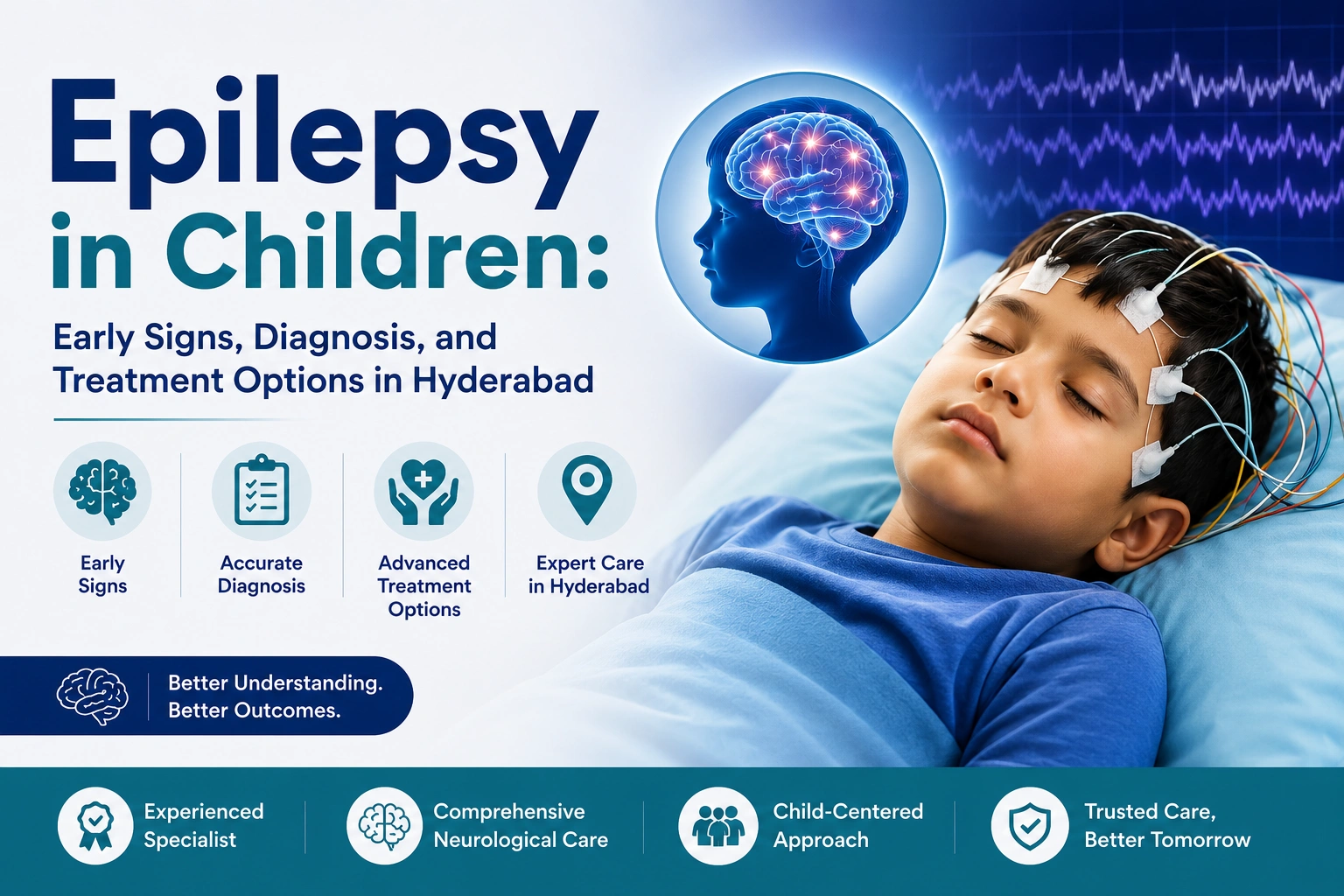
Watching your child have a seizure is one of the most frightening experiences a parent can go through. The good news is that epilepsy in children is far more manageable today than it was even a decade ago, and most children with the condition go on to live full, active lives with the right diagnosis and treatment plan.
This guide walks through what childhood epilepsy actually is, how it’s different from a one-off febrile seizure, what the diagnostic process looks like, and the treatment options a pediatric neurologist may recommend.
What Is Epilepsy in Children?
Epilepsy is a neurological condition marked by a tendency toward recurrent, unprovoked seizures caused by abnormal electrical activity in the brain. A single seizure does not necessarily mean a child has epilepsy — the diagnosis is generally considered only after two or more unprovoked seizures, or one seizure combined with a high likelihood of recurrence based on EEG or imaging findings.
Globally, epilepsy is recognized as one of the most common chronic neurological conditions of childhood, with population studies estimating that somewhere between 4 and 10 out of every 1,000 children are affected, and incidence highest during infancy before gradually declining through the school-age years. In India, awareness and treatment-seeking have improved significantly, but a treatment gap still exists in many regions — which is why early recognition and consultation with a qualified pediatric neurologist matters.
Common Types of Seizures in Children
Not all seizures look like the dramatic, full-body convulsions most people associate with epilepsy. Recognizable patterns include:
- Focal seizures – affecting one area of the brain, sometimes causing unusual sensations, brief staring, or jerking in one limb without loss of full consciousness
- Generalized tonic-clonic seizures – the classic pattern involving stiffening followed by rhythmic jerking and loss of consciousness
- Absence seizures – brief episodes of blank staring or unresponsiveness, often mistaken for daydreaming, lasting just a few seconds
- Myoclonic seizures – sudden, brief muscle jerks, often in the arms or legs
- Febrile seizures – triggered by fever, most common between 6 months and 5 years; these are usually not classified as epilepsy unless they recur without fever or become prolonged
Warning Signs Parents Should Not Ignore
- Repeated episodes of staring spells or “zoning out”
- Sudden, unexplained falls or drops in muscle tone
- Jerking movements of the limbs, especially in clusters
- Confusion, unusual sleepiness, or irritability after an episode
- Loss of bladder control during an episode
- A seizure lasting longer than 5 minutes (this is a medical emergency)
- Developmental regression — loss of previously acquired skills — alongside seizure-like episodes
If your child shows any of these signs, an evaluation with a pediatric neurologist is strongly recommended rather than waiting to see if it happens again.
How Is Childhood Epilepsy Diagnosed?
A thorough diagnostic workup typically includes:
- Detailed clinical history – a description of the episode from parents or caregivers, ideally including any video recorded on a phone, is often the single most useful diagnostic tool
- Electroencephalogram (EEG) – records the brain’s electrical activity and helps identify abnormal patterns associated with seizures
- MRI brain imaging – used to rule out structural causes such as malformations, scarring, or tumors
- Blood tests and metabolic screening – to rule out infections, electrolyte imbalances, or metabolic disorders that can mimic seizures
- Genetic testing – increasingly used in cases of early-onset or treatment-resistant epilepsy, since specific gene mutations are now known to underlie many childhood epilepsy syndromes
Treatment Options for Epilepsy in Children
Treatment is individualized based on seizure type, frequency, the child’s age, and any underlying cause. Options include:
- Anti-seizure medication (ASM) – the first-line treatment for most children; the goal is complete seizure control with the fewest side effects, often achieved with a single medication
- Ketogenic and modified diet therapy – a high-fat, low-carbohydrate diet supervised by a specialist, used particularly in certain drug-resistant epilepsy syndromes
- Vagus nerve stimulation (VNS) – a device-based therapy considered when medications alone don’t achieve adequate control
- Epilepsy surgery – reserved for select cases where seizures originate from a clearly identified, operable area of the brain and haven’t responded to medication
- Developmental and behavioral support – many children with epilepsy also benefit from occupational therapy, speech therapy, or special education support, particularly if there is an associated developmental delay
Most children with epilepsy achieve good seizure control with medication alone, and many eventually outgrow the condition or are able to taper off treatment under medical supervision after a seizure-free period.
Living with Childhood Epilepsy: Tips for Parents
- Keep a seizure diary noting date, duration, triggers, and recovery time
- Never restrain a child during a seizure; instead, turn them onto their side and remove nearby hazards
- Ensure medication is taken consistently — missed doses are one of the most common causes of breakthrough seizures
- Inform schools and caregivers about seizure first-aid basics
- Watch for signs of anxiety or social withdrawal, which are common in children managing a chronic condition, and seek counselling support if needed
Frequently Asked Questions
- Is epilepsy in children curable? Many childhood epilepsy syndromes are highly treatable, and a significant number of children outgrow their seizures by adolescence, particularly with certain syndromes that are known to resolve with age. “Cure” isn’t always the right frame — long-term seizure freedom, with or without medication, is the realistic and common outcome for most children.
- Does every fever-related seizure mean my child has epilepsy? No. A simple febrile seizure, especially a short one associated with a fever, does not automatically mean your child has epilepsy. Most children who have febrile seizures never develop epilepsy. However, prolonged, repeated, or unusual febrile seizures should be evaluated by a pediatric neurologist.
- Can a child with epilepsy attend school normally? Yes, in the vast majority of cases. With seizure control and appropriate communication with teachers, most children with epilepsy attend regular school, participate in most activities, and perform well academically.
- Are anti-seizure medications safe for long-term use in children? Anti-seizure medications are generally well tolerated, and pediatric neurologists select and monitor them carefully based on the child’s age, weight, and seizure type, adjusting doses over time to minimize side effects while maintaining control.
- What should I do if my child is having a seizure right now? Stay calm, gently turn the child onto their side, clear the area of hard or sharp objects, do not put anything in the mouth, time the seizure, and seek emergency medical care if it lasts longer than 5 minutes, if breathing seems difficult, or if it is the child’s first seizure.
- When should I see a pediatric neurologist instead of a general pediatrician? If your child has had more than one seizure, a seizure lasting several minutes, or seizure-like episodes accompanied by developmental changes, a pediatric neurologist has the specialized training in EEG interpretation and seizure management needed for accurate diagnosis and treatment planning.
About the Author
Dr. Habib G Pathan is a Senior Consultant Pediatric Neurologist with more than 19 years of experience diagnosing and treating neurological disorders in children, including epilepsy, febrile seizures, developmental delays, and movement disorders. He completed his fellowship in pediatric neurology at SAT Hospital, GMC Trivandrum, and is the founder and director of Dr. Habib’s Foster CDC, Hyderabad, where he has managed over 3,000 pediatric neurology cases.
This article is for general informational purposes and is not a substitute for professional medical evaluation. If your child is experiencing seizure symptoms, please book a consultation for a personalized diagnosis.

Recent Comments