
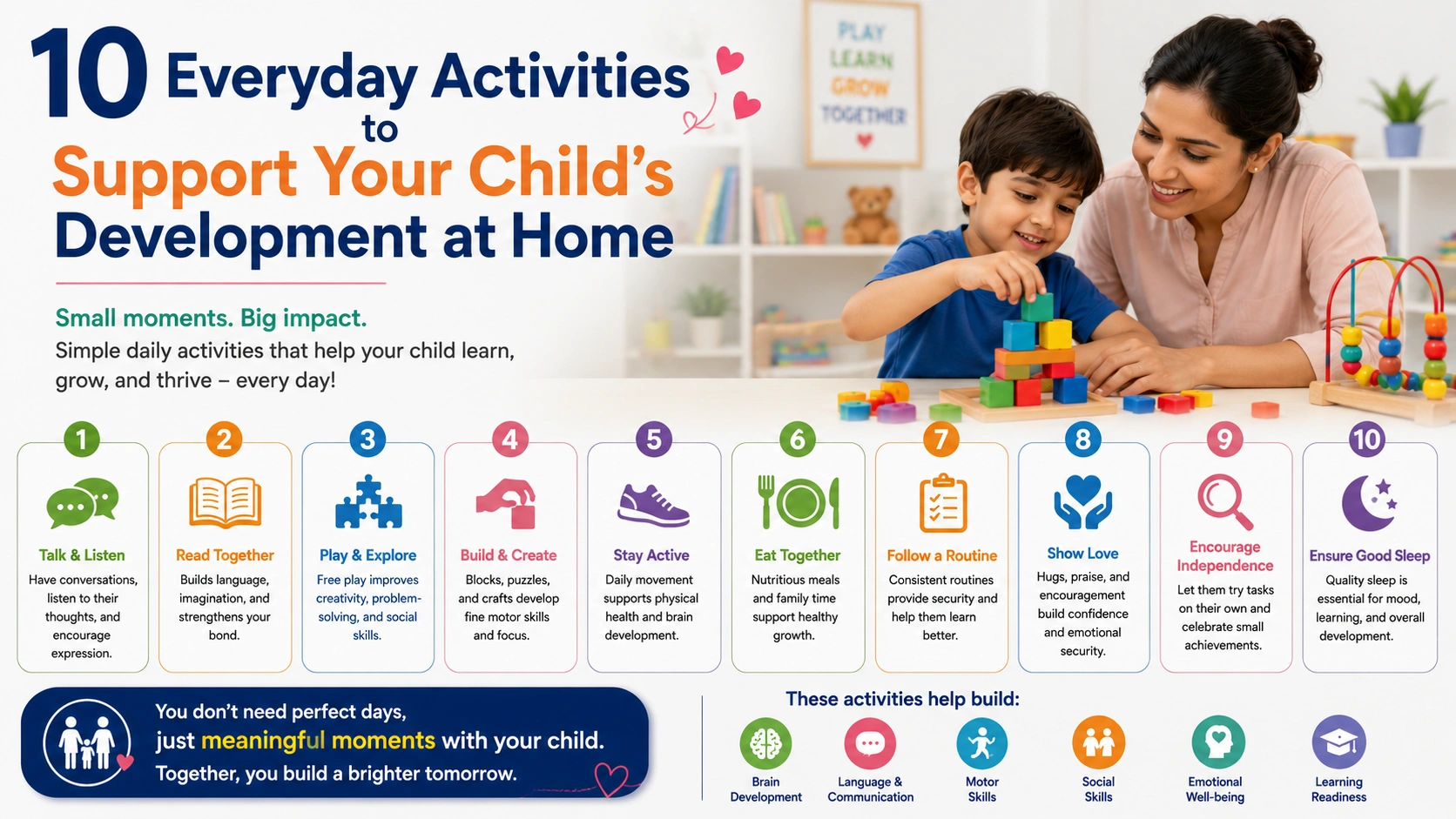
You don’t need special equipment, a therapy room, or a scheduled session to support your child’s development. Some of the most effective developmental support happens in ordinary moments — mealtime, bath time, a walk to the park. This guide shares ten simple, evidence-informed activities you can weave into daily life to nurture your child’s motor, language, social, and cognitive growth.
Why Everyday Activities Matter for Development
A child’s brain develops through repeated, everyday experience — not through occasional, isolated exercises. Talking, playing, moving, and problem-solving together builds the neural pathways behind language, coordination, emotional regulation, and reasoning. The good news for busy parents: you’re likely already doing many of these things. A few small, intentional adjustments can make daily routines even more developmentally rich.
10 Activities to Try at Home
1. Narrate Your Day Together
Describe what you’re doing as you do it — “Now we’re washing the rice, see how it turns the water cloudy?” This simple habit, sometimes called “self-talk” or “parallel talk,” builds vocabulary and language comprehension long before a child can respond in full sentences.
Best for: Language and communication development, ages 0–5.
2. Turn Chores Into Fine Motor Practice
Let your child help pour, stir, button, zip, or sort objects during everyday chores. These small hand movements build the fine motor control needed later for writing, buttoning clothes, and using utensils independently.
Best for: Fine motor skills, ages 2–7.
3. Read Together, Then Talk About It
Reading aloud is well known to support language, but pausing to ask simple questions — “What do you think happens next?” — builds comprehension, reasoning, and imagination, not just vocabulary.
Best for: Language, cognitive skills, and attention, ages 1–10.
4. Create Obstacle Courses with Household Items
Cushions to crawl over, a rope to balance along, chairs to weave through — simple obstacle courses build gross motor coordination, balance, and body awareness, all while being genuinely fun.
Best for: Gross motor skills and coordination, ages 2–8.
5. Practice Turn-Taking Games
Simple games like rolling a ball back and forth, board games, or even taking turns stacking blocks teach patience, social reciprocity, and the foundations of cooperative play — all valuable for social-emotional development.
Best for: Social skills and emotional regulation, ages 2–8.
6. Cook or Bake Together
Measuring, pouring, mixing, and following steps in a simple recipe builds sequencing skills, following multi-step instructions, and early math concepts (more, less, half), while offering a natural, low-pressure way to spend focused time together.
Best for: Cognitive skills and sequencing, ages 3–10.
7. Encourage Pretend Play
Let your child direct imaginative play — running a pretend shop, hosting a tea party, acting out a story. Pretend play strengthens language, social understanding, problem-solving, and emotional expression.
Best for: Social-emotional and cognitive development, ages 2–7.
8. Explore Different Textures and Sensory Play
Activities like playing with sand, water, dough, or textured fabrics help children process sensory information and build tolerance for a range of textures — useful for children who are sensitive to sensory input as well as those who aren’t.
Best for: Sensory processing, ages 1–6.
9. Set Up Simple Sorting and Matching Games
Sorting laundry by color, matching socks, or organizing toys by size or shape builds early categorization skills — a foundation for later math and logical reasoning.
Best for: Cognitive development, ages 2–7.
10. Build in Daily “Connection Time”
Even 10–15 minutes of undivided, child-led attention each day — no phones, no multitasking — supports emotional security and attachment, which underpins healthy behavioral and social development.
Best for: All ages, particularly valuable for emotional regulation and behavior.
Adapting Activities by Age
- Infants (0–12 months): Focus on sensory exposure, narrating routines, and responsive interaction — talking, singing, and reacting to your baby’s sounds and expressions.
- Toddlers (1–3 years): Emphasize movement, simple turn-taking, and expanding vocabulary through naming objects and short phrases.
- Preschoolers (3–5 years): Introduce simple sequencing (cooking steps, obstacle courses), pretend play, and cooperative games.
- School-age (5–10 years): Shift toward activities that build reasoning, independence, and more complex social skills — board games, multi-step chores, and collaborative projects.
When Everyday Activities Aren’t Quite Enough
These activities are wonderful for supporting typical development, but they are not a substitute for professional evaluation if you have specific concerns. Consider seeking a specialist opinion if you notice:
- A consistent gap between your child’s development and their peers, despite consistent engagement at home
- Loss of previously acquired skills
- Limited response to social interaction or communication attempts
- Significant difficulty with movement, coordination, or muscle tone
If any of this sounds familiar, a structured developmental assessment can clarify whether additional support — such as occupational therapy — would benefit your child, and can help you distinguish typical variation from a genuine developmental warning sign.
How Dr. Habib’s Foster CDC Supports Families
Beyond clinical evaluation and treatment, Dr. Habib’s Foster CDC works with parents directly — offering practical guidance on how to reinforce therapy goals at home, so progress isn’t limited to clinic visits alone. Many of the activities in this guide reflect the kind of everyday, parent-led support our team recommends alongside formal therapy.
Frequently Asked Questions
What is the best way to support my child’s development at home? Consistency matters more than complexity. Simple, repeated interactions — talking through daily routines, reading together, and unstructured play — build developmental skills more reliably than occasional, elaborate activities.
Who should consult a specialist about supporting their child’s development? Any parent who notices a consistent gap between their child and same-age peers, a loss of previously acquired skills, or a general sense that something isn’t progressing as expected should consider a professional consultation, even while continuing supportive activities at home.
What causes developmental delays despite an engaged home environment? Delays can stem from a wide range of factors — genetic, neurological, or related to pregnancy and birth — that are unrelated to how engaged or attentive a parent is. A stimulating home environment supports development but cannot always prevent a delay rooted in an underlying medical cause.
How is a developmental concern diagnosed if home activities aren’t helping? A pediatric specialist combines a detailed history, direct observation, and standardized screening tools to distinguish typical variation from a condition requiring further evaluation or therapy.
What is the best treatment if simple activities aren’t enough? Treatment depends entirely on the specific delay identified. It typically involves targeted therapy — speech, occupational, physical, or behavioral — often alongside continued supportive activities at home.
Can developmental delays be prevented through home activities alone? Not entirely. While a rich, responsive home environment supports healthy development, it cannot prevent delays caused by underlying genetic, neurological, or medical factors. Early recognition and, when needed, professional evaluation remain essential.
Sources & Further Reading
This article reflects general early-childhood development guidance consistent with recommendations from the World Health Organization (WHO), the CDC’s “Learn the Signs. Act Early.” program, the American Academy of Pediatrics (AAP), and the Indian Academy of Pediatrics (IAP).
Medical Disclaimer
This content is for general informational purposes only and does not replace an individualized medical evaluation. These activities are intended to support typical development and complement, not substitute for, professional care. If you have concerns about your child’s development, please consult Dr. Habib or another qualified pediatric specialist directly.
About the Reviewer
Dr. Habib G Pathan is a Senior Consultant Pediatric Neurologist and Director of Dr. Habib’s Foster CDC, Hyderabad. He completed his fellowship in pediatric neurology at SAT Hospital, Government Medical College, Trivandrum, under Dr. P.A.M. Kunju and Dr. Kalpana. Over more than 19 years of practice, he has personally evaluated and treated over 3,000 pediatric neurology cases and 1,00,000+ pediatric cases overall. View full profile →
Want a printable version of these activities to keep on your fridge? Get in touch with Dr. Habib’s Foster CDC for a free activity checklist →
Related reading: Brain Development Milestones by Age · What Happens During a Child Developmental Assessment? · Warning Signs of Neurological Disorders in Children

Recent Comments