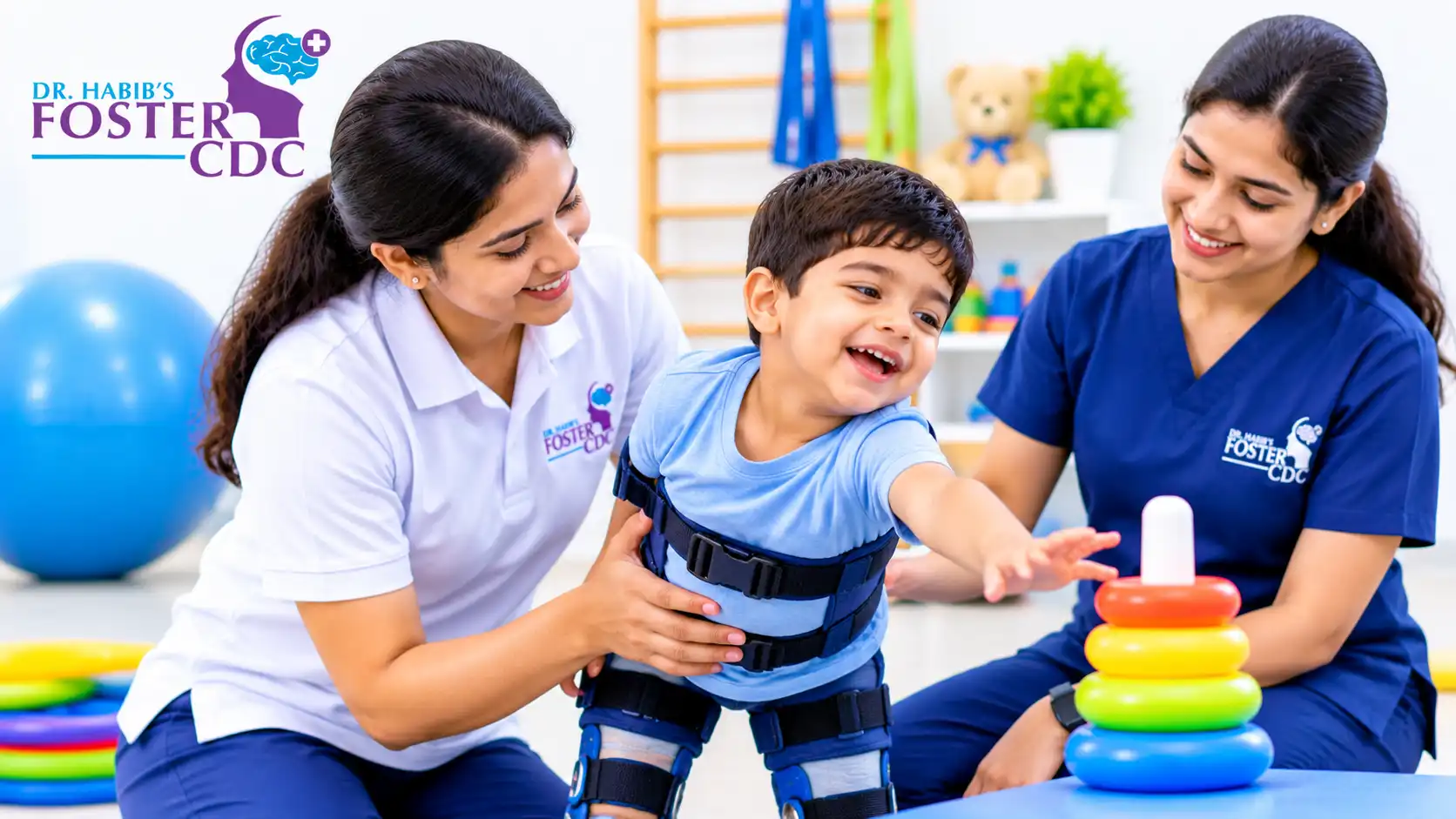
The best-supported treatment for children with cerebral palsy (CP) is active, goal-focused therapy, meaning regular, repeated practice of real tasks that matter to the child and family, combined with tone management (stretching, splints and orthotics, casting, oral medicines, botulinum toxin injections, and surgery in selected cases), hip checks, speech, swallowing, and communication support, and assistive technology. Physiotherapy and occupational therapy work best when parents are partners and practice happens at home, not just in the clinic. Treatment is tailored to the child’s type of CP and motor ability.
When parents first hear the words “cerebral palsy,” many describe the same moment: the room goes quiet, and the future suddenly feels very uncertain. Then the questions arrive. What therapy does my child need? How often? Which centre is best? Will he walk? Will she talk? What are all these injections, braces, and chairs?
This guide is meant to be a roadmap. Cerebral palsy is lifelong, but it is also one of the conditions where good, organized care makes a visible difference to movement, comfort, communication, and independence. Children with CP go to school, make friends, play sport, study, work, and build full lives. Our goal is to help you understand what modern treatment looks like, what the evidence says works, and how to choose a team you can trust.
(If your baby is still under a year old and you’re watching for early signs, start with our guide to early signs of cerebral palsy in infants.)
Understanding the Types: Spastic, Dyskinetic, Ataxic, and Mixed CP
CP is a group of conditions that affect movement, muscle tone, and posture because of an injury to or difference in the developing brain. The brain injury doesn’t progress, but the way it affects the body changes as a child grows. The type of CP shapes which treatments help most.
| Type | What it looks like | What it means for treatment |
|---|---|---|
| Spastic (most common) | Stiff, tight muscles; movements limited or jerky; may affect one side (hemiplegia), mainly the legs (diplegia), or all four limbs (quadriplegia) | Stretching, orthotics, casting, botulinum toxin, oral medicines, and sometimes surgery; strong focus on active practice and strengthening |
| Dyskinetic (dystonic or choreoathetoid) | Involuntary, twisting, writhing, or sudden movements; tone fluctuates, often with speech and swallowing involvement | Different medicines from those used for spasticity; seating and positioning; communication supports; sometimes deep brain stimulation in selected cases (see dystonia and spasticity management) |
| Ataxic | Unsteady balance, shaky or clumsy movements, wide-based walking | Balance and coordination training; safety and gait aids |
| Mixed | Features of more than one type, such as spasticity with dystonia | Combined, carefully individualized plans |
Children also differ greatly in how much CP affects them, from a mild weakness in one hand to needing support with most daily activities. That is why a good team talks about function and goals, not just the label.
The GMFCS: how doctors describe motor ability
You’ll often hear the letters GMFCS (Gross Motor Function Classification System). It groups children into five levels based on what they typically do in daily life, not on their potential. It helps teams set realistic goals, choose equipment, and plan hip checks. These descriptions are simplified, and the level can differ slightly by age.
| Level | In everyday terms (school-age child) | Typical supports |
|---|---|---|
| I | Walks and climbs stairs without limits; may be slower or less steady for running, jumping, and balance | Skill and fitness training; sport and play |
| II | Walks in most places, but has trouble on uneven ground, slopes, stairs, and in crowds; may use a handrail or limited aids | Orthotics, balance and strength training; a wheelchair may help for long distances |
| III | Walks with a hand-held device such as a walker or crutches indoors; uses a wheelchair for longer distances, sometimes self-propelled | Walkers, gait trainers, orthotics, a wheelchair for community use |
| IV | Limited self-mobility; usually transported in a manual chair or uses a power chair; may walk short distances with support in therapy | Power mobility, standing frames, supportive seating |
| V | Needs to be transported in a wheelchair in all settings; very limited head and trunk control | Custom seating, positioning, power mobility options where possible, comfort care |
Other classification systems describe hand ability (MACS), communication (CFCS), and eating and drinking (EDACS). Together they give a fuller picture of a child’s needs. The level does not predict a child’s intelligence or their happiness, and children can change levels over time.
The Role of Pediatric Physical & Occupational Therapy (NDT)
Therapy is the heart of CP treatment. But not all therapy is equal, and it helps to know what current evidence supports.
What the research says works
Large reviews of CP treatments have repeatedly found that the interventions with the strongest evidence are active, goal-directed, and practised often by the child, rather than passive treatments done to the child. Approaches with good evidence include:
| Approach | What it is | Helps with |
|---|---|---|
| Goal-directed training | Practising specific, meaningful tasks chosen with the family (for example, “feed myself” or “walk to the garden”) | Everyday skills, mobility, hand use, self-care |
| Task-specific and mobility training | Repeating real movements such as sit-to-stand, stairs, and walking, in real settings | Walking, balance, daily function |
| Constraint-induced movement therapy (CIMT) | For one-sided weakness: temporarily limiting the stronger hand so the weaker hand practises, in play | Hand use in hemiplegia |
| Bimanual training | Activities that need both hands to work together | Two-handed skills |
| Strength and fitness training | Safe, supervised strengthening and aerobic exercise | Muscle strength, endurance, health, confidence |
| Treadmill training (including with body-weight support) | Repetitive walking practice with safety support | Walking speed and endurance |
| Home programmes | Short, regular practice built into family routines, guided by the therapist | Everything, because frequent practice is what builds skill |
| Casting, splinting, and orthotic programmes | Maintaining muscle length and joint position | Range of motion, walking, hand function |
| Occupational therapy after botulinum toxin injections | Therapy timed to use the “window” after an injection | Better, longer-lasting gains |
| Environmental enrichment and context-focused therapy | Changing the task or environment so the child can succeed | Participation and independence |
A word about NDT (Neurodevelopmental Treatment or Bobath)
You’ll often see Neurodevelopmental Treatment (NDT, also called the Bobath concept) advertised by therapy centres, and it is widely used in India and worldwide. NDT uses skilled hands-on handling to encourage typical movement and posture, and many therapists and families value its attention to positioning and quality of movement.
Here is the honest picture: current evidence reviews rank active, goal-directed, task-specific training and the approaches listed above higher than NDT used on its own. The most helpful way to see NDT is as a handling and positioning skill that can support a goal-focused programme, not as a complete treatment by itself. When you evaluate a centre, ask what the goals are, how practice is built into the week, and how progress is measured, rather than choosing by method name alone.
How much therapy is enough?
- Quality, intensity, and consistency matter more than the number of sessions. A well-designed home programme between sessions often does more than extra clinic visits
- Parents are partners, not spectators. A good therapist coaches you to do the practice at home in a few short sessions each day
- Therapy should be fun. Children learn most through play, motivation, and success
- Set goals together, review them every few months, and measure progress (for example, with standard motor assessments or goal scales), so you can see what’s working
- Avoid overtraining, because tiredness and pain reduce learning, and rest and play are part of treatment
Occupational therapy for the child with CP
Occupational therapy (OT) focuses on what your child needs to do every day. An OT for a child with CP typically helps with:
- Hand function: reaching, grasping, releasing, using both hands, and handwriting or keyboard skills
- Self-care: feeding, dressing, bathing, and toileting
- Play and learning: adapting toys, seating, and tools so your child can take part
- Sensory and perceptual skills, including vision-related and sensory difficulties (see our guide on sensory processing issues in children)
- Splints and equipment for hands and arms, adapted utensils and cups, and positioning aids
- School participation: desks, writing aids, tablets, and a plan with teachers
- Coaching parents, so skills carry into daily life
For more detail, see our complete guide to occupational therapy for children in Hyderabad.
Managing Spasticity: Targeted Injections and Orthotics
Spasticity (stiff, tight muscles) can limit movement, cause pain, make care harder, and lead to permanent tightening of muscles and joints if it isn’t managed. Tone management works best as a step-by-step plan matched to the child, combined with therapy. (Our dedicated guide to pediatric dystonia and spasticity treatment goes deeper into tone disorders.)
1. Daily stretching, positioning, and active strengthening
The foundation of every plan: gentle stretching, good positioning during sleep and sitting, and strengthening of weak muscles. Spastic muscles are often weak as well as tight.
2. Orthotics, splints, and casting
- Ankle-foot orthoses (AFOs) support the foot and ankle for more efficient walking and to protect muscle length
- Night splints and hand or wrist splints keep joints in a good position
- Serial casting gradually stretches tight muscles, often together with botulinum toxin
- Well-fitted, regularly reviewed orthotics matter. Children outgrow them quickly, and ill-fitting ones cause sores
3. Oral medicines
Several medicines can reduce spasticity or dystonia throughout the body. They are chosen by the doctor according to the type of tone, age, and side effects such as drowsiness. Doses and changes are always set by the doctor. Never adjust or stop them yourself.
4. Botulinum toxin injections (often called “Botox”)
For tightness in specific muscles, such as calves, hamstrings, or forearm and hand muscles, botulinum toxin injections temporarily relax the targeted muscles.
- The effect usually builds over days to weeks and lasts a few months, after which injections can be repeated if still helpful
- It is most effective when combined with therapy, because the injection creates a window in which stretching, casting, strengthening, and practice can achieve more
- Children often have numbing cream, sedation, or light anesthesia for comfort. The procedure is brief
- It suits focal problems better than whole-body stiffness
5. Advanced options for selected children
- Intrathecal baclofen (ITB): a small pump that delivers medicine directly around the spinal cord, sometimes used for severe, widespread spasticity or dystonia
- Selective dorsal rhizotomy (SDR): a surgery that cuts certain nerve rootlets to reduce leg spasticity, used for carefully selected children, typically with spastic diplegia, and followed by intensive therapy
- Orthopedic surgery: lengthening tight tendons, correcting bone and joint deformities, and hip reconstruction if hips are migrating, often planned as combined procedures
- Deep brain stimulation: considered for some children with severe dystonia
These decisions are made by a team after careful assessment, never in a rush.
Hip checks: a quiet but vital part of care
In CP, the hips can slowly slip out of their sockets, often without pain at first. Regular hip surveillance, usually with periodic X-rays whose schedule depends on the child’s GMFCS level, lets the team catch changes early, when simple measures can help, and avoid painful problems later. Ask your team about your child’s hip surveillance plan.
Pain, bones, and general health
- Pain is common in CP and often under-recognized, especially in children who can’t say where it hurts. Report irritability, poor sleep, or sudden changes to the doctor
- Bone health: reduced weight-bearing, medicines, and poor nutrition can weaken bones, so ask about vitamin D, calcium, and standing programmes
- Constipation, reflux, sleep problems, and dental care deserve attention too. They affect comfort and behavior
Speech, Swallowing, and Communication Assistive Devices
Many children with CP have difficulty with speech, eating and drinking, drooling, or all three, because the muscles of the mouth and throat are affected. Good support here changes daily life.
Speech and language therapy helps with:
- Clearer speech, breath control, and voice
- Language and understanding, which may be better than speech suggests
- Safe, efficient eating and drinking
- Choosing and learning communication aids
Swallowing (dysphagia):
- Signs of trouble include coughing or choking with meals, a “wet” voice, very long mealtimes, poor weight gain, and repeated chest infections
- Assessment may include a watched feeding session and, if needed, a swallowing X-ray study
- Management may include positioning, changes to food and drink textures, feeding techniques, and, when oral feeding isn’t safe or adequate, a feeding tube, a decision made carefully with the family
- Drooling can be managed with therapy, medicines, injections, or occasionally surgery
Augmentative and alternative communication (AAC): AAC means any tool that helps a child communicate when speech is hard or unclear. It includes:
- Gestures, signs, and picture boards
- Symbol books and communication apps on a tablet
- Speech-generating devices, including those operated by switches or eye-gaze
- Message systems adapted to the child’s language and home setting
A common worry is that AAC will stop a child from learning to speak. Research does not support this; AAC usually supports language and reduces frustration. Start early, and involve the whole family. For general guidance on speech development, see speech and language delay in children. Also have hearing and vision checked, because they affect learning and communication.
Assistive technology for independence
The right equipment is a tool for freedom, not a sign of giving up. Depending on a child’s needs, it can include:
| Area | Examples |
|---|---|
| Mobility | Walkers, gait trainers, crutches, manual and power wheelchairs, adapted tricycles |
| Standing and positioning | Standing frames, supportive seating, night positioning systems |
| Daily living | Adapted cutlery and cups, dressing aids, shower and toilet seats, bath chairs |
| Communication | Picture boards, communication apps, speech-generating devices, eye-gaze systems |
| Learning and computer access | Adapted keyboards, switches, voice typing, tablet stands, text-to-speech |
| Home and school | Ramps, rails, desks at the right height, accessible toilets |
| Transport | Car seats and ramps; adapted vehicles when needed |
Tips for choosing equipment:
- Ask for a proper assessment and a trial before buying, because poor-fitting equipment is costly and can cause harm
- Plan for growth, with regular reviews
- Remember that power mobility can transform a young child’s independence and learning
- Ask about funding and schemes, and be cautious with unverified products or “miracle” devices
Fostering Social Inclusion and Adaptive Sports
The goal of therapy isn’t just stronger muscles. It’s a child who can take part: in school, play, friendships, family life, and eventually work and community. Experts call this participation, and it is one of the most important outcomes in CP.
School and learning
- Many children with CP attend mainstream schools with the right accommodations (accessible rooms, extra time, assistive tools, a teaching assistant or shadow teacher where needed)
- Some children also have learning, attention, vision, or hearing differences, and benefit from early assessment; see our overview of what happens during a child developmental assessment and our guide to developmental delay
- Where epilepsy is part of the picture, a school seizure plan is important; see epilepsy in children
- India’s Rights of Persons with Disabilities Act, 2016 recognizes cerebral palsy and supports inclusive education and reasonable accommodation. A UDID disability certificate can help with school and benefit access, and the Niramaya health insurance scheme under the National Trust covers certain disabilities, including CP. Check current eligibility and processes with your hospital or a parent organization
Adaptive sports and active play
Sport builds strength, fitness, confidence, and friendship. Many activities can be adapted for different abilities, such as:
- Swimming and water play
- Para athletics, para badminton, para table tennis, and wheelchair sports
- Boccia, a ball sport designed for people with significant motor challenges
- Adapted cycling, dance, yoga, and martial arts
- Horse riding and therapeutic riding programmes
- Inclusive team games at school and in the community
Always check with your child’s team about safe activities, fatigue, and any joint or hip concerns. Para sport bodies and local disability sports groups can point you to coaches and classes.
Friendships, independence, and emotional health
- Let your child do things for themselves, even if slowly, and give choices
- Don’t over-protect. Safety matters, but so does the chance to try, to fail, and to belong
- Watch for sadness, anxiety, and low confidence, which are common. Counseling and peer support help
- Plan for the teenage years: puberty, privacy, body image, relationships, and planning for education, work, and independent living
- Plan the move to adult services well before the 18th birthday
- Look after yourself and siblings. Parent groups, respite, and counseling are part of good care
Choosing a Therapy Centre for Your Child
A good centre gives your child the right therapy, at the right intensity, with the right goals, and involves you as a partner. Use this checklist:
- A team, not a single therapist: a pediatric neurologist or developmental pediatrician with physiotherapy, occupational therapy, and speech therapy, and access to orthopedics, orthotics, and other specialists
- Careful assessment first, including classification of your child’s type and motor ability
- Goals set with you, written down, and reviewed regularly
- Evidence-based, active therapy with a home programme, and parent coaching
- Outcome measurement, so progress is tracked, not assumed
- A plan for tone management and hip surveillance, with referrals when needed
- Help with equipment: trial, fitting, and follow-up
- Support for communication, feeding, learning, and emotional health
- A child-friendly, accessible environment
- Honest conversations about costs, expectations, and uncertainty
- Be cautious about: promises of a “cure,” guaranteed results, treatments that are painful or entirely passive, pressure to buy expensive packages, or unproven treatments (including unregulated stem-cell clinics) sold as cures. Ask your neurologist whether a treatment has good evidence
Questions parents often ask their child’s therapist
How many sessions does my child need each week? It depends on your child’s goals, age, and energy. Frequent, focused practice, including at home, usually matters more than the number of clinic sessions. Your therapist will recommend a schedule and adjust it.
What can I do at home? Short, regular practice built into routines, such as standing during teeth-brushing, reaching during dressing, or walking to the kitchen, is often the most effective. Ask for a simple written or video programme.
My child cries or resists therapy. What should I do? Tell the therapist. Sessions should be playful and positive, with breaks. Pain, tiredness, fear, or boredom can all be reasons, and a good therapist will adapt.
Is more therapy always better? Not always. Too much can tire children and families, and children need time to rest and play. The aim is the right amount of high-quality, goal-focused practice.
When should we consider injections, surgery, or equipment? When stiffness, pain, tight joints, or hip changes limit function or comfort, or when equipment would give independence. These are decided with your neurologist and team, as part of an overall plan.
Will my child walk? It depends on the type and level of CP, and the team can give a realistic outlook based on your child’s motor ability and development. Whether or not a child walks, there are many ways to be mobile, independent, and included.
Frequently Asked Questions
Q: What therapies are most effective for children with spastic cerebral palsy?
A: The best results come from an integrated approach: active, goal-directed physical and occupational therapy practised often (including at home), speech and swallowing support, orthotics and casting, and tone management with oral medicines or botulinum toxin injections, with surgery in selected cases. Therapy should be tailored to your child’s goals and level.
Q: What is the best physical therapy for a child with cerebral palsy?
A: Therapy that is active, goal-focused, and practised regularly, such as task-specific training, strengthening, and mobility practice, with a home programme and parent coaching, has the strongest evidence. Hands-on methods such as NDT can support this but are not a complete treatment on their own.
Q: How does occupational therapy help a child with CP?
A: Occupational therapy builds hand function and everyday independence, including feeding, dressing, play, and school tasks, and provides splints, adapted equipment, and strategies that help the child take part at home and school.
Q: Is Botox safe for children with cerebral palsy?
A: Botulinum toxin injections are widely used and generally well tolerated when given by an experienced specialist, though side effects can occur, and the effect is temporary. It works best with therapy. Your doctor will explain the benefits and risks for your child.
Q: Will my child with cerebral palsy need surgery?
A: Not every child does. Many are managed with therapy, orthotics, and medicines. Surgery is considered for specific problems such as tight tendons, hip migration, or severe spasticity, after careful assessment.
Q: What is GMFCS?
A: GMFCS is the Gross Motor Function Classification System, which describes a child’s everyday motor ability in five levels. It helps teams plan goals, equipment, and hip checks, and it does not describe a child’s potential or intelligence.
Q: Can children with cerebral palsy play sports?
A: Yes. Many take part in swimming, para sports, adapted cycling, dance, and inclusive team games. The right activity depends on the child, so check with the care team.
Q: Can a child with CP use communication devices if they can’t speak clearly?
A: Yes. Augmentative and alternative communication, from picture boards to speech-generating devices and eye-gaze systems, helps children express themselves, and does not prevent speech from developing.
Key Takeaways
- Treatment is a team effort built around your child’s goals, not just the diagnosis
- Active, goal-directed, regularly practised therapy has the strongest evidence; home practice is essential
- Tone management includes stretching, orthotics, casting, medicines, botulinum toxin, and, for some, surgery
- Hip checks are a quiet but vital part of care
- Speech, swallowing, and communication support (including AAC) improve safety, learning, and relationships
- The right assistive technology brings independence, not defeat
- Participation, in school, sport, and friendships, is a core goal
- Be cautious about cure claims, and ask for evidence
You Are Your Child’s Best Advocate
Every child with cerebral palsy has strengths, interests, and a personality that no diagnosis describes. The right therapies, the right equipment, and the right people around them help those qualities shine. If you’re looking for a team to walk beside you, we’re here.
Discover specialized CP programs at Dr. Habib’s Foster CDC in Tolichowki, Malakpet, and Suncity, Hyderabad. For seizures, breathing difficulty, choking, or any emergency, go to the nearest hospital first.
This article is for educational purposes and does not replace a medical consultation. If your child has sudden, severe, or worsening symptoms, seek urgent medical care.

Recent Comments