
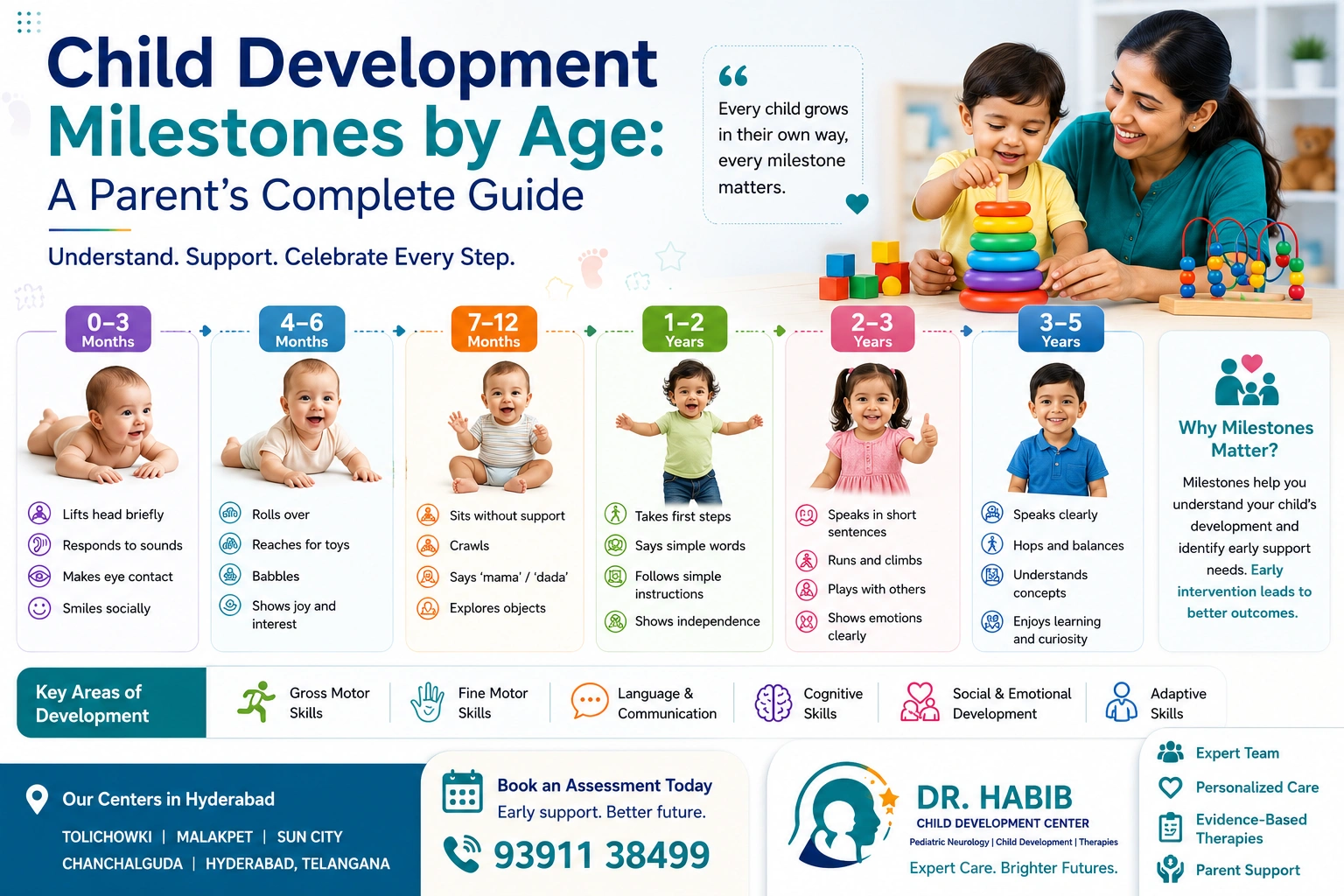
Every parent watches for the “firsts” — the first smile, the first word, the first steps. But it’s natural to wonder: is my child on track? Understanding child development milestones by age can help you know what to expect at each stage, and when a delay might be worth a closer look.
Quick Answer
Child development milestones are the skills most children reach by a certain age — in motor, language, social, and cognitive areas. While every child develops at their own pace, noticeable delays across multiple areas, or missing several milestones by the expected age, are reasons to consult a pediatric specialist for an evaluation.
Key Takeaways
- Development is grouped into four areas: motor, language, social-emotional, and cognitive skills.
- Milestones are general guides, not strict deadlines — some variation is normal.
- Missing multiple milestones, or losing previously gained skills, warrants professional evaluation.
- Early intervention (see our pediatric neurologist’s guide to early diagnosis) improves outcomes significantly.
- Regular pediatric check-ups help track progress against milestone charts.
- Simple home activities can support development at every age.
- Dr. Habib’s Foster CDC offers developmental assessments across Hyderabad, Tolichowki, Malakpet, and Sun City.
What Are Child Development Milestones?
Child development milestones are benchmark skills that most children achieve within a general age range — such as sitting without support, saying first words, or sharing toys with peers. Pediatricians and developmental specialists use these milestones as a framework to track a child’s growth across four core domains: gross and fine motor skills, speech and language, social-emotional skills, and cognitive (thinking and problem-solving) skills.
It’s important to remember that milestones represent an average range, not a fixed rulebook. Some children walk at 10 months, others at 16 months — both can be entirely normal. What matters more is the overall pattern of development across areas, and whether a child continues to make steady progress over time.
Quick Summary
Milestones are general benchmarks — not deadlines — used to track a child’s motor, language, social, and cognitive growth over time.
Milestones by Age: What to Expect
| Age Range | Motor Skills | Language & Communication | Social-Emotional | Cognitive |
| 0–6 months | Holds head up, rolls over | Coos, babbles | Smiles responsively | Follows objects with eyes |
| 6–12 months | Sits without support, crawls | Says “mama/dada,” responds to name | Shows stranger anxiety | Object permanence begins |
| 1–2 years | Walks independently, climbs | Says 10–50+ words, forms 2-word phrases | Imitates others, shows affection | Points to pictures, follows simple instructions |
| 2–3 years | Runs, kicks a ball | Speaks in short sentences | Parallel play with peers | Sorts shapes and colors |
| 3–5 years | Hops, uses stairs alternately | Tells simple stories | Cooperative play, takes turns | Understands counting, basic logic |
For a closer look at skills specific to hands and coordination, see our guide on Occupational Therapy for Children in Hyderabad. For a deeper age-by-age breakdown of brain growth specifically, see our companion article, Brain Development Milestones by Age (0–10 Years).
Quick Summary
Each age range brings expected progress across motor, language, social, and cognitive domains — useful as a general reference, not a strict checklist.
Common Causes of Developmental Delay
When a child doesn’t meet expected milestones, possible contributing factors include (see our detailed guide on causes of developmental delay in children):
- Premature birth or low birth weight
- Genetic or chromosomal conditions
- Neurological conditions affecting brain development
- Hearing or vision impairments affecting learning
- Limited early stimulation or environmental factors
- Autism spectrum disorder or other neurodevelopmental conditions
Quick Summary
Developmental delay can stem from medical, genetic, sensory, or environmental factors — identifying the cause helps guide the right support plan.
Signs That May Need a Closer Look
Consider a developmental evaluation if your child (see also our full checklist of signs and symptoms of developmental delay):
- Isn’t sitting by 9 months or walking by 18 months
- Has no meaningful words by 16–18 months
- Loses previously acquired skills at any age
- Shows little interest in social interaction or eye contact
- Struggles significantly more than peers with coordination or play
- Has a combination of delays across more than one developmental area
Quick Summary
A single late milestone is rarely concerning on its own — but multiple missed milestones, or regression, are signs worth discussing with a specialist.
How Developmental Delays Are Diagnosed
At Dr. Habib’s Foster CDC, a developmental evaluation typically includes a detailed history from parents, standardized milestone screening tools, and hands-on observation of the child during play and structured tasks. Because delays can stem from neurological, sensory, or behavioral causes, having a pediatric neurologist involved ensures a complete picture — rather than treating a symptom in isolation.
Image: A specialist walking parents through their child’s milestone assessment results.
Quick Summary
A thorough evaluation combines parent-reported history, standardized screening, and clinical observation to identify the true cause of a delay.
Benefits of Early Intervention
Children’s brains are most adaptable in the early years, which is why catching and addressing delays early tends to produce stronger, faster progress. Early intervention can reduce the gap between a child and their peers, ease frustration linked to skill gaps, and build a stronger foundation before school begins. Learn more in our dedicated guide: Recognizing Developmental Delay in Children.
Quick Summary
Addressing developmental concerns early gives a child’s brain the best chance to catch up and thrive.
Home Tips for Parents
- Talk, read, and sing to your child daily, even before they can respond
- Encourage floor play and tummy time for younger infants
- Offer age-appropriate toys that build fine motor skills (blocks, puzzles, crayons)
- Create consistent routines for meals, play, and sleep
- Celebrate small steps of progress rather than comparing to other children
- Keep a simple milestone log to track patterns over time
Quick Summary
Everyday interaction, play, and routine are some of the most powerful tools parents have to support development.
When to Consult a Specialist
If you’ve noticed multiple missed milestones, a loss of previously gained skills, or a gut feeling that something isn’t quite right, it’s reasonable to seek a professional opinion. A pediatric neurologist or developmental specialist can clarify whether what you’re seeing falls within normal variation or needs further support.
Quick Summary
Trust your instincts as a parent — a specialist evaluation can offer clarity and, when needed, an early path to support.
How Dr. Habib’s Child Development Center Supports Families in Hyderabad
Dr. Habib’s Foster CDC offers comprehensive developmental assessments led by Dr. Habib G. Pathan, Consultant Pediatric Neurologist with over 19 years of experience. Every assessment looks beyond a single missed milestone to understand the full developmental picture — motor, language, social, and cognitive — and connects families with the right next steps, whether that’s speech vs. neurological delay evaluation, Occupational Therapy for Children, or broader therapies for special needs children. Learn more about the center itself at Dr. Habib’s Foster CDC.
Families across Hyderabad can access these services at the center’s locations in Tolichowki, Malakpet, and Sun City, making expert developmental care accessible across the city.
Quick Summary
Dr. Habib’s Foster CDC combines neurology-led evaluation with a full range of therapy services, giving families a single, coordinated place to start.
Frequently Asked Questions
- What are the four main areas of child development? Motor skills, language and communication, social-emotional skills, and cognitive skills are the four core areas tracked in child development.
- Is it normal for my child to be behind on one milestone? Yes, some variation is normal. A single late milestone is usually not concerning, especially if progress continues steadily.
- At what age should a child start talking? Most children say a few words by 12–15 months and begin forming short phrases by age 2, though normal variation exists.
- What is considered a “red flag” in child development? Losing previously gained skills, or falling behind in multiple developmental areas at once, are considered stronger warning signs than a single delayed skill.
- Can premature birth affect developmental milestones? Yes, premature infants may reach milestones later than full-term peers and are often assessed using an adjusted age.
- How often should my child’s development be checked? Regular pediatric check-ups, along with milestone screening at key ages, help track development consistently over time.
- What happens during a developmental assessment at a CDC? The specialist reviews history, observes the child during play and tasks, and may use standardized screening tools to assess each developmental area.
- Does missing a milestone mean my child has autism? Not necessarily. Missed milestones can have many causes; a proper evaluation is needed to determine if autism or another condition is involved.
- Can early intervention really make a difference? Yes, research shows that starting support early, when the brain is most adaptable, generally leads to stronger long-term outcomes.
- Where can I get a developmental assessment in Hyderabad? Dr. Habib’s Foster CDC offers developmental assessments at its Tolichowki, Malakpet, and Sun City locations in Hyderabad.
Conclusion
Watching your child grow is one of parenting’s greatest joys — and understanding child development milestones can help you know what’s typical, and when it’s worth seeking expert guidance. If you have any concerns about your child’s progress, Dr. Habib’s Foster CDC in Hyderabad is here to help with a thorough, neurologist-guided developmental assessment. Book an assessment today to get clarity and a personalized path forward.
Medical Reviewer: Dr. Habib G. Pathan Consultant Pediatric Neurologist Child Development Center, Hyderabad
Medical Disclaimer: This article is intended for educational purposes only and should not replace professional medical advice, diagnosis, or treatment.

Recent Comments