
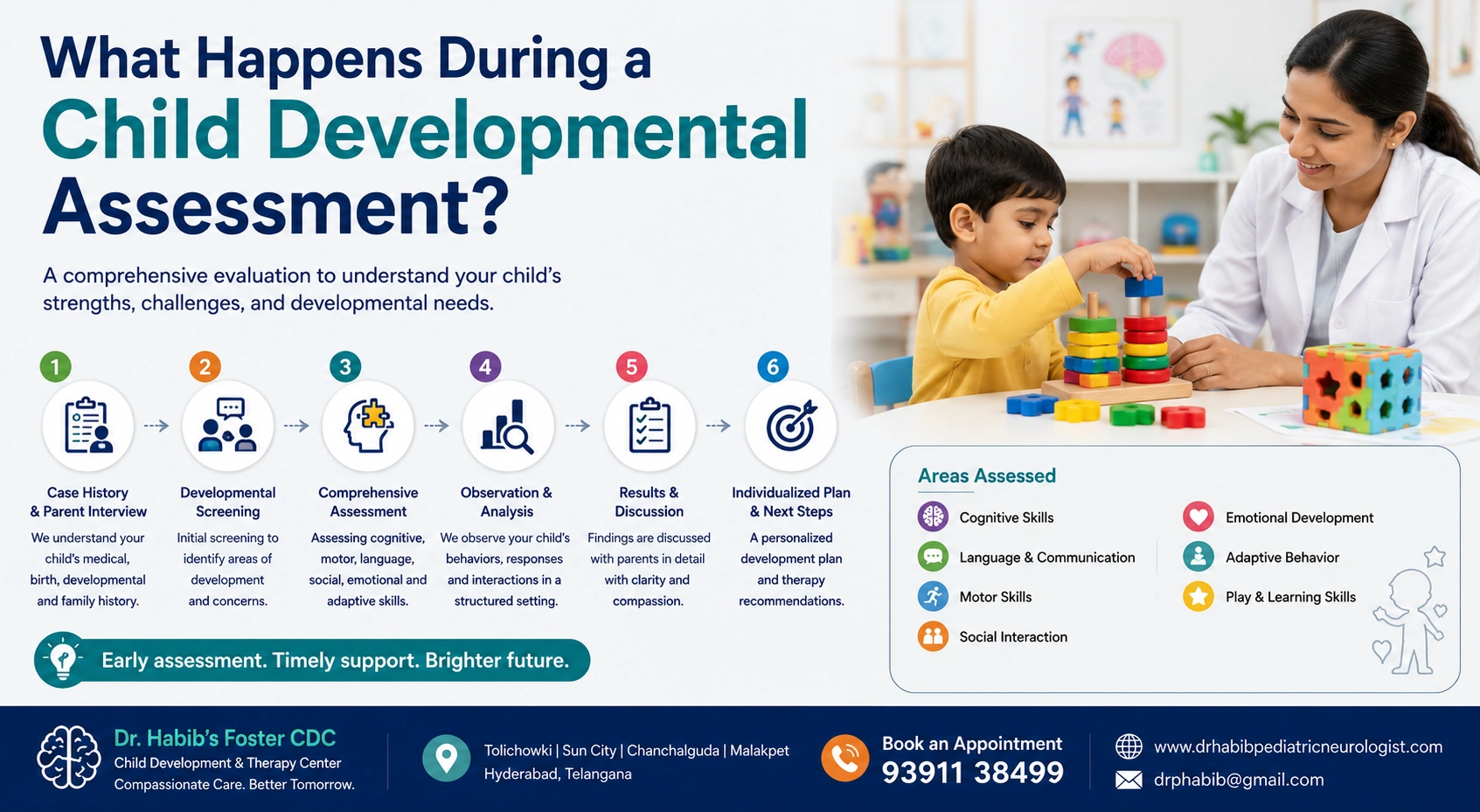
A child developmental assessment is a structured clinical evaluation used to understand how a child is progressing across key areas of development — movement (gross and fine motor skills), speech and language, social and emotional behavior, cognitive skills, and sensory processing.
It is not a single test but a combination of history-taking, structured observation, standardized screening tools, and clinical judgment, carried out by a specialist trained to recognize both typical variation and genuine developmental concerns.
The goal is straightforward: to find out, clearly and objectively, how your child is doing — and if support is needed, what kind of support will help most.
Who Should Consider a Developmental Assessment?
You don’t need a dramatic symptom to justify an assessment. Many parents seek one simply because something feels slightly off, even if they can’t pinpoint exactly what. That instinct is worth taking seriously.
More specifically, an assessment is worth considering if your child shows any of the following:
- Delayed speech or language compared to peers
- Limited eye contact or reduced interest in social interaction
- Difficulty following instructions or sitting through age-appropriate tasks
- Unusual or repetitive movements and behaviors
- Delayed motor milestones (sitting, walking, coordination)
- Loss of previously acquired skills (regression)
- Persistent difficulty with attention, impulse control, or emotional regulation
- A teacher or caregiver has raised a concern about your child’s development or behavior
None of these signs, on their own, confirm a diagnosis. That’s precisely why a structured assessment — rather than guesswork — matters.
Step-by-Step: What Happens During the Assessment
Step 1: Detailed History-Taking
The assessment begins with a conversation, not a test. Dr. Habib will ask about:
- Pregnancy, birth, and early infancy
- Developmental milestones — when your child sat, walked, spoke their first words
- Family history of developmental, neurological, or genetic conditions
- Your specific concerns, in your own words, with real examples
- Behavior and functioning at home, at school, and in social settings
This history often reveals patterns that a single observation in the clinic cannot — which is why detailed, honest input from parents is one of the most valuable parts of the process.
Step 2: Structured Observation
Your child will be observed directly — how they move, play, communicate, and respond to instructions and social cues. For younger children, this is often done through play-based activities that feel natural rather than clinical.
Step 3: Standardized Screening Tools
Depending on your child’s age and the specific concern, the specialist may use validated developmental screening tools to measure skills against expected ranges for that age group. These tools help ensure the assessment is objective and consistent, rather than based on impression alone.
Step 4: Focused Clinical & Neurological Examination
A physical and neurological examination checks muscle tone, reflexes, coordination, and other markers of nervous system function — relevant especially when motor delay, abnormal movements, or muscle weakness are part of the concern.
Step 5: Additional Testing, If Needed
Not every child requires further testing. When indicated, this may include:
- EEG, if seizures or seizure-like episodes are suspected
- MRI or other imaging, for structural concerns
- Hearing and vision screening, to rule out sensory causes of delay
- Genetic testing, when a hereditary condition is suspected
- Blood tests, if a metabolic cause is being considered
Step 6: Discussion of Findings
At the end of the assessment, findings are explained in plain language — what was observed, what it means, and what (if anything) requires further action. This is your opportunity to ask questions and fully understand the picture before moving forward.
Step 7: A Personalized Plan
If support is recommended, you’ll leave with a clear plan — which may include a specific therapy (speech, occupational, physical, or behavioral), a follow-up schedule, or referral to additional specialists, depending on what your child needs.
What Happens After the Assessment?
An assessment is a starting point, not an endpoint. Depending on the outcome, the path forward generally falls into one of three categories:
- Reassurance with monitoring — Your child’s development falls within typical range, and periodic monitoring is recommended rather than immediate intervention.
- Early intervention support — Mild-to-moderate concerns are identified, and targeted therapy (speech, occupational, or behavioral) is recommended to support your child’s progress.
- Diagnosis and coordinated care — A specific condition is identified (such as ADHD, autism spectrum disorder, or a motor disorder), and a structured, often multidisciplinary treatment plan is put in place.
Whatever the outcome, you leave with clarity — which is, for most parents, the most important part of the entire process.
Common Therapies Recommended After Assessment
- Speech and language therapy — for communication and language delays
- Occupational therapy — for fine motor skills, sensory processing, and daily living skills
- Physiotherapy — for gross motor and movement-related concerns
- Behavioral therapy — for attention, impulse control, and social-behavioral challenges
- Special education support — for learning difficulties affecting school performance
- Parent training programs — equipping parents with strategies to support their child’s development at home
Most children benefit from a combination of these approaches rather than a single therapy in isolation.
How to Prepare for Your Child’s Assessment
A little preparation helps the visit go smoothly:
- Bring any previous medical records, growth charts, or vaccination history
- Write down your specific concerns and examples beforehand — it’s easy to forget details in the moment
- Bring a favorite toy or comfort item to help your child feel at ease
- If possible, involve both parents or primary caregivers, since each often notices different things
- Try to schedule the visit at a time your child is usually rested and calm
Cost and Insurance Considerations in Hyderabad
Assessment costs vary depending on the extent of evaluation required and whether additional tests (like EEG or imaging) are needed. Some health insurance policies in India cover consultation and diagnostic costs, though coverage for ongoing therapy varies by insurer. We recommend confirming coverage details with your insurance provider and our billing team before your visit, so there are no surprises.
Why Families Choose Dr. Habib’s for Developmental Assessments
Dr. Habib G Pathan brings over 19 years of dedicated pediatric neurology experience, having personally evaluated more than 3,000 pediatric neurology cases and over 1,00,000 pediatric cases overall. Assessments at Dr. Habib’s combine:
- Specialist-led clinical evaluation, not a generic checklist
- Access to coordinated therapy services under one roof
- Clear, judgment-free communication with families at every step
- Three convenient locations across Hyderabad — Toli Chowki, Malakpet, and Suncity
Frequently Asked Questions
What is a child developmental assessment and how does it help children? It’s a structured evaluation of a child’s motor, language, social, and cognitive development, designed to identify whether a child’s progress is typical or whether additional support is needed. It helps by replacing uncertainty with a clear, evidence-based picture of your child’s development and a concrete plan of action.
Who should consult a specialist for a child assessment? Any parent noticing delayed milestones, behavioral concerns, regression, or a gut feeling that something isn’t quite right should consider a consultation. A pediatrician’s referral is helpful but not required to book an assessment.
What causes developmental delays in children? Causes vary widely and include genetic factors, complications during pregnancy or birth, premature birth, certain infections, and neurodevelopmental conditions such as autism spectrum disorder. In many cases, no single cause is identified, and the focus shifts to support rather than cause.
How is a developmental concern diagnosed? Diagnosis relies on a combination of detailed history, direct observation, standardized screening tools, and, when necessary, additional testing such as imaging or genetic analysis — not a single test in isolation.
What is the best treatment for developmental delays? There is no single “best” treatment — the right approach depends on the specific area of delay and its underlying cause. Most children benefit from a combination of targeted therapies (speech, occupational, physical, or behavioral) rather than one treatment alone.
Can developmental delays be prevented? Some risk factors (such as complications during pregnancy or premature birth) cannot always be prevented, though good prenatal care reduces certain risks. What can be controlled is the response once a concern is noticed — early evaluation and intervention consistently lead to better outcomes than waiting.
Is the assessment process different for toddlers versus school-age children? Yes. Assessments for toddlers rely heavily on play-based observation and parent-reported milestones, while assessments for school-age children often include more structured cognitive and academic screening, given the demands of a school environment.
How long does a full assessment take? A typical assessment visit takes about 45–60 minutes, though complex cases requiring additional testing may need more than one visit to reach a complete picture.
Sources & Further Reading
This article reflects standard clinical practice in developmental pediatrics and pediatric neurology, informed by guidance from the World Health Organization (WHO), the CDC’s “Learn the Signs. Act Early.” program, the American Academy of Pediatrics (AAP), and the Indian Academy of Pediatrics (IAP).
Medical Disclaimer
This content is for general informational purposes only and does not replace an individualized medical evaluation. Every child’s developmental path is unique, and only a qualified specialist can accurately assess your child’s specific needs. If you have concerns about your child’s development, please consult Dr. Habib or another qualified pediatric specialist directly.
About the Reviewer
Dr. Habib G Pathan is a Senior Consultant Pediatric Neurologist and Director of Dr. Habib’s Foster CDC, Hyderabad. He completed his fellowship in pediatric neurology at SAT Hospital, Government Medical College, Trivandrum, under Dr. P.A.M. Kunju and Dr. Kalpana. Over more than 19 years of practice, he has personally evaluated and treated over 3,000 pediatric neurology cases and 1,00,000+ pediatric cases overall. View full profile →
Ready to understand your child’s development with clarity? Schedule a Developmental Assessment with Dr. Habib’s →
Related reading: Child Development Centre · Brain Development Milestones by Age · Warning Signs of Neurological Disorders in Children

Recent Comments