
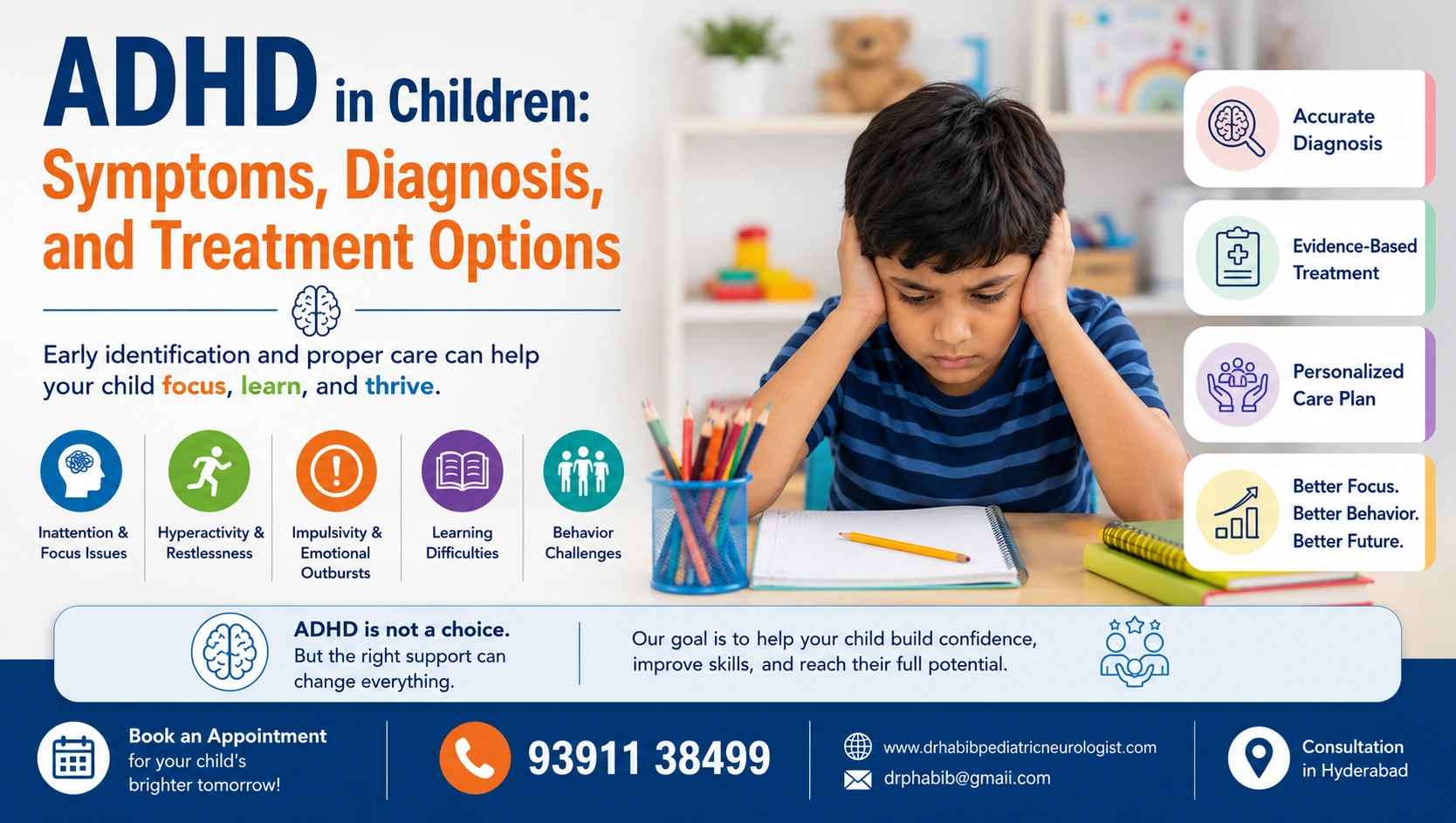
“Is my child just being a child, or is this ADHD?” It’s one of the most common questions parents bring into a pediatric neurology consultation. Every child is fidgety, forgetful, or impulsive sometimes — but when these behaviors are persistent, appear across home and school, and start affecting learning or relationships, it’s worth a proper evaluation.
This guide breaks down what Attention Deficit Hyperactivity Disorder (ADHD) actually is, how it presents differently across children, how it’s diagnosed, and what evidence-based treatment looks like.
What Is ADHD?
ADHD is a neurodevelopmental condition that affects a child’s ability to regulate attention, impulses, and activity level. It isn’t caused by poor parenting, too much screen time, or a lack of discipline — it stems from differences in brain development and functioning, particularly in the networks that control attention and self-regulation.
ADHD is among the most common neurodevelopmental conditions diagnosed in childhood. International prevalence estimates generally place it at roughly 5-11% of school-age children, with rates varying by country, screening practices, and awareness levels. In many parts of India, ADHD remains under-recognized rather than over-diagnosed, meaning children often go years without a formal evaluation while struggling silently at school.
The Three Presentations of ADHD
ADHD doesn’t look the same in every child. Doctors generally classify it into three presentations:
- Predominantly Inattentive – difficulty sustaining focus, frequent careless mistakes, forgetfulness, losing things, appearing “not to listen.” This presentation is often missed in girls, who tend to be diagnosed later than boys because their symptoms are quieter and less disruptive.
- Predominantly Hyperactive-Impulsive – fidgeting, difficulty staying seated, excessive talking, interrupting others, acting without thinking of consequences
- Combined Presentation – a mix of both inattentive and hyperactive-impulsive symptoms; this is the most commonly diagnosed type
Signs Parents and Teachers Often Notice
- Difficulty finishing schoolwork despite understanding the material
- Frequently losing books, homework, or belongings
- Trouble waiting their turn or interrupting conversations
- Restlessness that goes beyond typical childhood energy
- Emotional outbursts that seem disproportionate to the situation
- Struggling to follow multi-step instructions
- Academic performance that doesn’t match the child’s evident intelligence or effort
A useful marker: these behaviors should be present in more than one setting (home and school) and persistent for at least six months before ADHD is considered, since occasional inattention or high energy is completely normal in childhood.
How Is ADHD Diagnosed?
There’s no single blood test or scan that diagnoses ADHD. Instead, a pediatric neurologist relies on a structured, multi-source evaluation:
- Detailed developmental and behavioral history from parents, covering onset, setting, and severity of symptoms
- Standardized rating scales completed independently by parents and teachers (such as Vanderbilt or Conners scales) to capture how behavior differs across environments
- Clinical observation of the child during the consultation
- Ruling out other causes — hearing or vision problems, sleep disorders, anxiety, learning disabilities, or thyroid issues can all mimic ADHD symptoms
- Co-occurring condition screening, since ADHD frequently overlaps with anxiety, learning difficulties, or autism spectrum traits, and treatment plans work best when these are identified together rather than missed
Treatment Options for Childhood ADHD
Treatment is rarely one-size-fits-all. A comprehensive plan typically combines:
- Behavioral therapy – parent-training programs and structured behavior management techniques are considered first-line treatment, especially for younger children
- Medication – stimulant and non-stimulant options can meaningfully improve focus and impulse control for many children; a pediatric neurologist tailors the choice and dosage to the child’s age, symptom profile, and any co-existing conditions
- School-based accommodations – seating adjustments, extended time, or structured routines can make a substantial difference in classroom performance
- Skill-building support – occupational therapy for fine motor or sensory challenges, and social skills training where needed
- Family education – helping parents and siblings understand ADHD reduces household friction and supports consistency across home and school
Most children with ADHD respond well to a combination of behavioral strategies and, where appropriate, medication — and many see significant improvement in both academic performance and family relationships once a structured plan is in place.
Living with ADHD: Practical Tips for Parents
- Break instructions into small, single steps rather than long lists
- Use consistent daily routines and visual schedules
- Praise effort and specific behaviors rather than general criticism
- Work with the school to establish consistent expectations between home and classroom
- Limit screen time before homework or bedtime, since overstimulation can worsen focus difficulties
- Be patient with yourself — parenting a child with ADHD is genuinely harder day-to-day, and support (including for parents) is a legitimate part of the treatment plan
Frequently Asked Questions
- At what age can ADHD be diagnosed? ADHD can typically be diagnosed from around age 4 onward, though it’s most commonly identified between ages 6 and 12, when academic and social demands make symptoms more noticeable. Diagnosing very young children requires extra caution, since normal toddler behavior can overlap with ADHD symptoms.
- Will my child outgrow ADHD? Some children see symptoms lessen with age, particularly hyperactivity, but for many, ADHD persists into adolescence and adulthood in some form. Early intervention significantly improves long-term academic and social outcomes regardless of whether symptoms fully resolve.
- Is ADHD medication safe for long-term use? When prescribed and monitored by a pediatric neurologist, ADHD medications are generally well tolerated, with dosing adjusted over time based on growth, response, and any side effects. Medication is typically reviewed regularly rather than prescribed indefinitely without follow-up.
- Can ADHD be managed without medication? Yes, particularly in mild cases or younger children — behavioral therapy, parent training, and classroom accommodations alone are often effective first steps. Medication is generally considered when behavioral strategies alone aren’t providing enough improvement.
- Is ADHD the same as autism? No, though the two conditions can co-occur and share some overlapping traits like difficulty with attention or social interaction. A pediatric neurologist evaluates for both conditions separately, since the treatment approaches differ.
- How is ADHD different from a child just being “naturally energetic”? The key difference is impact and persistence: a naturally energetic child can still sit through a meal, follow instructions, and complete tasks with normal effort, while a child with ADHD struggles with these consistently, across multiple settings, in ways that affect learning or relationships.
About the Author
Dr. Habib G Pathan is a Senior Consultant Pediatric Neurologist with more than 19 years of experience diagnosing and treating neurodevelopmental and neurological conditions in children, including ADHD, autism spectrum disorder, and learning difficulties. He completed his fellowship in pediatric neurology at SAT Hospital, GMC Trivandrum, and is the founder and director of Dr. Habib’s Foster CDC, Hyderabad, which has supported over 3,000 pediatric neurology cases.
This article is for general informational purposes and is not a substitute for professional medical evaluation. If you suspect your child may have ADHD, please book a consultation for a personalized assessment.

Recent Comments