
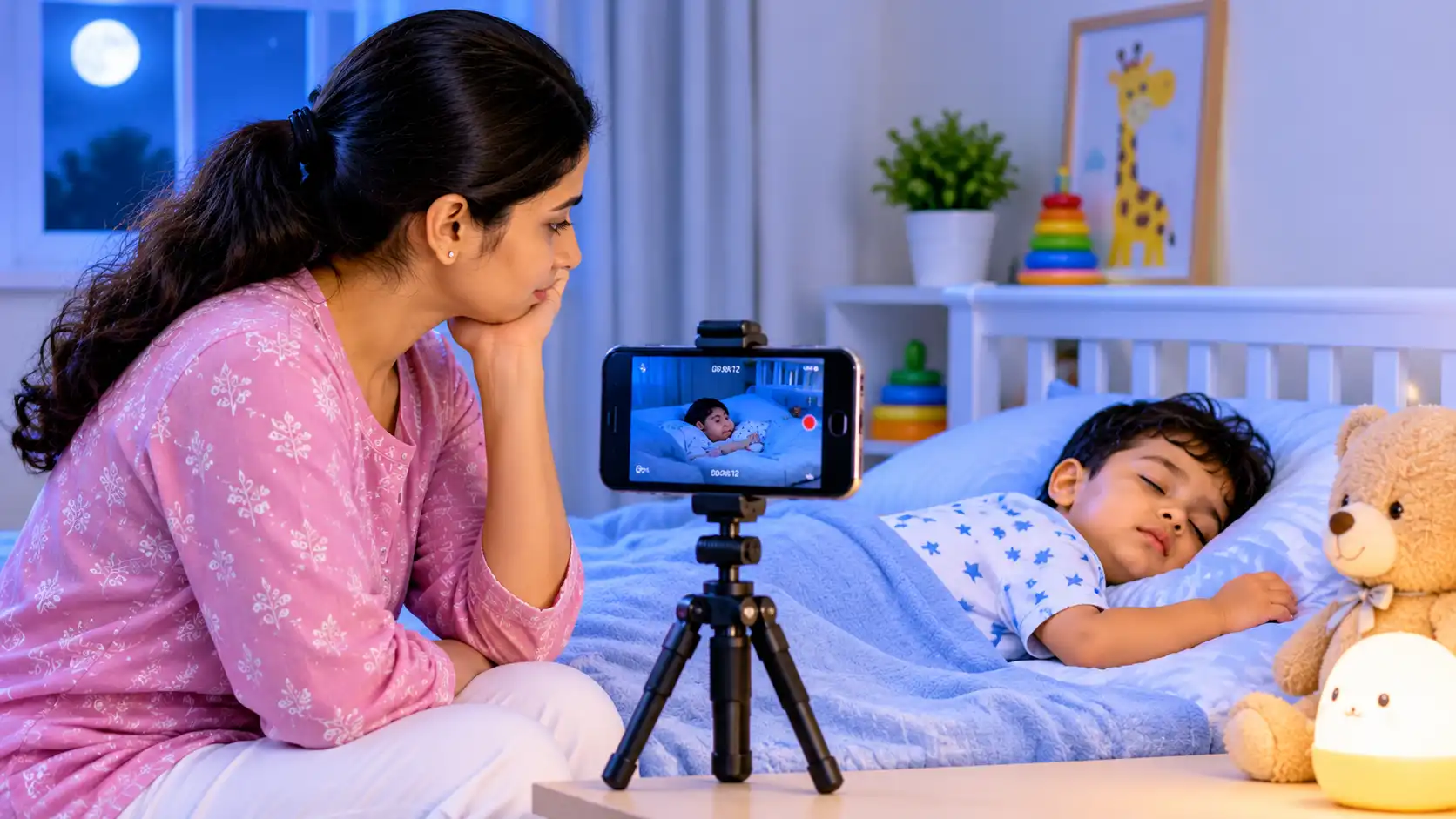
Night terrors happen in the first part of the night, during deep (non-REM) sleep. The child screams, looks terrified, can’t be comforted or properly woken, and remembers nothing in the morning. Usually it’s one episode a night, lasting several minutes. Nocturnal seizures tend to be brief (often under 2 minutes), the same every time (stereotyped), repeated several times a night or on many nights, and can also happen during daytime naps. They may include rhythmic jerking, stiffening, odd postures, or thrashing, sometimes with a bitten tongue, wet bed, or long confusion afterwards. The best clue is a video, and the best test is a sleep EEG.
It’s 11 p.m. A scream tears through the house. You run in, and your toddler is sitting upright with wide-open eyes, drenched in sweat, thrashing, and looking straight through you. You say their name. Nothing. You hold them. They push you away. Ten minutes later, they lie down and sleep, and in the morning they’re cheerful and remember nothing.
You, on the other hand, haven’t slept, and you’re left with one terrifying question: Was that a night terror, or a seizure?
First, a breath. The great majority of dramatic nighttime episodes in toddlers and young children are not seizures. They are sleep disturbances called parasomnias, which are common, harmless, and usually outgrown. But a small number of nighttime events are seizures, and those are worth catching. This guide will help you understand the spectrum of sleep disturbances in children, spot the clues that separate them, film what you’re seeing, know when a sleep EEG helps, and keep a sleepwalker safe.
Understanding the Spectrum of Pediatric Sleep Disturbances
Sleep isn’t one steady state. Through the night, children cycle between light sleep, deep sleep (non-REM or “slow-wave” sleep), and dream sleep (REM). Each stage produces different kinds of nighttime events:
| Category | Examples | What’s going on |
|---|---|---|
| REM-sleep events | Nightmares | A frightening dream, usually in the second half of the night |
| Non-REM arousal disorders (parasomnias) | Night terrors (sleep terrors), sleepwalking, confusional arousals | The brain is partly awake and partly in deep sleep, so the child looks awake but isn’t truly conscious |
| Seizures during sleep | Sleep-related (nocturnal) seizures | Abnormal electrical activity in the brain, which can happen from any stage of sleep or on waking |
| Other sleep disorders | Sleep-disordered breathing (snoring, sleep apnea), restless legs, periodic limb movements, sleep-related rhythmic movements (head-banging or rocking) | Problems with breathing or movement during sleep that can cause or mimic episodes |
Why this matters. These categories can look alike to a frightened parent at 2 a.m., but they need very different responses. Parasomnias need reassurance, routine, and safety. Seizures need a medical evaluation and, often, treatment. And some children have more than one problem, for example a child with epilepsy can also have night terrors, or a child with sleep apnea can have more night terrors because their sleep is repeatedly disturbed.
Nightmares vs. Night Terrors: Timing and Characteristics
Nightmares and night terrors are often confused, but they’re different events.
| Nightmare | Night terror (sleep terror) | Sleepwalking / confusional arousal | |
|---|---|---|---|
| Sleep stage | REM (dream) sleep | Deep non-REM sleep | Deep non-REM sleep |
| When in the night | Usually the second half, toward morning | Usually the first third, within a few hours of falling asleep | Usually the first third |
| What the child does | Wakes up fully, frightened, calls for you | Suddenly sits up and screams, with eyes wide open, sweating, racing heart, fast breathing | Walks, sits up, mumbles, fumbles, or looks confused |
| Awareness | Fully awake and aware | Not truly awake; doesn’t recognize you; may push you away | Not truly awake; may respond oddly or not at all |
| Can you comfort them? | Yes, comfort works | No, comfort often seems to make it worse, and they can’t be properly woken | Can be gently guided back to bed |
| Memory | Can often describe the dream | No memory the next morning | No memory the next morning |
| How long | Settles as soon as the child is comforted, though falling asleep again may take time | Typically a few minutes up to about 15 minutes (sometimes longer) | Minutes to half an hour |
| How often | Occasional | Usually one episode a night, and not every night | Usually one episode |
| Typical age | Common from toddler years through childhood | Most common from about 2 or 3 years to about 8 years | Common in school-age children |
| Family history | Not usually | Often yes (a parent or sibling had them) | Often yes |
Why do night terrors happen?
Night terrors aren’t caused by bad parenting, trauma, or “a scary day.” They arise when a child’s immature brain partly arouses from deep sleep without fully waking. Things that make them more likely include:
- Not enough sleep, or an overtired child, including skipped naps and late bedtimes
- An irregular sleep schedule
- Fever or illness
- Sleep-disordered breathing, such as snoring and sleep apnea from enlarged tonsils or adenoids
- Restless legs or leg movements during sleep
- A full bladder, noise, or an unfamiliar sleeping place
- Stress or big changes (a new school, a new sibling, a move)
- Certain medicines, and caffeine in older children
- A family tendency
Other clues that it’s a night terror or sleepwalking
- The episode begins suddenly and fades by itself
- The child doesn’t respond normally to your voice and isn’t aware of you
- It varies from episode to episode
- It happens once a night at most, a few times a month at most
- There’s no memory in the morning
- It doesn’t happen during daytime naps (although short naps can occasionally produce them in some very tired children)
- The child is otherwise healthy and developing normally
What to do during a night terror
- Stay calm and stay close, and keep the room dim and quiet
- Don’t shake, shout at, or try hard to wake your child. It rarely works, and it can prolong the episode or confuse them
- Don’t restrain them unless it’s needed for safety
- Use a soft, calm voice and guide them gently back to bed if they’ve moved
- Make sure the area is safe, with nothing sharp or hard nearby
- Wait. It will pass. Your child will usually settle and sleep
- Don’t discuss it as a “scary event” in the morning; a short, casual reassurance is enough
How to reduce night terrors
- Keep a regular sleep schedule, with the same bedtime and wake time, including weekends
- Make sure your child gets enough sleep for their age. As a rough guide, many toddlers need about 11 to 14 hours (including naps), preschoolers about 10 to 13 hours, and school-age children about 9 to 12 hours. Don’t drop a nap too early
- Build a calming bedtime routine (bath, story, quiet time), and avoid screens in the hour before bed
- Avoid caffeine (cola, tea, chocolate drinks), especially in the afternoon and evening
- Treat snoring or breathing problems. If your child snores loudly, gasps, breathes through the mouth, or sleeps restlessly, ask your doctor about sleep apnea
- Offer a bathroom trip before bed
- Support emotional health with a calm routine, time to talk, and attention to worries
- For frequent, predictable episodes, doctors sometimes suggest gentle “scheduled awakenings”, waking the child briefly about 15 to 30 minutes before the usual time of the episode for a couple of weeks. Ask your doctor before trying this
For more help with building steady routines, see our list of 10 everyday activities to support your child’s development at home.
When Nighttime Thrashing Is a Nocturnal Seizure
A small proportion of nighttime events are seizures. The tricky part is that seizures in sleep can look very much like night terrors or sleepwalking, and the two are often confused, even by doctors, without video or EEG.
What are nocturnal seizures?
A seizure is a short burst of abnormal electrical activity in the brain. Some epilepsies in children produce seizures mainly or only during sleep. Two kinds are worth knowing:
- Sleep-related hypermotor (frontal lobe) seizures: abrupt, brief episodes of thrashing, kicking, rocking, pedalling or “bicycling” movements, stiffening, odd body postures, or screaming, which can look dramatic and “violent.” They often happen several times a night and can cluster
- Childhood epilepsy with sleep-related focal seizures (such as self-limited epilepsy with centrotemporal spikes): often begins around school age; may cause twitching of one side of the face, drooling, gurgling sounds, or inability to speak, sometimes followed by stiffening and jerking of the whole body, mostly in sleep or on waking
- Generalized tonic-clonic seizures in sleep: stiffening followed by rhythmic jerking, then limpness, sometimes with a wet bed, bitten tongue, blue lips, and deep sleepiness afterwards
Our complete guide to epilepsy diagnosis and treatment for children and the page on early signs of epilepsy in children explain seizures in more detail.
Clues that point toward a nocturnal seizure
| Clue | Why it matters |
|---|---|
| Stereotyped: the same movements, in the same order, every time | Seizures tend to repeat identically; night terrors vary |
| Brief: often under 2 minutes, starting and ending abruptly | Night terrors usually last several minutes or longer |
| Several episodes in one night, or episodes on most nights | Seizures often cluster; night terrors are usually a single event a few times a month |
| Occurs during daytime naps, or when the child is awake | Night terrors rarely occur outside deep night sleep |
| Rhythmic jerking, stiffening, or a fixed posture (such as an arm held out) | These suggest seizure activity |
| Movements limited to one side of the body, or the head and eyes turning to one side | Suggests a seizure starting in one part of the brain |
| Tongue bite (usually at the side), wet bed, blue lips, or drooling | Common after seizures |
| Prolonged drowsiness, confusion, headache, or muscle aches afterwards | Typical after seizures |
| Weakness on one side after the episode that fades over hours | A seizure sign that needs medical attention |
| Child seems to be aware or tries to speak but can’t | Can occur in focal seizures |
| Daytime staring spells, jerks, or episodes of unresponsiveness | May signal epilepsy more broadly |
| New onset in a teenager, or in a child under about 2 years | Typical night terrors usually begin in the preschool years |
| Developmental concerns, learning problems, or a family history of epilepsy | Raises suspicion |
| Abnormal neurological examination | Should always prompt further assessment |
No single clue settles it. What matters is the pattern, and a doctor will weigh all of these together.
Quick decision guide (not a diagnosis)
This is a conversation starter, not a test. If you answer “yes” to any of the seizure-leaning items, or you are unsure, show a video to a doctor.
| Question | Leans toward night terror / sleepwalking | Leans toward seizure (get checked) |
|---|---|---|
| How long does it last? | Several minutes to 15 or more | Often under 2 minutes |
| Does it look the same every time? | No, it varies | Yes, identical |
| How often? | A few times a month; once a night | Several times a night, or many nights a week |
| Can your child be calmed or guided back to bed? | Often, after a while | Not at all, or abruptly stops |
| Does it happen during naps or while awake? | Rarely | Yes |
| Any rhythmic jerking, stiffening, one-sided movement, or eyes deviating? | No | Yes |
| Any tongue bite, wet bed, or blue lips? | No | Yes |
| How is your child afterwards? | Settles back to sleep quickly; normal in the morning | Very sleepy, confused, headache or weak for a long time |
| Is there a family history of sleepwalking or night terrors? | Yes | Family history of epilepsy |
Other possible causes of nighttime episodes
Not everything is a night terror or a seizure. Doctors also consider:
- Sleep apnea and other breathing problems, which can cause confusional arousals
- Restless legs and periodic limb movements (often linked to low iron stores, which a doctor can check)
- Sleep-related rhythmic movements such as head banging or body rocking in toddlers
- Acid reflux causing pain and waking
- Breath-holding or faint-like events
- Anxiety or post-traumatic stress (in some children, frightening events make nights worse)
- Medication effects
- Sleep problems linked to other conditions, such as autism or ADHD (see our guides to early signs of autism in toddlers and ADHD in children)
Video recording guide for parents
A video is the single most valuable thing you can bring. Doctors often can’t tell what an event was from words alone, and in the clinic, the episode almost never happens on cue.
What to do:
- Prepare in advance. Put your phone within reach, with the camera app ready and storage cleared. A small tripod or stand helps
- Keep your child safe first. Safety always comes before filming
- Start recording as early as you can, ideally from the very beginning, and keep going until the episode ends and your child settles
- Show the whole body and the face, with the room lit as well as possible, or use night mode or an infrared baby monitor camera. Try to see the eyes, the arms and legs, and whether movements are on one side
- Capture the sounds (screaming, gurgling, speech)
- Capture what happens next: how long until your child is calm, whether they respond to you, and whether they fall asleep
- Don’t interfere more than needed. Avoid shaking or shouting, but do whatever is needed for safety
- Note the details right afterwards: date, time, how long it lasted, how many in the night, what your child had eaten or done earlier, whether they were ill or overtired, and how they were the next morning
- Film more than one episode if possible, because that shows whether the movements are the same each time
- Keep the videos private. Share them only with your child’s doctor, and don’t post them online
For more on what to do during a seizure itself, see our seizure first aid guide.
The Diagnostic Power of Pediatric Polysomnography & Sleep EEG
When the video and history leave doubt, or when episodes are frequent, injurious, or unusual, tests can settle it.
| Test | What it involves | What it shows |
|---|---|---|
| Neurological examination and history | A doctor reviews your video and your child’s health, development, and family history | Often enough for a confident diagnosis of typical night terrors |
| Routine EEG | Painless sensors on the scalp record brain activity for about 20 to 40 minutes while awake | Epilepsy patterns; can miss sleep-related abnormalities |
| Sleep-deprived or sleep EEG | Recording during drowsiness and sleep, often after a shorter night, so some sleep is captured | Many sleep-related epilepsy patterns show up only in sleep |
| Overnight video-EEG monitoring | Continuous video and EEG, often overnight or longer, usually in a hospital or sleep lab | Can capture the actual event and show whether it is a seizure; the most powerful test for unclear nighttime events |
| Polysomnography (PSG): an overnight sleep study | Sensors record brain waves, eye movements, muscle activity, breathing, oxygen levels, heart rate, and leg movements, with video | Detects sleep apnea, limb movements, and arousal disorders; with extra EEG sensors, can also help detect seizures |
| MRI of the brain | Detailed pictures of brain structure | Used if a seizure is suspected, especially one starting in one part of the brain |
| Blood tests (for example, iron stores) | A simple blood sample | May be checked if restless legs or limb movements are suspected |
Good to know:
- A normal EEG doesn’t rule out nocturnal seizures, because seizures may not happen during the recording. That is why sleep recordings and video are so useful
- EEG changes alone don’t make a diagnosis, as some children have EEG abnormalities without seizures. Doctors look at the whole picture
- Tests are painless. Children usually cope well, especially with a favorite toy or parent nearby
- Availability in India: Child-friendly polysomnography and overnight video-EEG are available in a limited number of centres, and may involve travel and a waiting time. Ask your doctor what is available near you in Hyderabad, and don’t delay a first assessment while waiting
If the diagnosis is epilepsy, treatment depends on the type of seizures, and many children do very well; see our epilepsy guide.
When to see a pediatric neurologist
Please book an assessment if:
- Episodes happen several times a week, or several times in one night
- The movements are always the same, brief, or look like jerking, stiffening, or an odd posture
- Episodes happen during naps or while awake
- There’s a tongue bite, wet bed, blue lips, or long confusion afterwards
- Your child gets hurt, or the episodes are getting worse
- Night terrors start after the age of about 10 or in a teenager, or in a child under about 2
- Your child is very sleepy during the day, snores loudly, or has breathing pauses
- There are developmental, learning, behavior, or attention concerns (see our developmental assessment guide)
- Your gut tells you something isn’t right
Safety Proofing the Bedroom for Sleepwalkers
Sleepwalking is usually harmless, but a sleepwalking child isn’t aware of danger. The main risk is injury, from stairs, windows, doors, and furniture. A few changes make a big difference.
Bedroom and home safety checklist
Doors, windows, and balconies
- Fit secure latches or locks on outside doors and place them high, out of the child’s reach
- Use door alarms, chimes, or a bell on the bedroom door, so you hear if your child leaves
- Lock or secure windows, and use sturdy window grills or guards
- Secure balcony doors with high latches or locks, which is especially important in apartments and upper floors
- Never leave keys in doors
Stairs and floors
- Use stair gates at the top and bottom of stairs
- Move the child’s bed to a ground-floor or low-risk bedroom if possible
- Keep the floor clear of toys, cords, and clutter
- Avoid bunk beds (a sleepwalking child should sleep on the lower bunk or a regular bed)
Furniture and the room
- Pad or cover sharp furniture corners
- Keep breakable items, heavy objects, and glass away from the sleeping area
- Use a low bed or a mattress guard if the child tends to fall
- Keep electric appliances, heaters, and sharp objects out of reach
- Use a soft night light so the path is visible
Outside and around the home
- Make sure swimming pools, water tanks, and gates are secured
- Keep gates and compound doors locked at night
Habits
- Keep to a regular, adequate sleep schedule
- Have your child use the toilet before bed
- If your child is found sleepwalking, guide them gently back to bed with a calm voice and gentle touch. Don’t shout or shake them awake
- If your child sleeps away from home (camps, relatives, school trips), tell the adults in charge about the sleepwalking and safety measures
- Keep a diary of episodes, to share with the doctor
Seek help sooner if a child sleepwalks very often, goes outdoors or toward hazards, or injures themselves.
Frequently Asked Questions
Q: How can parents tell the difference between a night terror and a nocturnal seizure?
A: Night terrors occur early in the night during non-REM sleep; the child screams, looks terrified, cannot be awakened, and has no recall. Nocturnal seizures feature stereotyped, rhythmic thrashing or posturing, happen multiple times a night, and can occur during daytime naps. A video and, if needed, a sleep EEG help confirm which it is.
Q: Are night terrors dangerous?
A: Night terrors are not harmful to the brain and are usually outgrown, though they are distressing for parents. The main risk is injury if a child moves around during an episode, so keep the area safe.
Q: Should I wake my child during a night terror?
A: No. Trying to wake a child during a night terror rarely works and can prolong it or add to the confusion. Stay calm, keep your child safe, and let the episode pass.
Q: At what age do night terrors start and stop?
A: Night terrors most often begin between about 2 and 3 years and are most common in early childhood, and many children outgrow them by early adolescence. New onset in a teenager, or episodes that are very frequent, deserve a medical check.
Q: Can sleepwalking or night terrors be a sign of epilepsy?
A: Usually not. But some nighttime seizures resemble these events, so brief, identical, frequent episodes, episodes during naps, or episodes with jerking, stiffening, tongue bite, or long confusion afterwards need medical assessment.
Q: Can a child have both night terrors and seizures?
A: Yes. Having one doesn’t rule out the other, and children with epilepsy can also have sleep disturbances such as night terrors. A doctor can sort out which events are which.
Q: How are nocturnal seizures diagnosed?
A: Doctors use a detailed history, your video of the episode, a neurological examination, and tests such as a sleep EEG or overnight video-EEG, sometimes with MRI. A normal routine EEG does not rule out sleep-related seizures.
Q: What is the difference between a nightmare and a night terror?
A: A nightmare happens in dream sleep, usually in the second half of the night. The child wakes fully, can describe the dream, and can be comforted. A night terror happens in deep sleep early in the night, and the child is not truly awake, can’t be comforted, and has no memory of it.
Key Takeaways
- Most dramatic nighttime episodes in children are night terrors, nightmares, or sleepwalking, not seizures
- Night terrors: early in the night, several minutes, varied, child can’t be woken or comforted, no memory, usually once a night
- Nocturnal seizures: often brief, identical each time, several times a night or most nights, may occur during naps, with jerking, stiffening, tongue bite, wet bed, or long confusion
- Film the episode safely. A video is the most useful clue
- A sleep EEG or overnight video-EEG can confirm a seizure, and a normal routine EEG doesn’t rule one out
- Protect sleep, treat snoring, and keep a regular routine
- Make the bedroom safe for sleepwalkers, especially doors, windows, balconies, and stairs
- Seek help if episodes are frequent, brief and identical, happen in naps, cause injury, or worry you
You Know Your Child Best
Watching your child scream or thrash in the night is one of the most frightening things a parent can see, and it’s natural to fear the worst. In most cases the explanation is benign and temporary. If it isn’t, answers are available, and a short video on your phone can be the first step. If you’d like an expert opinion, we’re here to help.
Schedule a pediatric sleep neurology consultation and sleep EEG with Dr. Habib Pathan at Dr. Habib’s Foster CDC in Hyderabad. For jerking or stiffness lasting more than 5 minutes, blue lips, trouble breathing, or any emergency, go to the nearest hospital first.
This article is for educational purposes and does not replace a medical consultation. If your child has sudden, severe, or worsening symptoms, seek urgent medical care.

Recent Comments