
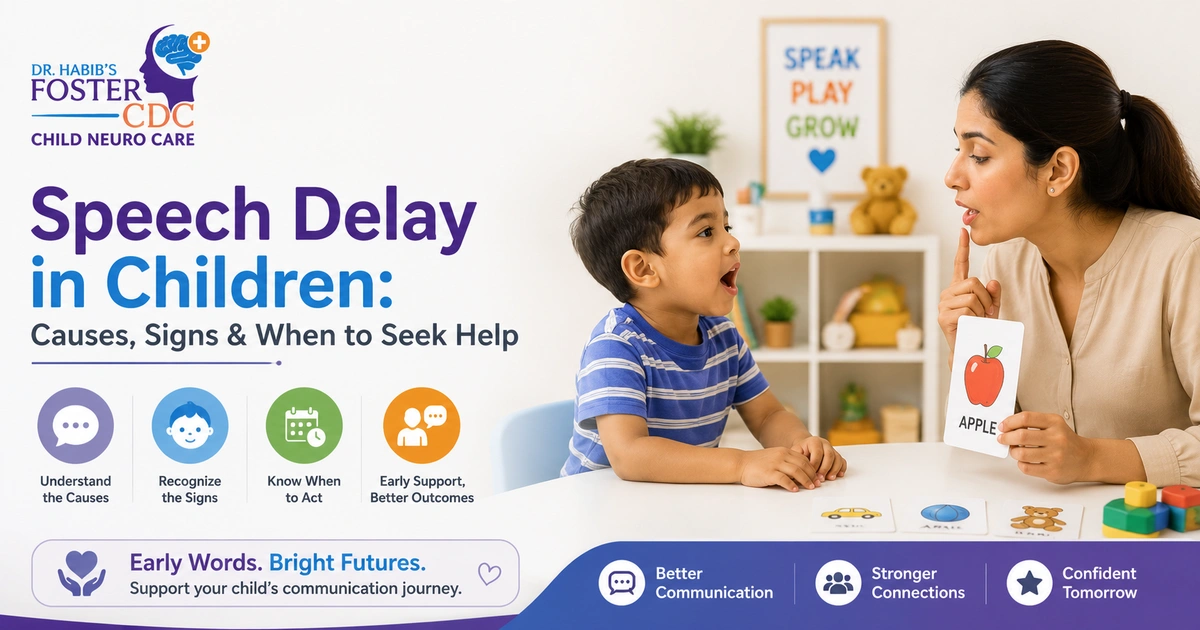
“Every child develops at their own pace” is true — and it’s also the phrase that keeps a lot of parents waiting longer than they should before getting a real answer. If your child isn’t talking as much as their peers, cousins, or older sibling did at the same age, you’re in a difficult spot: how do you tell normal variation from something that actually needs attention?
This guide walks through what speech delay is, what typically causes it, the signs worth taking seriously at different ages, and how a proper evaluation works — so you can move from “I’m not sure” to a clear next step.
What Counts as a Speech Delay?
A speech delay means a child’s spoken language is developing more slowly than expected for their age — fewer words, shorter sentences, or less clarity than typical milestones would predict. It’s worth distinguishing between a few related but different things:
- Speech delay — difficulty with the physical production of sounds and words
- Language delay — difficulty understanding language and/or expressing thoughts, even if sounds themselves are clear
- Speech disorder — a specific difficulty with how sounds are formed (for example, stuttering or articulation disorders), which may or may not come with a broader delay
Many children have some overlap between these, which is exactly why a proper evaluation — not a checklist alone — matters.
What Causes Speech Delay in Children?
There isn’t always a single identifiable cause, and that’s normal. Common contributors include:
- Hearing difficulties — even mild or intermittent hearing loss (from recurrent ear infections, for example) can meaningfully slow speech development
- Oral-motor difficulties — difficulty coordinating the lips, tongue, and jaw needed to form sounds
- Developmental conditions — speech delay can occur alongside autism spectrum disorder, ADHD, or broader developmental delay, though it can also occur entirely on its own
- Limited language exposure or interaction — children need rich, responsive back-and-forth communication to build language; this is rarely the sole cause but can compound other factors
- Family history — a family history of late talking or language difficulties slightly raises the likelihood, though it doesn’t predict it
- Bilingual or multilingual environments — this can shift how language develops but is not itself a cause of true speech delay; bilingual children may mix languages or lag slightly in one language while developing normally overall
If you’re weighing whether autism could be part of the picture, our guide to early signs of autism in toddlers covers related signs beyond speech alone.
Signs of Speech Delay by Age
These are general guideposts, not a diagnosis — but they’re a reasonable basis for deciding whether to seek an evaluation.
By 12 months: Not babbling, not responding to their name, not using gestures like waving or pointing.
By 18 months: Fewer than 10-20 words, not pointing to show interest, not responding consistently to simple instructions.
By 2 years: Fewer than 50 words, not yet combining two words together (“more milk,” “want up”), difficult for familiar people to understand.
By 3 years: Not speaking in short sentences, frequently unclear speech even to family, difficulty being understood by people outside the family.
By 4 years and beyond: Persistent unclear speech, difficulty following multi-step instructions, noticeable struggle with grammar or sentence structure compared to peers.
A useful general reference alongside this is our child development milestones by age guide, which covers development beyond speech as well.
Red Flags That Warrant a Prompt Evaluation
Some signs are worth acting on sooner rather than waiting to see:
- Loss of words or skills the child previously had (this is different from slow progress, and always warrants prompt evaluation)
- No babbling by 12 months or no words at all by 16 months
- Limited eye contact or response to their name, alongside speech concerns
- A known or suspected hearing difficulty
- Persistent, significant frustration or behavioural outbursts that seem tied to communication difficulty
If any of these apply, it’s worth booking an evaluation rather than waiting for the next scheduled check-up.
Normal Variation vs. a Delay That Needs Support
A few things that are usually not cause for concern on their own:
- A child who understands far more than they say (receptive skills often outpace expressive ones — this alone isn’t a red flag)
- Mixing languages in a bilingual household
- A slightly later start that still shows steady month-to-month progress
What tends to distinguish a delay worth addressing is a pattern, not a single missed milestone: multiple areas lagging together, little to no progress over a few months, or a gap that’s widening rather than closing relative to peers. If you’re unsure, our article on developmental delay in children: when to see a specialist can help you think through the broader picture.
What Happens During a Speech and Language Evaluation
A proper evaluation typically includes:
- A detailed history from parents — when concerns started, family history, hearing history, and developmental milestones overall
- A hearing check or referral, since hearing is often the first thing ruled in or out
- Direct assessment of the child’s speech sounds, vocabulary, sentence structure, and comprehension
- Observation of how the child communicates and interacts, not just formal testing
- A discussion of findings and, where relevant, a referral for further evaluation (for example, if autism or a broader developmental delay is also suspected)
For a fuller picture of what this looks like across development generally, see what happens during a child developmental assessment.
How Speech Therapy Helps
Speech-language therapy is tailored to what’s actually driving the delay — building vocabulary and sentence structure, improving sound production and clarity, strengthening comprehension, or supporting alternative communication methods where needed. Sessions are usually play-based for younger children, since language is learned most naturally through interaction rather than drills.
Speech therapy is often only one part of a child’s plan. Where sensory or motor difficulties are also present, occupational therapy may be recommended alongside it — see our complete guide to occupational therapy for children in Hyderabad for more on that.
What Parents Can Do at Home
Speech therapy progress is reinforced far more by daily interaction than by clinic time alone:
- Narrate everyday activities out loud (“we’re putting on your shoes now”) rather than expecting a child to initiate first
- Expand on what your child says rather than correcting it directly — if they say “car go,” respond with “yes, the car is going fast!”
- Read together daily, even briefly, and pause to let your child fill in familiar words
- Limit passive screen time in favour of back-and-forth interaction, which builds language far more effectively
For more structured ideas across development generally, see 10 everyday activities to support your child’s development at home.
When to Stop Waiting and Seek Help
The evidence is fairly consistent: children who start speech therapy earlier tend to close gaps faster and more fully than those who start later. If a child is missing multiple age-appropriate milestones, or if a delay isn’t closing with time, it’s reasonable — and usually the right call — to seek an evaluation rather than continue waiting to see.
Frequently Asked Questions
How do I know if my child’s speech is just late, or an actual delay? A single missed milestone in isolation is less concerning than a pattern — multiple areas lagging together, little progress over several months, or a widening gap compared to peers. If you’re unsure, a speech and language evaluation gives a clear answer rather than more guessing.
Does speech delay always mean autism? No. Speech delay can occur entirely on its own, without any other developmental differences. It can also occur alongside autism or ADHD, which is why a proper evaluation looks at the whole picture, not speech in isolation.
At what age should I get my child evaluated for speech delay? As soon as you notice a pattern of concern — there’s no minimum age to wait for. Early evaluation, even if it turns out reassuring, is far better than a “wait and see” approach that delays support your child may actually need.
Next step: If you’re noticing signs of speech delay, book a speech and language evaluation with Dr. Habib’s Foster CDC at our Tolichowki, Malakpet, or Suncity clinics in Hyderabad.
This article is for general information and does not replace a professional medical evaluation. Reviewed by Dr. Habib G. Pathan, Consultant Pediatric Neurologist.

Recent Comments