
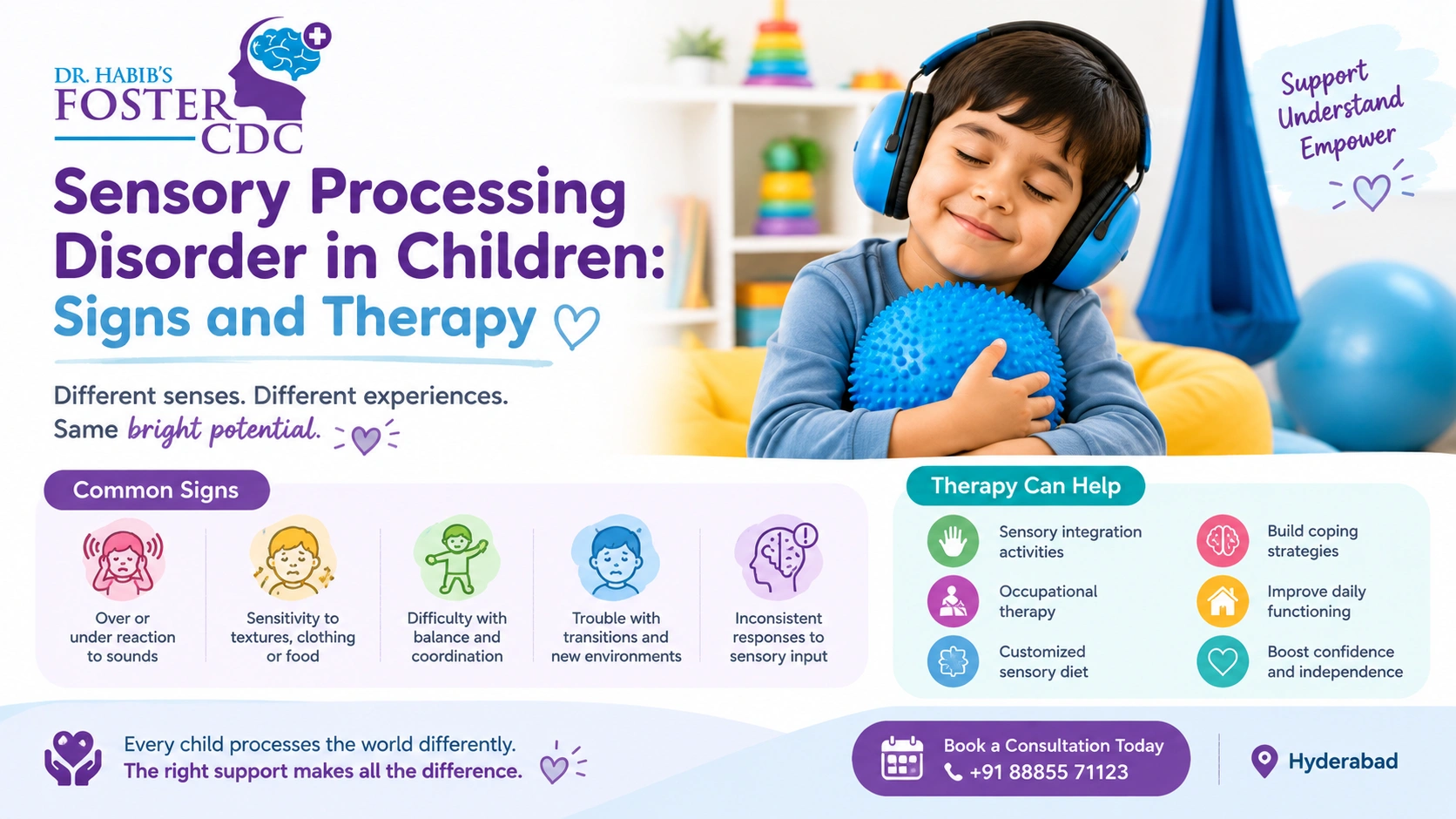
Sensory processing disorder (SPD) is a condition where a child’s brain has difficulty receiving and responding to information from the senses — sound, touch, taste, movement, and body position — in a typical way. It can make a child over-react to ordinary input (a tag in a shirt, background noise) or under-react to it (seeking out intense spinning, crashing, or pressure). Occupational therapy, specifically sensory integration therapy, is the primary evidence-based treatment.
TL;DR — Key Takeaways
- SPD affects how the brain processes sensory input, not the senses themselves — hearing and vision are usually normal; it’s the brain’s response to that input that’s atypical
- Children can be sensory over-responsive, sensory under-responsive, or sensory seeking — and some children show a mix of all three across different senses
- SPD frequently overlaps with autism spectrum disorder and ADHD, but it also occurs entirely on its own
- Occupational therapy using sensory integration techniques is the standard, evidence-based treatment approach
- A pattern of signs across settings (home, school, daily routines) — not one sensitive reaction — is what typically warrants an evaluation
What Is Sensory Processing Disorder?
Every day, the brain receives a constant stream of sensory information — sound, touch, taste, smell, sight, movement (vestibular sense), and body position (proprioception) — and organizes it into a response that lets a person function smoothly. For a child with sensory processing disorder, that organizing step doesn’t work the typical way. The sensory input itself is registered fine; it’s the brain’s interpretation and response to that input that’s atypical.
This is why a child with SPD isn’t “being dramatic” about a shirt tag, and isn’t “just seeking attention” by crashing into furniture — the sensory experience genuinely feels different to them than it does to most children.
The Three Main Patterns of Sensory Processing Difficulty
| Pattern | What It Looks Like | Common Behaviours |
| Sensory Over-Responsive | Reacts more intensely than expected to sensory input | Distress over tags, seams, or textures; covers ears at moderate noise; avoids messy play; overwhelmed in crowded or loud spaces |
| Sensory Under-Responsive | Reacts less than expected to sensory input | Doesn’t notice pain or temperature changes readily; seems unaware of being touched or called; low energy in response to stimulation |
| Sensory Seeking | Actively seeks out intense sensory input | Constant movement, crashing, jumping, or spinning; touches everything; seeks out loud noises or strong flavours; chews on non-food objects |
Many children show a mix — for example, over-responsive to sound but sensory-seeking with movement. This is one reason a professional evaluation, rather than a general checklist, matters for identifying a child’s specific sensory profile.
Signs of Sensory Processing Disorder by Age
Infants and toddlers: Extreme distress during dressing, bathing, or hair washing; difficulty with transitions; unusually fussy or unusually calm in response to typical stimulation.
Preschool age (3-5 years): Avoidance of playground equipment or, conversely, constant seeking of intense movement; meltdowns triggered by clothing textures, food textures, or loud environments; clumsiness alongside sensory avoidance.
School age (6+ years): Difficulty sitting still in class, sensory-driven avoidance of group activities, strong food selectivity, meltdowns that seem disproportionate to the trigger but make sense once the sensory driver is identified.
A related but different topic — how these signs connect to broader motor development — is covered in our guides to fine motor skill delays and gross motor skill development, since sensory processing and motor coordination frequently overlap.
What Causes Sensory Processing Disorder?
The precise mechanism isn’t fully mapped by research, but a few things are well established:
- It reflects differences in how the brain processes sensory signals, not a problem with the sense organs themselves (hearing and vision tests are typically normal)
- It commonly co-occurs with autism spectrum disorder and ADHD — sensory differences are recognized as a core feature in autism diagnostic criteria
- It can occur on its own, without any other developmental condition present
- Prematurity and certain early medical histories are associated with a somewhat higher likelihood of sensory processing differences
If autism is part of the picture for your child, our guide to early signs of autism in toddlers covers the related, broader signs beyond sensory behaviour alone.
The Sensory Systems Involved
Sensory processing isn’t limited to the five commonly known senses. Occupational therapists typically assess eight sensory systems when evaluating a child:
- Tactile (touch) — sensitivity to textures, temperature, and pressure
- Auditory (hearing) — response to volume, pitch, and background noise
- Visual (sight) — response to light, movement, and visually busy environments
- Olfactory (smell) and gustatory (taste) — often linked to food selectivity and aversions
- Vestibular (movement and balance) — processed through the inner ear; affects balance, spatial orientation, and tolerance for movement like swinging or spinning
- Proprioceptive (body position) — the sense of where the body is in space, affecting coordination and the need for input like deep pressure or “heavy work”
- Interoceptive (internal body signals) — awareness of internal states like hunger, thirst, temperature, and the need to use the bathroom
A child can have difficulty in just one of these systems or across several simultaneously — which is exactly why a broad, systematic evaluation matters more than judging sensory difficulty from a single behaviour, like food refusal or noise sensitivity, in isolation.
Why This Matters More Than Many Parents Realize
Sensory processing difficulties are estimated by some research to affect a meaningful minority of children in the general population, with notably higher rates among children with autism and ADHD. Left unaddressed, persistent sensory dysregulation can affect a child’s willingness to participate in school, social settings, and even routine self-care — not because the child is unwilling, but because the sensory experience of those settings is genuinely more taxing for them than it is for most peers.
Understanding this reframes a lot of behaviour parents are often told to simply discipline: a meltdown in a loud shopping mall, refusal to wear certain clothing, or constant fidgeting in the classroom often has a sensory driver underneath it, and addressing that driver directly tends to be far more effective than behavioural consequences alone.
This is one of the most common points of confusion for parents, so it’s worth answering directly: sensory processing difficulties are common in autism, but not every child with SPD is autistic, and not every autistic child has significant sensory difficulties.
Autism is a broader neurodevelopmental difference involving social communication and interaction, alongside restricted or repetitive behaviours (which often include sensory features). SPD, when it occurs independently, involves sensory processing differences without the social-communication differences that define autism. A proper developmental evaluation is the only reliable way to tell which pattern applies to a specific child — sensory behaviour alone isn’t enough to distinguish the two.
How Is Sensory Processing Disorder Diagnosed?
An evaluation for SPD typically includes:
- A detailed developmental and sensory history from parents, covering behaviour across different settings — home, school, and daily routines
- Direct observation of the child’s response to different types of sensory input during structured and play-based activities
- Standardized sensory processing assessment tools, which compare a child’s responses against expected patterns for their age
- Screening for related conditions, including autism and ADHD, since these frequently co-occur
For a broader sense of how developmental evaluations generally work, see what happens during a child developmental assessment.
How Occupational Therapy Treats Sensory Processing Disorder
Sensory integration therapy, delivered by an occupational therapist, is the standard evidence-based approach. It uses structured, play-based sensory activities — swinging, deep pressure input, textured play, balance challenges — to help a child’s brain organize and respond to sensory information more effectively over time.
Sessions are individualized to the child’s specific sensory profile: a sensory-avoidant child is gradually and gently introduced to tolerable sensory experiences, while a sensory-seeking child is given structured, appropriate outlets for the input they’re seeking, alongside strategies to build regulation. For a broader look at how occupational therapy works generally, see our complete guide to occupational therapy for children in Hyderabad, and for the specific overlap with autism, our occupational therapy for autism guide.
What Parents Can Do at Home
- Build a “sensory diet” into the daily routine — regular, planned sensory activities (swinging, heavy work like carrying objects, quiet time) rather than only reacting after a meltdown starts
- Identify specific triggers by tracking when meltdowns or avoidance happen, which often reveals a sensory pattern that isn’t obvious in the moment
- Prepare for transitions and new environments in advance — warning a child before a loud or crowded setting reduces the shock of unexpected sensory input
- Offer sensory tools such as noise-reducing headphones, textured seating, or fidget tools where appropriate, based on your therapist’s specific recommendations
- Avoid forcing tolerance of overwhelming input — gradual, therapist-guided exposure works far better than repeated forced exposure, which tends to increase distress over time
For more general, structured ideas, see 10 everyday activities to support your child’s development at home.
Choosing a Sensory Integration Therapy Provider
When evaluating a therapy provider for sensory processing difficulties, a few things are worth checking:
- Clinical oversight by a pediatric neurologist, developmental pediatrician, or a qualified occupational therapist trained specifically in sensory integration
- An individualized sensory profile assessment, rather than a generic sensory activity program applied to every child
- A dedicated sensory-equipped space — swings, textured materials, balance equipment — since sensory integration therapy relies on access to graded sensory experiences that are difficult to replicate without proper equipment
- Parent training as part of the plan, so sensory strategies carry over consistently into home and school life
- Coordination with other therapies your child may be receiving, particularly if autism, ADHD, or a motor delay is also part of the picture
When to Seek a Professional Evaluation
A single sensitive reaction — disliking one texture, one loud event — is rarely significant on its own. What warrants an evaluation is a consistent pattern across settings and time: sensory reactions that disrupt daily routines, school participation, or family life; sensory-seeking behaviour that puts the child at risk (dangerous climbing, mouthing objects); or sensory difficulty alongside other developmental concerns. If this sounds like your child, earlier evaluation and therapy consistently lead to better, faster outcomes than waiting.
Frequently Asked Questions
What is the difference between sensory processing disorder and being “picky” or “dramatic”? SPD reflects a genuine difference in how the brain processes sensory input — the discomfort or intensity a child experiences is real, not exaggerated or intentional. Recognizing this distinction is often the first step toward getting a child appropriate support rather than discipline for behaviour they can’t fully control.
Can sensory processing disorder be outgrown without therapy? Some sensory sensitivities soften naturally with age, but significant, pattern-level sensory difficulties usually benefit from targeted occupational therapy rather than being left to resolve on their own, especially if they’re affecting daily functioning or school participation.
Is sensory processing disorder a formal medical diagnosis? It isn’t currently listed as a standalone diagnosis in major diagnostic manuals, but it’s a well-recognized clinical pattern that occupational therapists and pediatric specialists assess and treat directly, often as part of a broader developmental evaluation.
How long does sensory integration therapy typically take to show results? This varies significantly by child and the intensity of therapy, but many families notice meaningful changes in regulation and daily functioning within a few months of consistent therapy, with continued progress over a longer course of treatment.
Does every child with sensory issues need occupational therapy? Not necessarily — mild, occasional sensory preferences that don’t disrupt daily life may not need formal therapy. A professional evaluation is the best way to determine whether a child’s specific sensory pattern would benefit from structured intervention.
Next step: If your child is showing signs of sensory processing difficulty, book an OT evaluation with Dr. Habib’s Foster CDC at our Tolichowki, Malakpet, or Suncity clinics in Hyderabad.

Recent Comments