
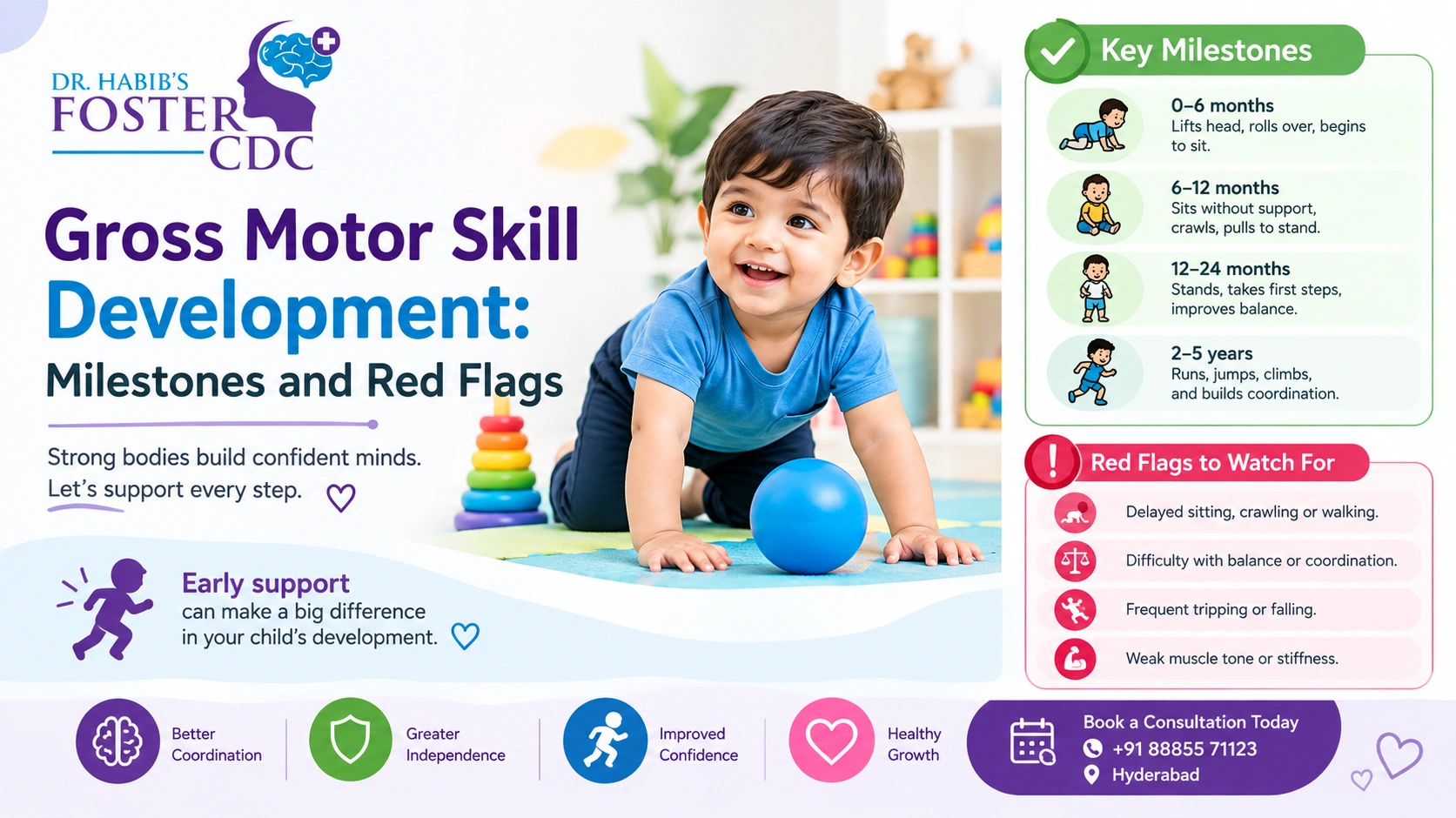
Your child’s cousin was running at 13 months. Your child is 16 months and still cruising along the furniture. A friend’s toddler catches a ball without flinching; yours turns away every time. Is this just a different pace of development, or something worth a closer look?
Gross motor skills are the large-muscle movements a child uses to sit, crawl, walk, run, jump, climb, and balance. They develop in a fairly predictable sequence, which is exactly why a noticeable gap from that sequence — not a single missed milestone, but a pattern — is usually the clearest sign that it’s worth talking to a specialist rather than waiting it out.
This guide lays out the actual milestones by age, the red flags that deserve prompt attention, what causes gross motor delay, and what an occupational therapy evaluation and treatment plan typically look like.
What Are Gross Motor Skills?
Gross motor skills are the coordinated movements of the large muscles in the arms, legs, torso, and core that allow a child to control their body in space — sitting upright, crawling, walking, running, jumping, climbing stairs, and maintaining balance. They’re built on a foundation of muscle strength, balance, coordination, and body awareness, and they typically develop before fine motor skills (like handwriting) because large-muscle control comes before small-muscle precision.
This is different from fine motor skills, which involve the small muscles of the hands and fingers used for tasks like holding a pencil or buttoning a shirt. If your child’s difficulty is more in that area, our guide to fine motor skill delays in children covers that specifically. Many children experience overlap between the two, and a full occupational therapy evaluation typically looks at both.
Why Gross Motor Development Matters Beyond “Being Athletic”
It’s easy to assume gross motor skills are only about sports and playground confidence. In reality, they underpin much more of daily functioning than most parents expect:
- Classroom participation — sitting upright at a desk for extended periods requires core strength most people never think about
- Self-care independence — climbing onto a chair, managing stairs, or getting dressed while balancing all draw on gross motor control
- Social inclusion — playground games, sports, and group activities are often where peer friendships form; a child who struggles physically may start avoiding these settings
- Confidence and self-esteem — repeated physical difficulty in front of peers can affect a child’s willingness to try new things well beyond the physical skill itself
- Later fine motor development — core and shoulder stability, both gross motor skills, provide the physical foundation a child needs before fine motor tasks like handwriting can develop well; a child with weak gross motor control sometimes struggles with fine motor tasks for reasons that trace back to this foundation rather than the hands themselves
This is part of why occupational therapists rarely look at gross motor skills in complete isolation — they’re often the base that everything else, from classroom stamina to handwriting, is built on.
Gross Motor Milestones by Age
These are general developmental guideposts, not a rigid checklist — but a consistent pattern of missed milestones across this list is a reasonable basis for seeking an evaluation.
By 6 months: Rolls both ways, sits briefly with support, pushes up onto forearms during tummy time.
By 9-12 months: Sits without support, crawls (though not every child crawls in a typical pattern, and that alone isn’t a red flag), pulls to stand, may take a few steps holding onto furniture.
By 15-18 months: Walks independently, attempts to run, climbs onto low furniture, walks up steps with help.
By 2 years: Runs with reasonable control, kicks a ball, climbs onto and off furniture without help, walks up and down stairs with one hand held.
By 3 years: Climbs playground equipment, pedals a tricycle, jumps with both feet off the ground, walks up stairs alternating feet.
By 4 years: Hops on one foot a few times, catches a large ball most of the time, climbs and descends stairs like an adult (alternating feet without support), throws a ball with some direction.
By 5-6 years and beyond: Skips, balances on one foot for several seconds, catches a small ball reliably, rides a bicycle (with or without training wheels depending on exposure and practice).
For a broader picture of development beyond motor skills specifically, our child development milestones by age guide is a useful companion reference.
Red Flags That Warrant a Prompt Evaluation
Some signs are worth acting on without waiting for the next scheduled check-up:
- Not walking independently by 18 months
- Persistent toe-walking past the toddler years
- Frequent falling or tripping well beyond what’s typical for the child’s age
- Very low or very high muscle tone (a child who feels noticeably “floppy” or unusually stiff when picked up or during movement)
- Marked asymmetry — using one side of the body clearly more than the other
- Avoidance of climbing, running, or playground equipment that same-age peers engage with readily
- Loss of a gross motor skill the child previously had — this is different from slow progress and always warrants prompt evaluation, regardless of age
Is It a Real Delay, or Just a Different Pace?
This is the exact confusion most parents are stuck in, and it’s worth answering directly: children develop gross motor skills at genuinely different paces, and a single late milestone is rarely meaningful on its own. What tends to distinguish a delay worth addressing from normal variation is a pattern — several milestones lagging together, little to no progress over a few months, or a widening gap compared to peers rather than one that’s closing.
A child who walked a bit later than average but otherwise runs, climbs, and plays confidently is very different from a child who is behind on walking, running, and balance all at once, or who seems to be making very slow progress across the board. If you’re genuinely unsure which situation you’re looking at, that uncertainty is itself a good enough reason to seek an evaluation — there’s no downside to checking, even if the answer turns out to be reassuring.
If broader developmental concerns are present alongside gross motor delay, our article on developmental delay in children: when to see a specialist may help you think through the wider picture.
What Causes Gross Motor Delay?
There’s rarely a single cause, and often none is ever fully pinpointed — but common contributors include:
- Low muscle tone (hypotonia) — reduced muscle tension that makes sustained physical effort, posture, and balance more difficult
- Motor planning difficulties (dyspraxia) — trouble coordinating and sequencing movements, even when strength itself isn’t the primary issue
- Sensory processing differences — difficulty accurately registering balance and body-position input (the vestibular and proprioceptive senses) can affect coordination and confidence in movement
- Limited opportunity for movement practice — gross motor skills develop through repeated physical play; significantly reduced opportunities for active, unstructured play can contribute to slower progress
- Developmental conditions — gross motor delay is common alongside autism spectrum disorder, ADHD, or broader developmental delay, though it frequently occurs entirely on its own with no other developmental differences present
- Prematurity or early medical history — children born prematurely or with certain early medical complications sometimes show a temporary lag in gross motor milestones
It’s worth saying plainly: in a large number of cases, no single cause is ever definitively identified, and that’s not a gap in the evaluation — it simply reflects how multi-factorial motor development is. What matters more for planning therapy is understanding the pattern of a child’s specific strengths and difficulties, not necessarily pinning down a single root cause.
How Gross Motor Delay Can Look Different From Child to Child
Not every child with gross motor delay presents the same way, which is part of why a professional evaluation matters more than a checklist alone:
- A child with low muscle tone may seem to tire quickly, slump rather than sit upright, or avoid physically demanding play
- A child with motor planning difficulty may understand exactly what movement they want to make but struggle to execute it smoothly — appearing clumsy despite adequate strength
- A child with sensory processing differences may avoid movement-based play entirely (swings, climbing, spinning) or, conversely, seek it out intensely and still appear poorly coordinated
- A child on the autism spectrum may show gross motor delay alongside other developmental differences in communication or social interaction — our guide to early signs of autism in toddlers covers this overlap in more detail
What Happens During an OT Evaluation for Gross Motor Skills
A thorough evaluation typically includes a detailed developmental history from parents, direct observation of the child’s balance, coordination, muscle tone, and movement patterns during age-appropriate tasks, and often standardized assessment tools that compare the child’s current skills against expected developmental benchmarks. The therapist will also consider whether sensory processing is contributing to the picture, since gross motor and sensory difficulties frequently overlap. For a broader sense of what evaluations generally involve across development, see what happens during a child developmental assessment.
How Occupational Therapy Helps With Gross Motor Delay
Occupational therapy for gross motor delay typically combines structured movement activities to build strength, balance, and coordination with sensory-based strategies where sensory processing is playing a role. Sessions are generally play-based, especially for younger children — climbing, swinging, obstacle courses, and ball games designed to target specific skills while keeping the child genuinely engaged, since motivation drives far more progress than repetition alone. Therapy plans are typically reviewed and adjusted regularly as the child’s skills develop, rather than following a fixed, one-size-fits-all program. For a broader look at how occupational therapy works generally, see our complete guide to occupational therapy for children in Hyderabad.
What Parents Can Do at Home
Everyday movement opportunities matter as much as, and often more than, structured exercises:
- Prioritize active, unstructured play — climbing on playground equipment, running in open spaces, and rough-and-tumble play all build core strength and coordination naturally
- Build in balance challenges — walking along a low curb or a line taped on the floor, standing on one foot during a game, or balancing on a cushion
- Make movement part of daily routine, not just designated “exercise time” — carrying light objects, climbing stairs with supervision, or animal-walk games (crawling like a bear, hopping like a frog) all count
- Reduce prolonged sedentary time, including extended screen time, in favour of active play whenever possible
- Keep it playful and low-pressure — a child who feels judged or rushed during physical activity often becomes more reluctant, not less, so celebrating effort matters more than performance
For more structured, general ideas, see 10 everyday activities to support your child’s development at home.
When to Stop Waiting and Book an Evaluation
If your child is missing multiple gross motor milestones together, showing any of the red flags above, or if progress simply isn’t closing the gap with peers over a few months, it’s reasonable — and usually the right call — to seek a professional evaluation rather than continuing to wait and see. Earlier evaluation and, where needed, earlier therapy consistently lead to faster and fuller progress than delaying support.
Frequently Asked Questions
How do I know if my child’s motor delay is serious or just a slower pace of development? A single late milestone in isolation is rarely concerning. A pattern — several gross motor skills lagging together, little progress over a few months, or a widening gap compared to peers — is what typically distinguishes a delay worth addressing. If you’re unsure, an OT evaluation gives a clear, professional answer rather than more guessing.
At what age should I get my child evaluated for gross motor delay? As soon as you notice a consistent pattern of concern. There’s no minimum age to wait for, and earlier evaluation — even if it turns out reassuring — is far better than delaying support a child may genuinely need.
Can gross motor delay improve with therapy, or is it something a child just grows out of? Many children make significant progress with targeted occupational therapy, especially when it starts early. While some children do catch up with time and typical development alone, a structured evaluation is the only reliable way to know whether that’s likely for your specific child or whether targeted support would help.
Is toe-walking always a sign of a problem? Occasional toe-walking in very young toddlers is common and often resolves on its own. Persistent toe-walking that continues well past the toddler years, or that comes with tight calf muscles or difficulty walking flat-footed, is worth a professional evaluation.
Next step: If you’re noticing signs of gross motor delay, book an OT evaluation with Dr. Habib’s Foster CDC at our Tolichowki, Malakpet, or Suncity clinics in Hyderabad.

Recent Comments