
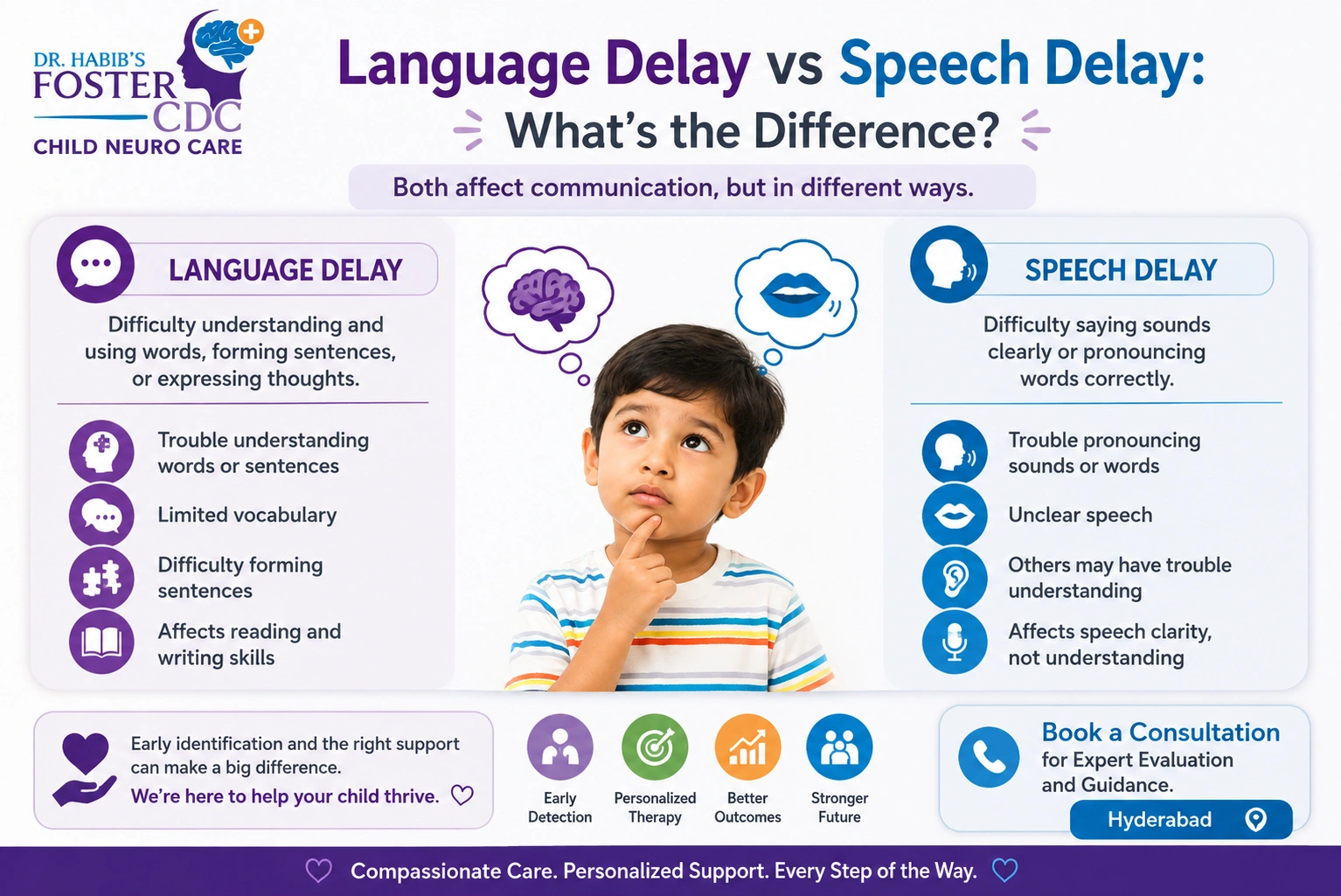
Parents often use “speech delay” and “language delay” interchangeably — and honestly, most people do, including well-meaning family members offering opinions. But the two are different, and knowing which one you’re actually seeing changes what kind of help is appropriate.
A child who can pronounce words clearly but struggles to string them into sentences or follow instructions has a different profile from a child who understands everything but simply can’t get sounds out clearly. Both need support — but not always the same kind.
If you haven’t already, our companion guide on speech delay in children: causes, signs, and when to seek help covers the speech side of this in more depth. This article focuses on the distinction, and on language delay specifically.
Speech vs. Language: The Core Difference
- Speech is about the physical production of sounds — how clearly a child can articulate words, whether they stutter, and how understandable they are to others.
- Language is about the system behind communication — understanding words and grammar (receptive language) and using words, sentences, and ideas to express meaning (expressive language).
A simple way to think about it: a child with a pure speech difficulty knows exactly what they want to say and has the vocabulary for it, but the sounds don’t come out clearly. A child with a language difficulty may speak perfectly clearly, but struggle to understand what’s said to them, or to form sentences that express what they mean.
In practice, many children have some overlap between the two — which is exactly why an evaluation looks at both, not just one.
Receptive vs. Expressive Language Delay
Language delay itself has two sides, and children can struggle with one, the other, or both:
Receptive Language Delay
Difficulty understanding language — following instructions, understanding questions, grasping the meaning of what’s said. Signs include not responding consistently to their name, appearing not to understand simple instructions, or relying heavily on visual cues (pointing, gestures from others) to figure out what’s being asked.
Expressive Language Delay
Difficulty using language to communicate — limited vocabulary, trouble forming sentences, or difficulty organizing thoughts into words, even when the child clearly understands more than they can express. This is the more commonly recognized form, since it’s the one parents notice most directly (“he’s not really talking”).
It’s worth noting that expressive language typically lags slightly behind receptive language in all children — a two-year-old normally understands more than they can say. A true expressive delay is when that gap is unusually wide or isn’t narrowing with time.
Signs That Point Toward Language Delay (Rather Than Speech Alone)
- Understands little of what’s said, even simple, familiar instructions
- Doesn’t ask questions or use words to request things, even though sounds themselves are clear when they do speak
- Struggles to follow two-step instructions by age 2-3
- Has difficulty telling even a very simple story or sequence of events by age 4-5
- Vocabulary and sentence complexity noticeably behind same-age peers, despite clear pronunciation
Compare this with speech-specific signs — unclear pronunciation, sound substitutions, stuttering — which are covered in more detail in our speech delay guide.
What Causes Language Delay?
- Limited responsive interaction — language develops through back-and-forth exchange; children need to be talked with, not just talked at or exposed to passive media
- Hearing difficulties — since language is built on what a child hears and processes over time
- Developmental conditions — language delay can occur alongside autism spectrum disorder, ADHD, or intellectual disability, though it can also occur independently
- Family history — a family history of language difficulties modestly raises likelihood
- General developmental delay — where language lags alongside motor or cognitive milestones rather than in isolation
If broader developmental concerns are present alongside language delay, our guide on developmental delay in children: when to see a specialist may be useful context, as may early signs of autism in toddlers if communication concerns come with other differences in social interaction or behaviour.
Why the Distinction Matters for Therapy
Getting the right diagnosis shapes the right therapy plan:
- A pure speech delay typically responds well to articulation-focused therapy — practicing specific sounds and improving clarity.
- A language delay needs a different approach — building comprehension and vocabulary, teaching sentence structure, and creating rich opportunities for meaningful back-and-forth communication.
- A combined delay (common) needs a plan that addresses both, usually in a coordinated way rather than treating one in isolation.
This is exactly why a proper speech-language evaluation — rather than guessing from a checklist — matters. Treating a language delay as if it were only a speech issue (or vice versa) can mean a child doesn’t get the specific support they actually need.
What a Language Evaluation Looks Like
An evaluation typically assesses both receptive and expressive language separately, alongside a hearing check and a full developmental history. The therapist observes how the child understands instructions and questions, how they use words and sentences, and how they communicate in natural play or conversation — not just through formal test items. For a broader sense of what evaluations generally involve, see what happens during a child developmental assessment.
What Parents Can Do at Home
Language — more than speech alone — is built through everyday interaction:
- Follow your child’s lead in play, and narrate what’s happening rather than quizzing them with questions
- Expand on what they say rather than simply correcting it (“ball go” → “yes, the ball is rolling fast!”)
- Read together daily and talk about the pictures, not just the words on the page
- Give instructions one step at a time, and build up gradually as comprehension grows
- Prioritize real back-and-forth interaction over passive screen time, which doesn’t build the same responsive language skills
For more structured ideas, see 10 everyday activities to support your child’s development at home.
Frequently Asked Questions
What’s the simplest way to tell language delay from speech delay? Speech delay is about how clearly a child produces sounds and words. Language delay is about understanding and using language itself — vocabulary, sentence structure, and comprehension — even when what a child says is perfectly clear.
Can a child have both speech and language delay at the same time? Yes, and it’s fairly common. A thorough evaluation assesses both separately so therapy can address whichever areas actually need support, rather than assuming it’s only one or the other.
Does language delay mean my child will need special education? Not necessarily. Many children catch up fully with targeted speech-language therapy, especially when it starts early. Ongoing educational support is considered only if a broader developmental need is identified alongside the language delay.
Next step: If you’re unsure whether your child’s communication concerns point to speech delay, language delay, or both, book a speech and language evaluation with Dr. Habib’s Foster CDC at our Tolichowki, Malakpet, or Suncity clinics in Hyderabad.
This article is for general information and does not replace a professional medical evaluation. Reviewed by Dr. Habib G. Pathan, Consultant Pediatric Neurologist.

Recent Comments