
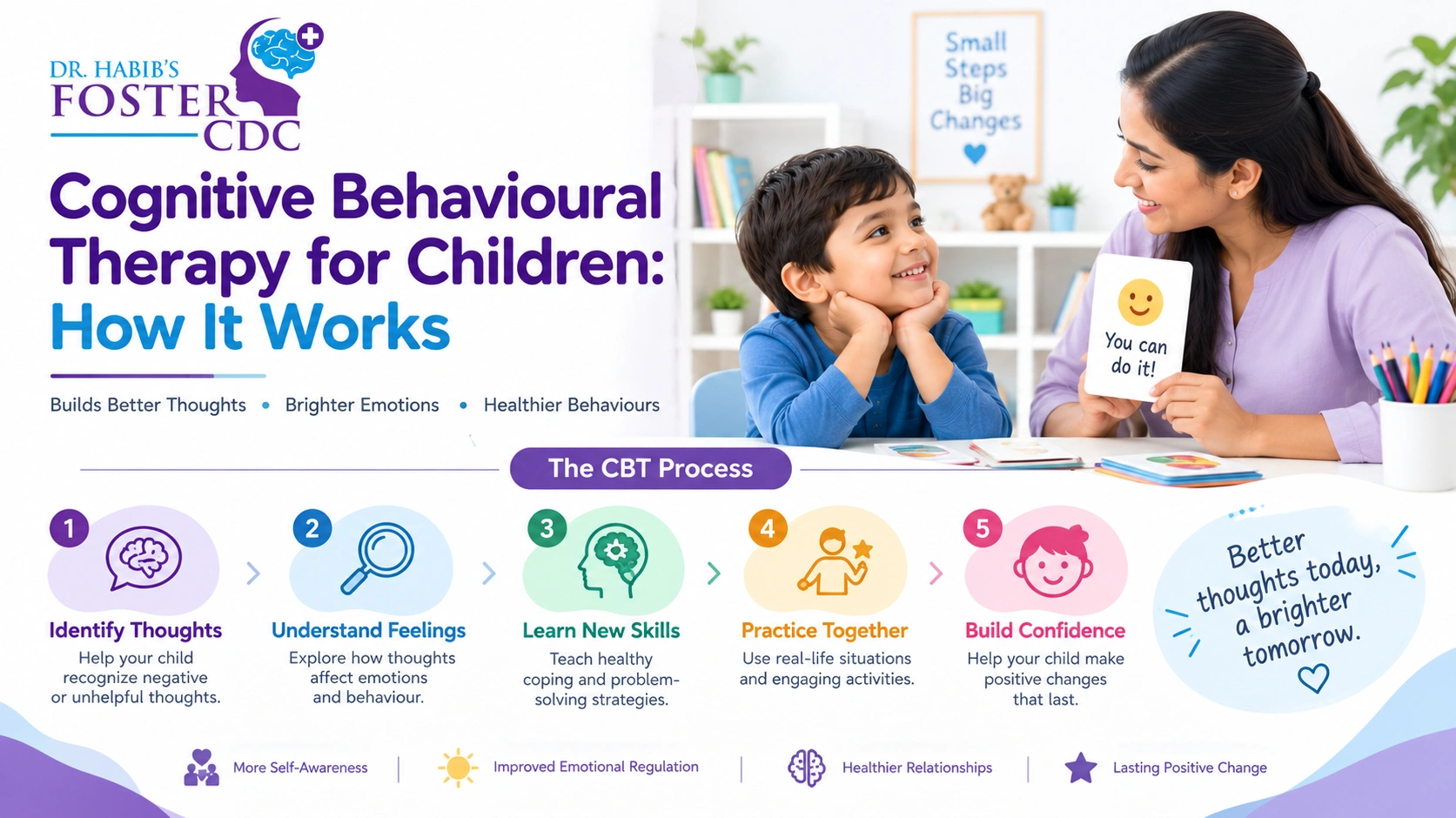
Your child says “I’m bad at everything” after one wrong answer. A minor disappointment turns into an hour-long meltdown. Worry about something small spirals into worry about everything. If this sounds familiar, you may have already heard CBT mentioned as an option — but “cognitive behavioural therapy” can sound abstract and adult-oriented, which makes it hard to picture what it actually looks like for a child.
This guide breaks down what CBT is, how it’s adapted for children at different ages, what it can help with, and what a real session looks like.
What Is Cognitive Behavioural Therapy?
CBT is a structured, evidence-based therapy built on a simple but powerful idea: thoughts, feelings, and behaviours are connected, and changing one can change the others. A child who thinks “I always mess things up” is more likely to feel discouraged and avoid trying — while learning to notice and challenge that thought can shift both the feeling and the behaviour that follows it.
For children, CBT is adapted to be concrete, visual, and often playful, rather than relying on the kind of abstract self-reflection adult CBT often involves. Younger children in particular need age-appropriate tools — stories, drawings, games — to access the same underlying skills.
What Can CBT Help With?
CBT is one of the most researched therapies for children, with strong evidence for:
- Anxiety — generalized worry, specific fears, separation anxiety, social anxiety
- Anger management — recognizing anger triggers and building alternative responses
- Low self-esteem and negative self-talk — persistent “I can’t” or “I’m not good enough” thinking patterns
- Obsessive or intrusive worries — including some presentations of OCD in children
- Behavioural difficulties — particularly where negative thought patterns are fueling behaviour, such as avoidance or outbursts
- Emotional regulation more broadly — helping children build a toolkit for managing big feelings
CBT is often used alongside, not instead of, other approaches. If ADHD is part of your child’s picture, our guide on ADHD in children: symptoms, diagnosis, and treatment options covers where CBT fits into a broader ADHD treatment plan.
How CBT Is Adapted for Different Ages
Younger Children (Roughly 5-8 years)
CBT at this age relies heavily on stories, characters, drawing, and play rather than direct conversation about thoughts and feelings. A therapist might use a puppet or character to externalize a worry (“the worry monster”), making an abstract internal experience something the child can talk about and problem-solve more concretely.
School-Age Children (Roughly 8-12 years)
Children in this range can usually start identifying their own thoughts and feelings more directly, with therapist support. Techniques often include simple thought-tracking (“what did you think right before you felt upset?”), gradual exposure to feared situations, and structured problem-solving steps.
Preteens and Adolescents
Older children can typically engage with more traditional CBT structure — identifying thought patterns, examining evidence for and against a worry, and practicing specific coping strategies more independently, closer to how CBT works for adults.
Across all ages, the therapist’s job is to make the skills concrete and practiced, not just discussed — CBT is fundamentally a skills-building therapy, not primarily a talking therapy.
What a CBT Session Actually Looks Like
A typical session might include a brief check-in on the week, a specific skill-building activity (identifying a thought pattern, practicing a coping strategy, working through a worksheet or game designed for the child’s age), and a small, specific task to practice before the next session. Sessions are usually structured but not rigid — a skilled therapist adjusts pacing and format to keep a child genuinely engaged rather than just compliant.
CBT vs. Other Behaviour Therapy Approaches
This is a common point of confusion, so it’s worth clarifying directly: CBT focuses specifically on the connection between thoughts, feelings, and behaviour, and is particularly well-suited to anxiety, low mood, and negative thinking patterns. Broader behaviour therapy approaches (like those used for autism) more often focus on building specific skills and shaping behaviour through reinforcement, without necessarily targeting underlying thought patterns directly. Many children benefit from a combination, tailored to their specific needs — our guide to behaviour therapy for autism covers that adjacent approach in more depth.
What Happens During an Evaluation
Before starting CBT, a clinician typically conducts a detailed history covering the specific worries, behaviours, or emotional patterns you’ve noticed, how they show up across settings, and their impact on daily life. This helps determine whether CBT is the right fit, whether it should be combined with another approach, and what specific goals therapy should target. For a broader sense of how developmental and behavioural evaluations generally work, see what happens during a child developmental assessment.
What Parents Can Do at Home
CBT skills are most effective when reinforced consistently between sessions:
- Practice the specific skill your child is learning — if they’re working on identifying thoughts, gently ask “what were you thinking right before that happened?” during real moments, not just in therapy
- Model your own coping strategies out loud — narrating how you manage your own frustration or worry teaches by example
- Avoid rushing to fix the feeling — CBT teaches children to sit with and work through difficult emotions, which is undermined if a parent always immediately removes the discomfort
- Celebrate effort in using a strategy, not just successful outcomes — trying to use a coping skill, even imperfectly, is real progress
- Stay in touch with the therapist about what’s being worked on, so home reinforcement lines up with the actual therapy goals
For more general, structured ideas, see 10 everyday activities to support your child’s development at home.
Addressing Stigma Around Therapy
It’s common for parents to worry that starting therapy means something is “wrong” with their child, or to face questions or judgment from family about it. It’s worth reframing this directly: CBT teaches practical coping skills that benefit most children who use them, regardless of how significant the underlying difficulty is. Seeking support early, when a worry or behaviour pattern is still manageable, tends to lead to much better outcomes than waiting until it becomes a bigger problem — and normalizing that with your child (and, where needed, with family) is itself part of good mental health support.
When to Consider CBT for Your Child
CBT is worth considering if your child shows persistent anxiety, frequent and disproportionate emotional reactions, ongoing negative self-talk, specific fears interfering with daily life, or behavioural patterns that seem driven by underlying worry or distress. If you’re unsure whether what you’re seeing warrants professional support, that uncertainty is itself a reasonable enough reason to seek an evaluation.
Frequently Asked Questions
At what age can a child start CBT? CBT can be adapted for children as young as 5-6 years old using age-appropriate tools like play and storytelling, though the specific techniques used depend heavily on the child’s developmental level rather than age alone.
How long does CBT typically take to show results? This varies by child and the issue being addressed, but many families notice meaningful changes within a few months of consistent sessions, with continued progress over a longer course of therapy for more entrenched patterns.
Is CBT only for children with a diagnosed condition like anxiety disorder? No. CBT can help children build coping skills for persistent worry, anger, or negative thinking patterns even without a formal diagnosis, since the underlying skills — recognizing and reframing unhelpful thoughts — benefit most children who struggle with these patterns.
Can CBT be combined with other therapies, like occupational or speech therapy? Yes. CBT is often used alongside other therapies as part of a coordinated plan, particularly when a child has overlapping needs — for example, anxiety alongside ADHD or a developmental delay.
Will my child have to talk about their feelings directly in CBT? Not necessarily, especially for younger children. Therapists often use indirect methods — stories, games, drawing — to work with the same underlying thoughts and feelings without requiring direct verbal discussion, which many children find more accessible.
Next step: If you’d like to explore whether CBT could help your child manage anxiety, anger, or difficult emotions, book a behavioural assessment with Dr. Habib’s Foster CDC at our Tolichowki, Malakpet, or Suncity clinics in Hyderabad.

Recent Comments