
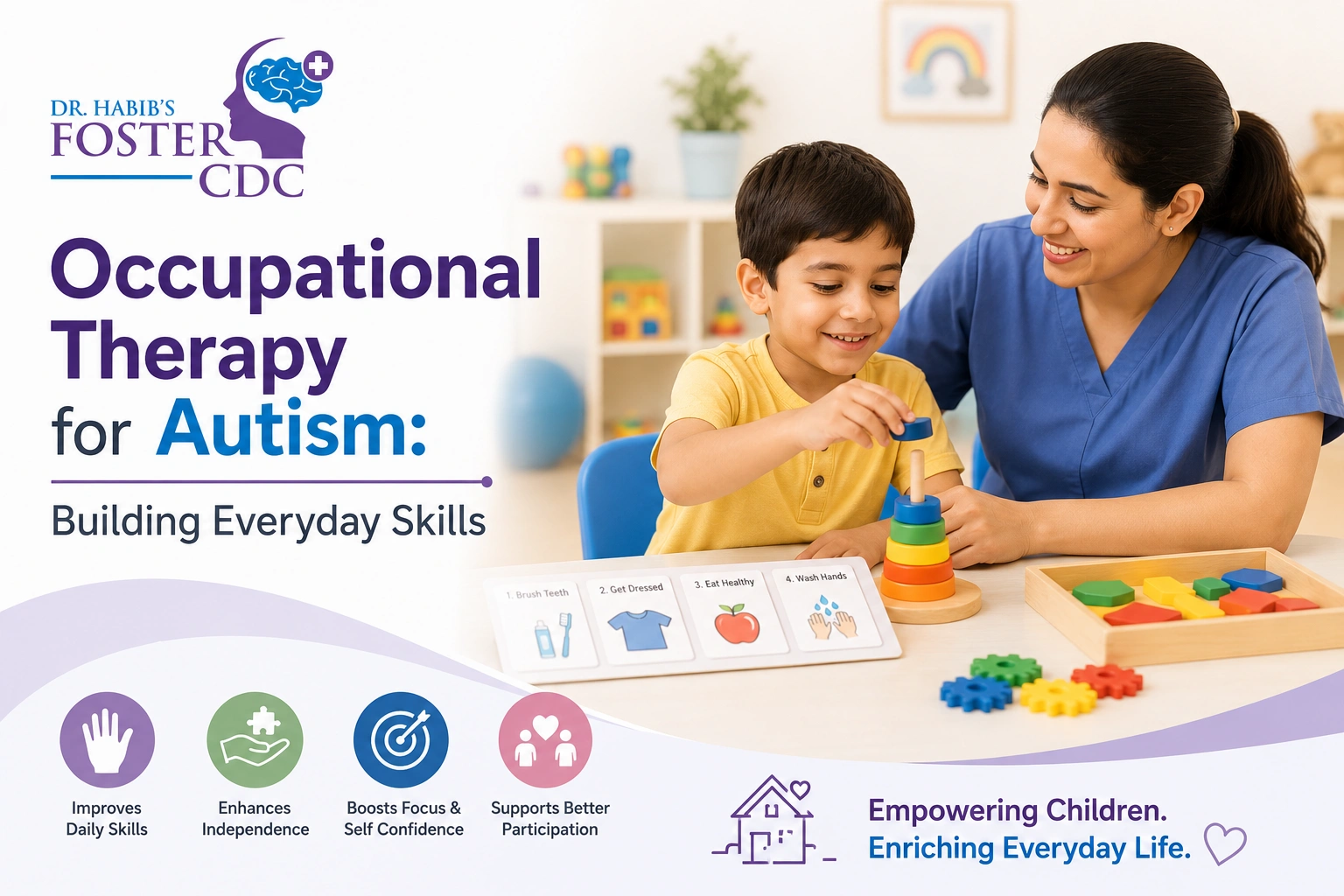
For many autistic children, it’s not language or social interaction that causes the most day-to-day friction — it’s the everyday physical world. Tags in clothing, loud rooms, tying shoelaces, holding a pencil, sitting still at a desk. These are the kinds of challenges occupational therapy (OT) is built to address.
If your child struggles more with sensory reactions, motor coordination, or daily routines than with communication alone, OT is often one of the most immediately useful therapies you can add to their plan. Here’s how it works, what it covers, and what to expect.
For the bigger picture, see our guides on early signs of autism in toddlers, how autism is diagnosed in children, and our overview of autism therapy options in Hyderabad, which covers how OT fits alongside behaviour therapy and speech therapy. If your child has already been referred to behaviour therapy, our guide to behaviour therapy for autism is a useful companion read.
What Is Occupational Therapy, and Why Does It Matter for Autism?
Occupational therapy focuses on helping children participate in the everyday “occupations” of childhood — playing, dressing, eating, writing, and interacting with their environment — as independently and comfortably as possible.
For autistic children, OT often centers on two closely linked areas:
- Sensory processing — how a child registers and responds to sound, touch, movement, light, and texture
- Motor skills — both fine motor skills (handwriting, buttons, using cutlery) and gross motor skills (balance, coordination, running, climbing)
Difficulties in either area can show up as meltdowns, avoidance, clumsiness, or resistance to everyday tasks — often mistaken for “behaviour problems” when the real driver is sensory or motor difficulty.
For a broader look at OT beyond autism specifically, see our complete guide to occupational therapy for children in Hyderabad.
How Occupational Therapy Helps Autistic Children
Sensory Regulation
Many autistic children are either over-responsive (overwhelmed by sound, light, or touch) or under-responsive (seeking out intense sensory input) to their environment. OT uses structured sensory activities — swinging, deep pressure, textured play — to help children process input in a more regulated way, which in turn reduces meltdowns and improves focus.
Fine Motor Skills
Handwriting, using scissors, buttoning a shirt, or holding utensils all require coordinated small-muscle movement. OT breaks these skills into manageable steps and builds them through repetition and play-based practice.
Gross Motor Skills
Balance, coordination, and body awareness affect everything from playground participation to sitting upright at a desk. OT activities target these foundational movement skills so children can engage more comfortably in physical and classroom settings.
Daily Living Skills
Dressing, eating, toileting, and grooming are often harder for autistic children due to a combination of sensory sensitivity and motor difficulty. OT works on these skills directly, with strategies tailored to the child’s specific sensory profile.
Self-Regulation and Focus
By addressing the sensory root of dysregulation, OT often improves a child’s ability to sit, attend, and engage — which supports progress in behaviour therapy, speech therapy, and classroom learning as well.
What an OT Session Looks Like
Sessions are typically play-based rather than desk-based, especially for younger children. A therapist might use swings, trampolines, textured materials, or weighted tools to work on sensory regulation, alongside targeted fine motor activities like puzzles, threading, or drawing. Sessions are usually one-on-one, and often take place in a room equipped specifically for sensory and motor work.
OT for Toddlers vs. School-Age Children
- Toddlers: Focus tends to be on sensory regulation, basic motor milestones, and play skills, often woven into parent coaching so strategies carry over into daily routines.
- School-age children: OT shifts toward classroom-relevant skills — handwriting, sitting tolerance, using classroom tools, managing sensory input in a busy environment, and building independence in self-care.
Comparing your child’s current skills against general milestones can help frame these goals — see our child development milestones by age guide.
What to Expect During the Evaluation
Before therapy starts, an OT evaluation typically assesses sensory processing patterns, fine and gross motor skills, and daily living skills through observation, standardized tools, and parent-reported history. This helps the therapist build a plan targeted to your child’s specific profile rather than a generic program. For more on what this process generally involves, see what happens during a child developmental assessment.
What Parents Can Do at Home
OT strategies work best when reinforced consistently outside the clinic:
- Build sensory breaks (movement, deep pressure, quiet time) into the daily routine, not just when a meltdown starts
- Offer textured, hands-on play — sand, dough, water play — to build sensory tolerance gradually
- Practice fine motor skills through everyday tasks: buttoning, pouring, using utensils
- Keep transitions and routines predictable to reduce sensory-driven stress
For more structured ideas, see 10 everyday activities to support your child’s development at home.
In-Clinic vs. Online Occupational Therapy
In-clinic OT gives access to sensory equipment and hands-on, therapist-guided activities that are difficult to replicate at home — generally the better option for direct skill-building, especially with younger children. Online sessions can still be useful for parent coaching and home-strategy planning, but usually work best as a supplement rather than a substitute for in-person sessions.
Choosing an OT Provider in Hyderabad
Look for a program that offers:
- Individualized sensory and motor assessment, not a generic activity checklist
- Coordination with other therapies your child is receiving — behaviour therapy, speech therapy, or special education
- Clinical oversight from a pediatric neurologist or developmental specialist
- Parent training, so strategies extend beyond the therapy room
- Regular progress review, with goals adjusted as your child develops
Session frequency and cost depend on your child’s specific needs and are best discussed directly with the clinical team during evaluation.
Frequently Asked Questions
What is occupational therapy for autism, and how does it help children? It’s a therapy that helps autistic children manage sensory processing, motor skills, and daily living tasks, so they can participate in everyday activities — play, dressing, eating, writing, and classroom life — more comfortably and independently.
How is OT different from behaviour therapy for autism? Behaviour therapy focuses on building communication and social skills through structured teaching and reinforcement, while OT focuses specifically on sensory processing and motor skills. Most children benefit from both as part of a coordinated plan.
Who should a parent consult before starting occupational therapy? A pediatric neurologist or developmental specialist can assess whether sensory or motor difficulties are contributing to your child’s challenges and recommend the right intensity and focus for OT.
Next step: If sensory sensitivities or motor delays are affecting your child’s daily life, book an appointment with Dr. Habib’s Foster CDC at our Tolichowki, Malakpet, or Suncity clinics in Hyderabad.
This article is for general information and does not replace a professional medical evaluation. Reviewed by Dr. Habib G. Pathan, Consultant Pediatric Neurologist.

Recent Comments