
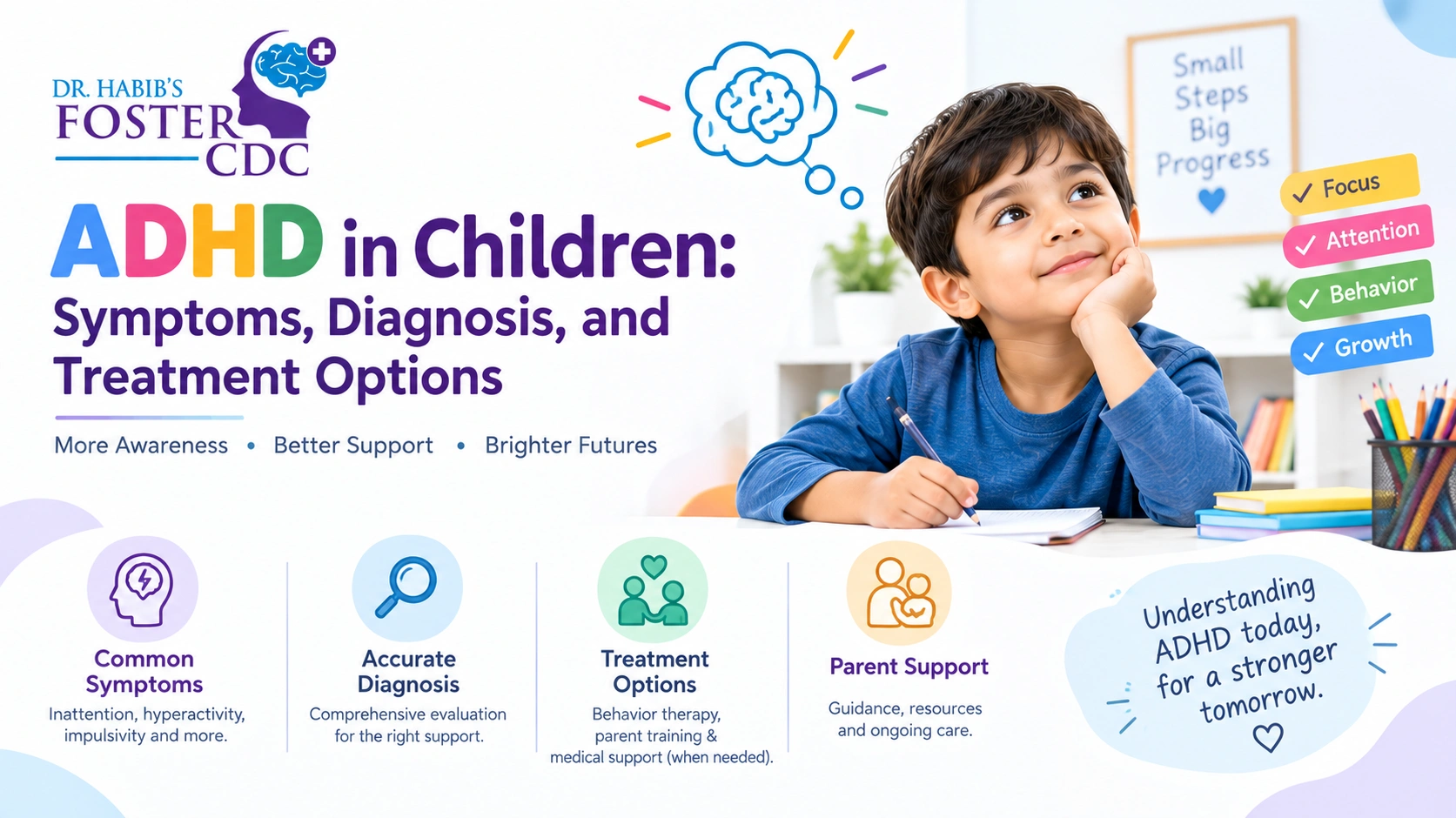
If you’re managing daily meltdowns over homework, constant reminders that don’t seem to land, or a teacher’s note home about “disruptive behaviour” — you’re probably exhausted in a very specific way. Not just tired, but frequently second-guessing yourself: is this normal childhood energy, a parenting issue, or something that actually has a name and a path forward?
ADHD (attention-deficit/hyperactivity disorder) is one of the most common — and most misunderstood — neurodevelopmental conditions in children. This guide covers the real symptoms, how diagnosis actually works, what treatment involves, and practical ways to manage day-to-day behaviour while you figure out the right support for your child.
ADHD Symptoms: What It Actually Looks Like
ADHD symptoms generally fall into two categories, and children can show one pattern more than the other, or a combination of both:
Inattention:
- Difficulty sustaining focus on tasks, especially non-preferred ones like homework
- Frequently losing items needed for tasks (school supplies, homework itself)
- Seeming not to listen when spoken to directly
- Difficulty following through on instructions or finishing tasks
- Easily distracted by unrelated stimuli
Hyperactivity and Impulsivity:
- Difficulty staying seated when expected to
- Excessive talking or difficulty waiting for a turn
- Fidgeting, restlessness, or an inability to engage in activities quietly
- Interrupting others or blurting out answers before a question is finished
- Acting without considering consequences
A key point that’s easy to miss: these behaviours need to be present across more than one setting (home and school, for example) and significantly impact daily functioning to point toward ADHD specifically, rather than being situational — a child who struggles only in one specific class or only with one particular parent’s rules is showing something different from ADHD.
Why ADHD Gets Misread as “Bad Behaviour”
This is worth naming directly, because it’s often the source of real frustration and stigma for both children and parents: a lot of ADHD behaviour looks, on the surface, like defiance, laziness, or poor discipline. A child who “won’t sit still,” “won’t listen,” or “keeps forgetting things” is frequently judged on effort and intention — when the underlying issue is a difference in how their brain manages attention, impulse control, and self-regulation, not a lack of trying.
This matters practically, not just emotionally: behaviour management strategies built around punishment for “choosing” not to comply tend to fail with ADHD, because the child usually isn’t choosing the behaviour in the way it looks. Strategies built around structure, clear expectations, and support for the underlying difficulty tend to work far better.
How ADHD Is Diagnosed
There’s no single test for ADHD. Diagnosis is a clinical process that typically includes:
- A detailed developmental and behavioural history — when symptoms started, how they show up across settings, and their impact on daily life
- Input from multiple settings — parents and teachers are usually both consulted, since the “more than one setting” criterion is central to diagnosis
- Standardized rating scales completed by parents and teachers, which help structure and quantify the behaviours being observed
- A clinical evaluation by a pediatric neurologist or developmental specialist, ruling out other conditions that can present similarly (anxiety, learning difficulties, sleep problems, or sensory processing differences)
- A discussion of findings and, where appropriate, a diagnosis and recommended treatment plan
For a broader sense of how developmental evaluations generally work, see what happens during a child developmental assessment.
Treatment Options for ADHD
Most effective ADHD treatment plans combine more than one approach, tailored to the individual child:
Behavioural Therapy
Structured approaches that teach self-regulation, build positive behaviour patterns through consistent reinforcement, and equip parents with specific management strategies — often one of the first-line approaches recommended, particularly for younger children.
Occupational Therapy
Addresses the sensory, fine motor, and executive functioning difficulties that frequently accompany ADHD — handwriting struggles, sensory regulation, and daily routine management. Our guide on how occupational therapy helps children with ADHD covers this in detail.
Parent Training
Programs that teach parents specific, practical strategies for managing ADHD-related behaviour at home — consistent structure, effective instruction-giving, and reinforcement techniques that work with an ADHD brain rather than against it.
School-Based Support
Classroom accommodations — preferential seating, extended time, structured breaks — can meaningfully reduce daily friction for a child with ADHD, and are worth discussing directly with your child’s school once a diagnosis or evaluation is in progress.
Medical Management
For some children, medication is recommended alongside behavioural and therapeutic support, based on a full clinical evaluation. This decision is individualized and made in consultation with a pediatric neurologist or developmental pediatrician, weighing the specific child’s needs.
Practical Behaviour Management Strategies for Home
These won’t replace a formal evaluation or treatment plan, but they tend to reduce daily friction significantly:
- Use clear, short instructions — one step at a time, rather than multi-part requests, and check that your child has actually registered the instruction
- Build predictable routines with visual schedules where possible — predictability reduces the cognitive load of remembering what comes next
- Catch and reinforce positive behaviour specifically (“I noticed you started your homework right away”) rather than only responding to what goes wrong
- Build in movement breaks, especially before tasks requiring sustained focus — a few minutes of physical activity genuinely helps many children with ADHD settle into focused work afterward
- Set up the environment to reduce distraction during focused tasks — a quieter, less visually busy space for homework, for example
- Expect and plan for transitions to be hard — giving advance warning before switching activities reduces resistance significantly
Addressing the Frustration and Stigma
If you’re feeling frustrated, judged, or exhausted by comments — from family, from school, sometimes from strangers — about your child’s behaviour, that reaction is completely understandable, and you’re far from the only parent navigating it. A few things that tend to help:
- Having a clear explanation ready for family or acquaintances, rather than re-explaining from scratch every time
- Connecting with your child’s school proactively, framing the conversation around support rather than only problems
- Remembering that a diagnosis isn’t a life sentence on how your child’s story goes — with the right support, most children with ADHD build strong coping strategies and go on to do well
- Giving yourself the same patience you’re working to extend to your child — parenting a child with ADHD is genuinely more demanding day to day, and that’s worth acknowledging rather than dismissing
When to Seek a Professional Evaluation
If your child’s attention, impulsivity, or activity level is significantly affecting school performance, friendships, or family life — and especially if it’s showing up consistently across more than one setting — it’s worth seeking a professional evaluation rather than continuing to manage it alone. An evaluation doesn’t commit you to any particular treatment; it simply gives you a clearer picture and a path forward.
Frequently Asked Questions
Is ADHD caused by bad parenting or too much screen time? No. ADHD is a neurodevelopmental condition with a strong genetic component; it is not caused by parenting style, discipline approach, or screen exposure, though environment can influence how symptoms show up day to day.
At what age can ADHD be diagnosed? ADHD can typically be diagnosed from around age 4, though symptoms are often more reliably assessed once a child is in a school setting where attention and behaviour can be observed and compared across contexts.
Does every child with ADHD need medication? No. Medication is one option considered as part of an individualized treatment plan, often alongside behavioural therapy, occupational therapy, and parent training — not a universal requirement for every child diagnosed with ADHD.
Can ADHD be outgrown? Some children see symptoms lessen with age and with strong coping strategies in place, but for many, ADHD continues in some form into adolescence and adulthood. Early support tends to build skills that make managing it far more manageable long-term, whether or not symptoms fully resolve.
How is ADHD different from a child just being energetic or strong-willed? The key distinction is impact and consistency: ADHD-related behaviours occur across multiple settings and significantly interfere with daily functioning — school performance, friendships, family routines — rather than being occasional high energy or typical strong-willed behaviour in a single context.
Next step: If you’re noticing signs of ADHD or need practical support managing your child’s behaviour, book a behavioural assessment with Dr. Habib’s Foster CDC at our Tolichowki, Malakpet, or Suncity clinics in Hyderabad.

Recent Comments