“Non-verbal” is one of the most misunderstood words in child development. It doesn’t mean a child has nothing to say, or that meaningful communication is out of reach — it means their path to communication doesn’t run primarily through spoken words. With the right tools and consistent support, non-verbal and minimally verbal children can communicate clearly, express needs, share ideas, and connect with the people around them.
This guide covers how communication is built for non-verbal children, the tools and therapies involved, and how to know if your child’s current approach is actually working.
If you’re still working through a speech or language concern more broadly, our guides on speech delay in children and language delay vs. speech delay cover that ground. This article picks up specifically where verbal speech isn’t yet — or may not be — the primary path forward.
Communication Is Bigger Than Speech
It’s worth separating two things that often get conflated: talking and communicating. A child can communicate clearly through gestures, pointing, pictures, sign, or a communication device, well before — or even without ever — using spoken words. The goal of communication therapy for non-verbal children isn’t to force speech at all costs; it’s to build a reliable way for the child to express needs, thoughts, and connection, using whatever channel works for them.
For some children, this alternative communication becomes a bridge that later supports spoken language. For others, it remains their primary and entirely valid way of communicating long-term. Both outcomes represent real progress.
Why Some Children Are Non-Verbal or Minimally Verbal
Being non-verbal or late to speak can stem from several different underlying factors, and often more than one applies:
- Autism spectrum disorder — communication differences are a core feature for many autistic children, though the degree varies widely
- Apraxia of speech — a motor-planning difficulty where the brain struggles to coordinate the precise movements needed for speech, even when the child knows exactly what they want to say
- Intellectual or developmental disability — where communication develops more slowly alongside broader cognitive development
- Hearing loss — reduced access to spoken language input can significantly affect speech development
- Severe language delay — where expressive language is delayed enough that functional speech hasn’t yet emerged
Identifying the underlying reason matters, because it shapes which approach is likely to help most. If autism is part of the picture, our guide to early signs of autism in toddlers offers useful related context.
Tools and Approaches for Building Communication
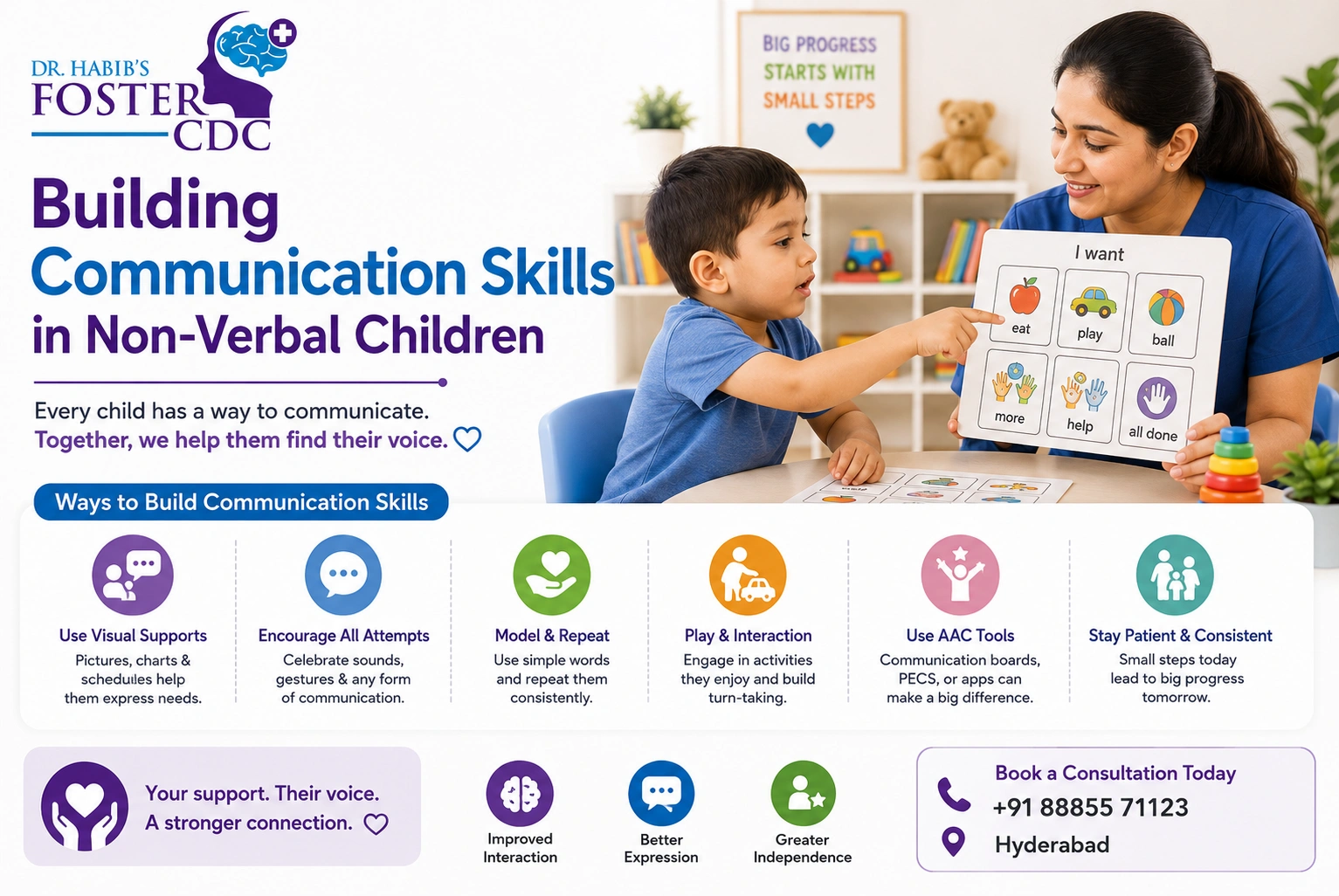
Gestures and Natural Signs
Pointing, reaching, waving, and simple signs are often the earliest and most accessible communication tools, and therapists frequently start here regardless of what other methods are introduced later.
Picture Exchange Communication (PECS)
A structured system where a child exchanges a picture card for a desired item or activity, gradually building toward combining pictures into simple sentences. It’s widely used because it requires no equipment and can be introduced early.
Sign Language (Functional Signing)
A set of functional signs — not necessarily formal sign language — used to represent common needs and words. This can be especially useful for children with strong motor imitation skills.
Augmentative and Alternative Communication (AAC) Devices
Ranging from simple picture boards to tablet-based apps with voice output, AAC devices let a child build sentences by selecting symbols or words, with the device speaking the message aloud. Modern AAC systems can grow in complexity alongside the child’s language development.
Speech-Generating Interventions
For children with apraxia or motor speech difficulty specifically, structured motor-based speech approaches aim to build the physical coordination needed for spoken words over time, often used alongside — not instead of — an alternative communication system.
A common and important point worth emphasizing: introducing AAC or picture systems does not delay or prevent spoken language from developing. Research consistently shows the opposite — giving a child a reliable way to communicate now tends to reduce frustration and often supports, rather than replaces, later speech development.
What to Expect from Therapy
A speech-language therapist typically starts by identifying which communication method the child engages with most naturally, then builds structured, motivating opportunities to use it — through play, daily routines, and, critically, real interaction rather than isolated drills. Progress is measured not just in vocabulary, but in how independently and spontaneously a child initiates communication, since that’s what translates into daily life.
What a Communication Evaluation Involves
An evaluation for a non-verbal or minimally verbal child typically includes a full developmental and hearing history, direct observation of how the child currently attempts to communicate (even informally — reaching, pulling, vocalizing), an assessment of comprehension, and a trial of different communication tools to see what the child responds to best. For a broader sense of what evaluations generally involve, see what happens during a child developmental assessment.
What Parents Can Do at Home
Consistency between therapy and home life makes a significant difference:
- Use whatever communication method your child is learning consistently at home too, not just in therapy sessions — a picture system or device only works if it’s available and modeled throughout the day
- Respond to any communication attempt — a reach, a sound, a gesture — as meaningful, rather than waiting for words
- Offer real choices throughout the day (which snack, which toy) as natural opportunities to practice communicating
- Avoid anticipating every need before your child has a chance to express it — a brief, natural pause often invites communication
For more structured, general ideas, see 10 everyday activities to support your child’s development at home.
Signs Communication Support Is Working
Progress in non-verbal communication doesn’t always look like spoken words appearing — and that’s worth normalizing for parents who may be watching for the wrong signal. Meaningful progress includes:
- Increased spontaneous use of gestures, pictures, signs, or a device to request or comment
- Fewer frustration-driven meltdowns tied to not being understood
- Growing ability to combine symbols or words into short phrases
- More initiated communication, rather than only responding when prompted
Frequently Asked Questions
Will using picture cards or an AAC device stop my child from learning to talk? No — this is one of the most common misconceptions. Evidence consistently shows that alternative communication tools tend to support, not replace, spoken language development by reducing frustration and building the foundation for communication generally.
How do I know which communication method is right for my child? This is best determined through a speech-language evaluation, which typically trials a few approaches to see what the child engages with most naturally, rather than assuming one method fits every child.
Is being non-verbal a permanent condition? Not necessarily. Some children remain non-verbal or minimally verbal long-term and communicate fully and meaningfully through alternative methods; others develop spoken language over time, often after building strong communication through another method first. Both are valid outcomes of successful therapy.
Next step: If you’d like to explore communication strategies for a non-verbal or minimally verbal child, book a speech and language evaluation with Dr. Habib’s Foster CDC at our Tolichowki, Malakpet, or Suncity clinics in Hyderabad.
This article is for general information and does not replace a professional medical evaluation. Reviewed by Dr. Habib G. Pathan, Consultant Pediatric Neurologist.

Recent Comments