
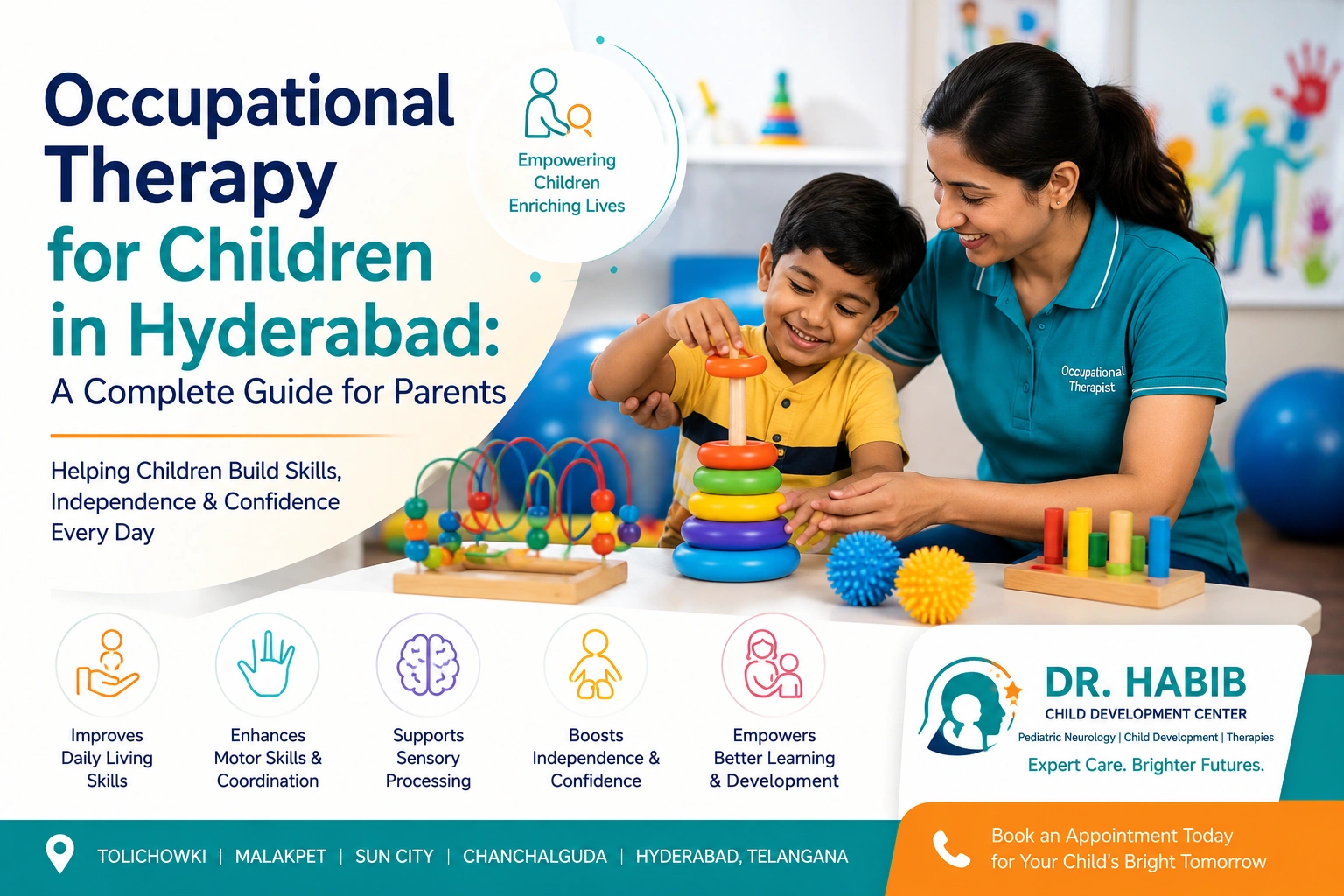
If your child struggles with handwriting, buttoning a shirt, sitting still in class, or seems overly sensitive to loud noises or certain textures, you’re not alone. Many parents in Hyderabad search for occupational therapy for children when everyday tasks — the ones other kids seem to do effortlessly — become a daily struggle at home or school. The good news is that with the right support, most children make meaningful progress.
Quick Answer
Occupational therapy (OT) helps children build the physical, sensory, and cognitive skills needed for everyday activities — like dressing, writing, playing, and social interaction. At Dr. Habib’s Child Development Center in Hyderabad, pediatric OT combines sensory integration, fine and gross motor training, and daily-living skill-building, guided by a pediatric neurologist-led team.
Key Takeaways
- Occupational therapy addresses fine motor, gross motor, sensory processing, and self-care skill delays in children.
- It benefits children with autism, ADHD, developmental delay, cerebral palsy, sensory processing disorder, and learning difficulties.
- Early intervention (before age 6) generally leads to faster and stronger progress.
- OT sessions are play-based, individualized, and goal-driven.
- Dr. Habib’s Foster CDC offers OT services across Tolichowki, Malakpet, and Sun City in Hyderabad.
- A pediatric neurologist’s evaluation helps identify the underlying cause before therapy begins.
- Consistent home practice alongside clinic sessions improves outcomes significantly.
What Is Occupational Therapy for Children?
Occupational therapy for children is a specialized form of therapy that helps kids develop the skills needed to participate fully in daily life — from holding a pencil correctly to playing with friends, eating independently, and managing sensory input like noise, light, or touch. Unlike physiotherapy, which focuses mainly on movement and strength, pediatric OT takes a broader view: it looks at how a child processes information, moves, and functions across home, school, and social settings.
An occupational therapist assesses a child’s current abilities, identifies gaps, and designs a structured plan involving play-based exercises, sensory activities, and skill-building tasks. The goal isn’t just to “fix” a specific problem — it’s to help the child function more independently and confidently in real-world situations.
Quick Summary
OT is a child-centered therapy that builds the physical, sensory, and cognitive skills a child needs for daily tasks — through structured, play-based sessions guided by a trained therapist.
Common Causes of Developmental and Motor Difficulties in Children
Several underlying conditions can lead a child to need occupational therapy, including:
- Autism Spectrum Disorder (ASD) — often involving sensory sensitivities and motor planning difficulties
- ADHD — impacting attention, impulse control, and task organization
- Developmental delay — slower-than-expected progress in motor, speech, or cognitive milestones
- Cerebral palsy — affecting muscle tone, coordination, and movement
- Sensory Processing Disorder (SPD) — difficulty responding appropriately to sensory input
- Premature birth — sometimes associated with delayed motor and sensory development
- Genetic syndromes — such as Down syndrome, which can affect muscle tone and coordination
Quick Summary
Motor and sensory difficulties in children often stem from neurodevelopmental conditions, premature birth, or genetic factors — which is why a proper neurological evaluation matters before starting therapy.
Signs Your Child May Need Occupational Therapy
Parents often notice these signs before seeking help:
- Difficulty holding a pencil, using scissors, or buttoning clothes
- Avoiding or being overly sensitive to certain textures, sounds, or lights
- Poor balance or clumsiness compared to peers
- Trouble with age-appropriate self-care (brushing teeth, eating, dressing)
- Difficulty focusing on tasks or sitting still
- Delayed milestones in crawling, walking, or hand-eye coordination
- Meltdowns triggered by sensory overload (crowded places, tags on clothes, loud sounds)
If several of these sound familiar, an evaluation by a pediatric neurologist or occupational therapist can clarify what’s going on and what support your child needs.
Quick Summary
Struggles with fine motor tasks, sensory sensitivities, balance, or self-care independence are common early indicators that a child may benefit from an OT evaluation.
How Occupational Therapy Difficulties Are Diagnosed
Diagnosis typically starts with a detailed developmental history and a hands-on assessment. At Dr. Habib’s Foster CDC, this process usually includes:
| Step | What Happens |
| Initial consultation | Pediatric neurologist reviews developmental history and milestones |
| Standardized assessments | Therapist evaluates fine motor, gross motor, and sensory processing skills |
| Observation | Child is observed during structured play and daily-task simulations |
| Team discussion | Findings are shared with parents, along with a personalized therapy plan |
Because motor and sensory difficulties can overlap with neurological, behavioral, or developmental conditions, having a pediatric neurologist involved in the diagnostic process helps ensure nothing underlying is missed.
Quick Summary
A proper OT diagnosis combines developmental history, standardized testing, and clinical observation — ideally overseen by a pediatric neurologist for a complete picture.
Occupational Therapy Techniques and Treatment Approaches
Pediatric OT is highly individualized, but common techniques include:
- Sensory integration therapy — helping children process and respond to sensory input appropriately
- Fine motor skill training — activities to strengthen hand muscles and improve pencil grip, cutting, and buttoning
- Gross motor activities — improving balance, coordination, and core strength
- Visual-motor integration exercises — connecting what a child sees with how they move (important for handwriting and catching a ball)
- Self-care skill building — practicing dressing, feeding, and grooming tasks in a structured way
- Social skills and play-based therapy — building turn-taking, sharing, and peer interaction skills
- Assistive strategies — adaptive tools or classroom accommodations when needed
Sessions are almost always play-based, especially for younger children, since play is how children naturally learn and practice new skills.
Quick Summary
Effective OT blends sensory, motor, and self-care training into engaging, play-based activities tailored to each child’s specific needs.
Benefits of Early Intervention
Research consistently shows that starting therapy earlier — ideally before school age — leads to better long-term outcomes. Early intervention can:
- Build stronger foundational skills before school demands increase
- Reduce frustration and behavioral challenges linked to skill gaps
- Improve a child’s confidence and independence
- Make later academic and social transitions smoother
- Reduce the intensity or duration of therapy needed over time
A brain in early childhood is highly adaptable, which is why pediatric specialists often stress not delaying an evaluation if you notice warning signs.
Quick Summary
The earlier a developmental concern is addressed, the more effectively a child’s brain can adapt — making early evaluation and therapy a worthwhile priority.
Home Tips for Parents
While clinic sessions are essential, consistent practice at home reinforces progress:
- Incorporate simple fine motor activities: playdough, threading beads, using clothespins
- Create sensory-friendly routines, especially during transitions or bedtime
- Break tasks into small, manageable steps (e.g., dressing one item at a time)
- Praise effort, not just success, to build confidence
- Maintain consistent daily routines, which help children with sensory or attention challenges feel secure
- Stay in close communication with your child’s therapist about what’s working at home
Quick Summary
Small, consistent home activities — paired with patience and routine — can meaningfully support the progress made in therapy sessions.
When to Consult a Specialist
Consider booking an evaluation if your child:
- Is noticeably behind peers in motor or self-care skills
- Has frequent meltdowns linked to sensory triggers
- Struggles significantly with handwriting or classroom tasks despite effort
- Was born prematurely or has a known developmental or neurological condition
- Shows signs alongside speech delay, social difficulty, or attention problems
A pediatric neurologist can help determine whether occupational therapy alone is sufficient or whether a combined approach (with speech therapy, behavioral therapy, or special education support) would serve your child better.
Quick Summary
When motor, sensory, or self-care difficulties are affecting daily life or schooling, an evaluation with a pediatric specialist is a reasonable next step.
How Dr. Habib’s Child Development Center Supports Families in Hyderabad
Dr. Habib’s Foster CDC offers occupational therapy for children as part of a broader, neurologist-guided developmental care model — rather than therapy in isolation. Every child’s OT plan is developed in coordination with Dr. Habib G. Pathan, Consultant Pediatric Neurologist with over 19 years of experience, ensuring that any underlying neurological factors are properly identified and addressed alongside therapy.
Families across Hyderabad can access these services through the center’s locations in Tolichowki, Malakpet, and Sun City, making consistent, quality pediatric OT more accessible across the city and surrounding areas in Telangana. The center’s holistic approach also connects families to related services — including speech therapy, behavioral therapy, and early intervention programs — when a child’s needs go beyond occupational therapy alone.
Quick Summary
Dr. Habib’s Foster CDC combines pediatric neurology expertise with dedicated occupational therapy services across multiple Hyderabad locations, offering families a coordinated path to support their child’s development.
Frequently Asked Questions
- What age should a child start occupational therapy? There’s no fixed minimum age — OT can begin as early as infancy if delays are identified. Earlier intervention generally supports faster, stronger progress.
- How is occupational therapy different from physiotherapy? Physiotherapy focuses on movement, strength, and mobility, while occupational therapy addresses the broader set of skills needed for daily activities, including sensory processing and self-care.
- Does my child need a diagnosis before starting OT? Not necessarily. Many children begin therapy based on identified skill delays, with a formal diagnosis (if applicable) determined alongside or after the evaluation.
- How long does occupational therapy take to show results? This varies by child, but many families notice initial improvements within a few months of consistent therapy, with continued progress over time.
- Is occupational therapy only for children with autism? No. OT supports children with ADHD, developmental delay, cerebral palsy, sensory processing disorder, and general fine or gross motor difficulties, not only autism.
- How often are OT sessions needed? Session frequency depends on the child’s needs, typically ranging from once to a few times per week, as recommended by the therapist.
- Can occupational therapy help with handwriting problems? Yes, fine motor and visual-motor integration exercises in OT are commonly used to improve handwriting and pencil control.
- What happens during a first OT evaluation? The therapist observes the child during play and task-based activities, gathers developmental history from parents, and may use standardized assessment tools.
- Do parents need to be involved in therapy? Yes. Parent involvement — through home practice and consistent routines — significantly supports the effectiveness of clinic-based therapy.
- Is occupational therapy covered by insurance in India? Coverage varies by insurer and policy. It’s best to check directly with your insurance provider regarding pediatric therapy coverage.
- What conditions commonly require OT alongside neurology care? Cerebral palsy, developmental delay, autism, and genetic syndromes often benefit from combined neurology and occupational therapy management.
- Can occupational therapy help with sensory sensitivities? Yes, sensory integration techniques are a core part of OT and are specifically designed to help children regulate responses to sensory input.
- Will my child need therapy forever? Most children “graduate” from active therapy once they reach their functional goals, though some conditions may need ongoing periodic support.
- Are OT sessions play-based for older children too? Play-based methods are most common for younger children; older children often work with more structured, goal-oriented tasks alongside some interactive elements.
- How do I book an OT assessment at Dr. Habib’s Foster CDC? You can book a consultation through the center’s appointment page or by contacting the Tolichowki, Malakpet, or Sun City clinic directly.
Conclusion
Every child develops at their own pace, but when motor, sensory, or self-care difficulties start affecting daily life, timely support can make a real difference. Occupational therapy for children in Hyderabad at Dr. Habib’s Child Development Center combines pediatric neurology expertise with dedicated, individualized therapy — helping children build the skills and confidence they need to thrive at home, at school, and beyond. If you’ve noticed any of the signs discussed above, consider booking a developmental assessment for your child today.

Recent Comments