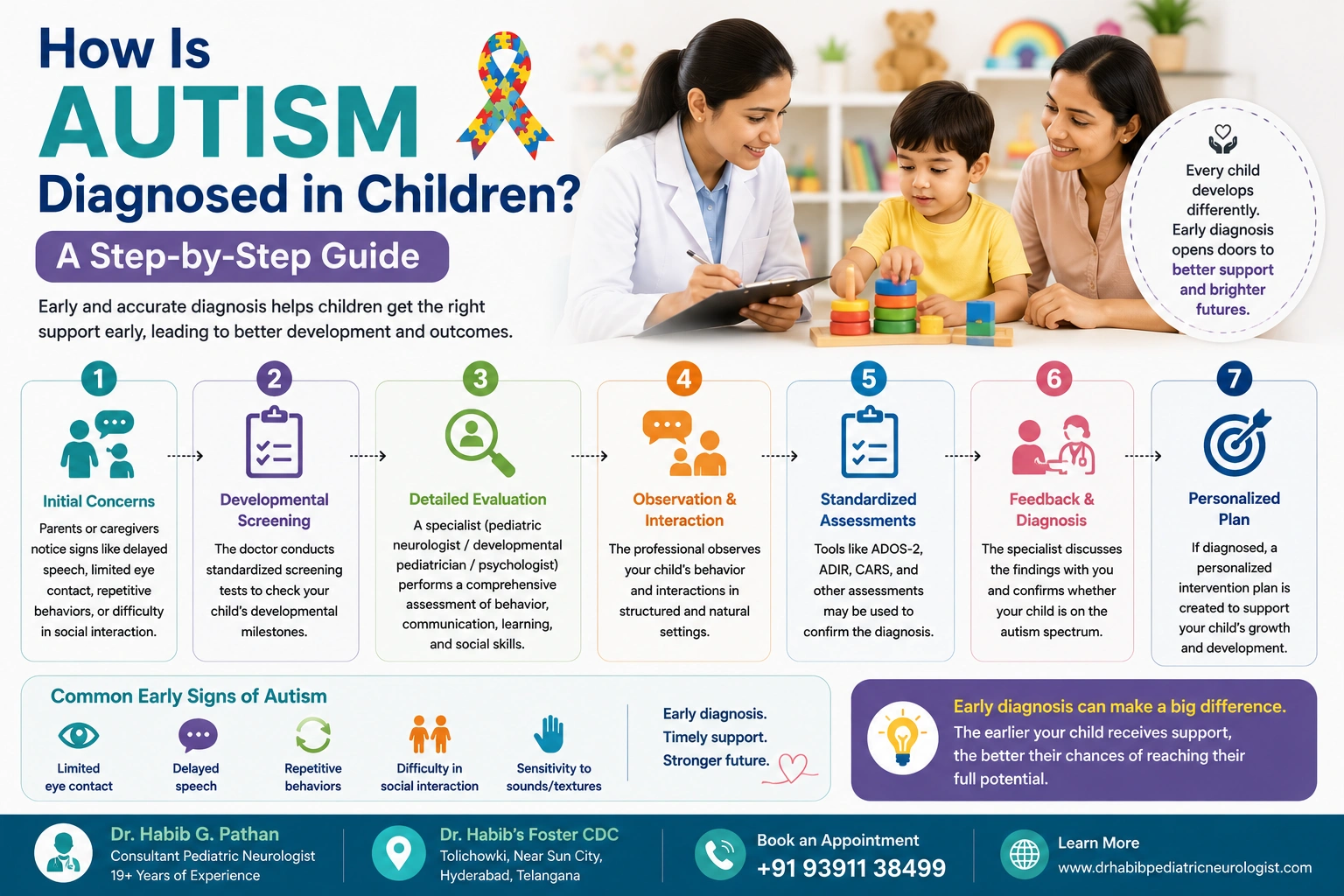
Once you’ve decided to seek an evaluation, a new question usually follows: “What actually happens next?” Understanding the diagnostic process ahead of time can make it far less intimidating. This guide walks through autism diagnosis in children step by step — from the first appointment to receiving results — so you know exactly what to expect.
Quick Answer
Autism diagnosis in children involves a structured process: an initial consultation and developmental history, standardized screening and observation, input from a multidisciplinary team where needed, and a final discussion of results with a personalized next-step plan. There’s no single blood test or scan for autism — diagnosis relies on trained clinical judgment supported by validated tools.
Key Takeaways
- Autism diagnosis is a multi-step clinical process, not a single test.
- The process typically includes history-taking, standardized screening, direct observation, and a results discussion.
- A pediatric neurologist’s involvement helps rule out or identify overlapping neurological conditions.
- Diagnosis can happen as early as 18–24 months, though some children are diagnosed later.
- A diagnosis opens the door to targeted therapy and school-based support, not a fixed label.
- Parents are active participants throughout the process, not passive observers.
- Dr. Habib’s Foster CDC conducts autism evaluations across Tolichowki, Malakpet, and Sun City in Hyderabad.
Step 1: Initial Consultation and Developmental History
The process begins with a detailed conversation between the specialist and parents. This covers pregnancy and birth history, developmental milestones, family history of neurodevelopmental conditions, and the specific behaviors that prompted the visit. Bringing a written list of concerns, or a short video of your child’s behavior at home, can be genuinely helpful here — clinical settings don’t always capture what you see daily.
Quick Summary
The first step is a thorough conversation, not a test — the specialist is building a complete picture of your child’s history and your specific concerns.
Step 2: Standardized Screening Tools
Specialists use validated screening instruments designed specifically for early childhood — these are structured questionnaires and observational checklists that compare your child’s behavior against expected developmental patterns. Screening tools help flag areas that need closer evaluation but are not, by themselves, a diagnosis.
Quick Summary
Screening tools are structured, validated instruments that flag areas for closer evaluation — a screening result alone doesn’t confirm or rule out autism.
Step 3: Direct Behavioral Observation
Next, the child is observed directly — typically during structured play and simple social tasks designed to reveal how they communicate, share attention, and respond to social cues. This step is often the most informative part of the process, since it lets the specialist see real-time behavior rather than relying solely on parent report.
Quick Summary
Direct observation during play and structured tasks lets the specialist see communication and social patterns firsthand.
Step 4: Multidisciplinary Input (When Needed)
For some children, a fuller picture requires input from more than one specialist — a speech-language evaluation for communication patterns, an occupational therapy assessment for sensory and motor patterns, or a hearing test to rule out hearing loss as a contributing factor. This isn’t a sign of a complicated case; it simply ensures other possible explanations are properly considered.
Quick Summary
A team-based approach, drawing on speech, occupational therapy, or hearing assessments where relevant, helps ensure an accurate and complete picture.
Step 5: Results Discussion and Next Steps
Once the evaluation is complete, the specialist shares findings directly with parents in plain language — explaining what was observed, whether the criteria for autism spectrum disorder are met, and what a personalized next-step plan looks like. This is also the point where questions about therapy options, school support, and resources are addressed.
Quick Summary
The process ends with a clear conversation, not just a label — covering what was found and what a realistic next-step plan involves.
Diagnostic Process at a Glance
| Step | What Happens | Typical Duration |
| 1. Consultation | History-taking and concern discussion | 30–45 minutes |
| 2. Screening | Standardized questionnaires and checklists | 20–30 minutes |
| 3. Observation | Structured play-based assessment | 45–60 minutes |
| 4. Multidisciplinary input (if needed) | Speech, OT, or hearing evaluation | Varies |
| 5. Results discussion | Findings explained, next steps planned | 30–45 minutes |
Why a Pediatric Neurologist’s Involvement Matters
Several neurological and developmental conditions can present with overlapping features — including developmental delay, ADHD, and certain genetic syndromes. Having a pediatric neurologist involved in the diagnostic process helps distinguish autism from these overlapping conditions, and can identify any additional neurological factors that need their own attention alongside a developmental plan.
Quick Summary
Neurological expertise helps distinguish autism from conditions with overlapping features, ensuring nothing else is missed along the way.
What Happens After a Diagnosis
A diagnosis is the start of a plan, not an endpoint. Depending on your child’s specific needs, next steps commonly include occupational therapy, speech therapy, behavioural therapy, and — where appropriate — support for the school environment. Many families find that having a clear diagnosis actually reduces anxiety, since it replaces uncertainty with a concrete direction.
Quick Summary
A diagnosis opens the door to a personalized therapy plan — most families find clarity easier to act on than ongoing uncertainty.
Common Questions About the Process
- Will my child need multiple visits? Often yes — a thorough evaluation is rarely completed in a single sitting.
- Can a diagnosis change over time? A child’s needs and presentation can evolve, which is why periodic follow-up is often part of a care plan.
- Is a second opinion reasonable? Yes, particularly for complex cases — a second opinion is a normal part of responsible healthcare decision-making.
Quick Summary
Multiple visits, evolving needs over time, and the option of a second opinion are all a normal part of a responsible diagnostic process.
How Dr. Habib’s Foster CDC Supports Families in Hyderabad
Dr. Habib G. Pathan, Consultant Pediatric Neurologist with over 19 years of experience, leads the autism diagnostic process at Foster CDC’s Tolichowki, Malakpet, and Sun City locations, combining neurological expertise with structured developmental assessment. Families leave with clear answers and, when needed, direct access to occupational therapy, speech therapy, and behavioural therapy under one coordinated plan.
Quick Summary
Foster CDC combines neurology-led diagnosis with direct access to therapy services, keeping the process coordinated rather than fragmented across providers.
Frequently Asked Questions
- Is there a blood test or scan that diagnoses autism? No. Autism is diagnosed through clinical observation, developmental history, and standardized screening tools — not a single lab test or scan.
- How long does the full diagnostic process take? It varies, but a thorough evaluation often spans more than one visit, particularly if multidisciplinary input is needed.
- What age is autism usually diagnosed? Many children are diagnosed between 18 months and 3 years, though diagnosis can happen later, especially for milder presentations.
- Do I need a doctor’s referral to book an evaluation? This varies by clinic; contacting the center directly is the easiest way to confirm the exact process for your situation.
- Will my child be observed alone or with me present? This depends on the assessment approach; many evaluations include both parent-present and structured one-on-one observation.
- What if the results are inconclusive? Inconclusive results are not unusual and typically lead to a follow-up evaluation after some time, rather than an immediate final answer.
- Can older children and teens still be diagnosed? Yes, diagnosis is possible at any age, though the evaluation approach may be adapted for older children.
- Does insurance cover autism evaluation in India? Coverage varies by insurer and policy; check directly with your provider regarding developmental and psychiatric evaluation coverage.
- What should I bring to the first appointment? A list of specific concerns, any prior developmental records, and, if possible, a short video of relevant behaviors at home.
- Where can I book an autism evaluation in Hyderabad? Dr. Habib’s Foster CDC conducts autism evaluations at its Tolichowki, Malakpet, and Sun City locations.
Conclusion
Understanding what happens during autism diagnosis in children can turn an intimidating unknown into a manageable, step-by-step process. If you’ve been putting off booking an evaluation simply because you weren’t sure what to expect, hopefully this guide has closed that gap. Book an evaluation with Dr. Habib’s Foster CDC to take the first step.
Medical Reviewer: Dr. Habib G. Pathan Consultant Pediatric Neurologist Child Development Center, Hyderabad
Medical Disclaimer: This article is intended for educational purposes only and should not replace professional medical evaluation or diagnosis.

Recent Comments