
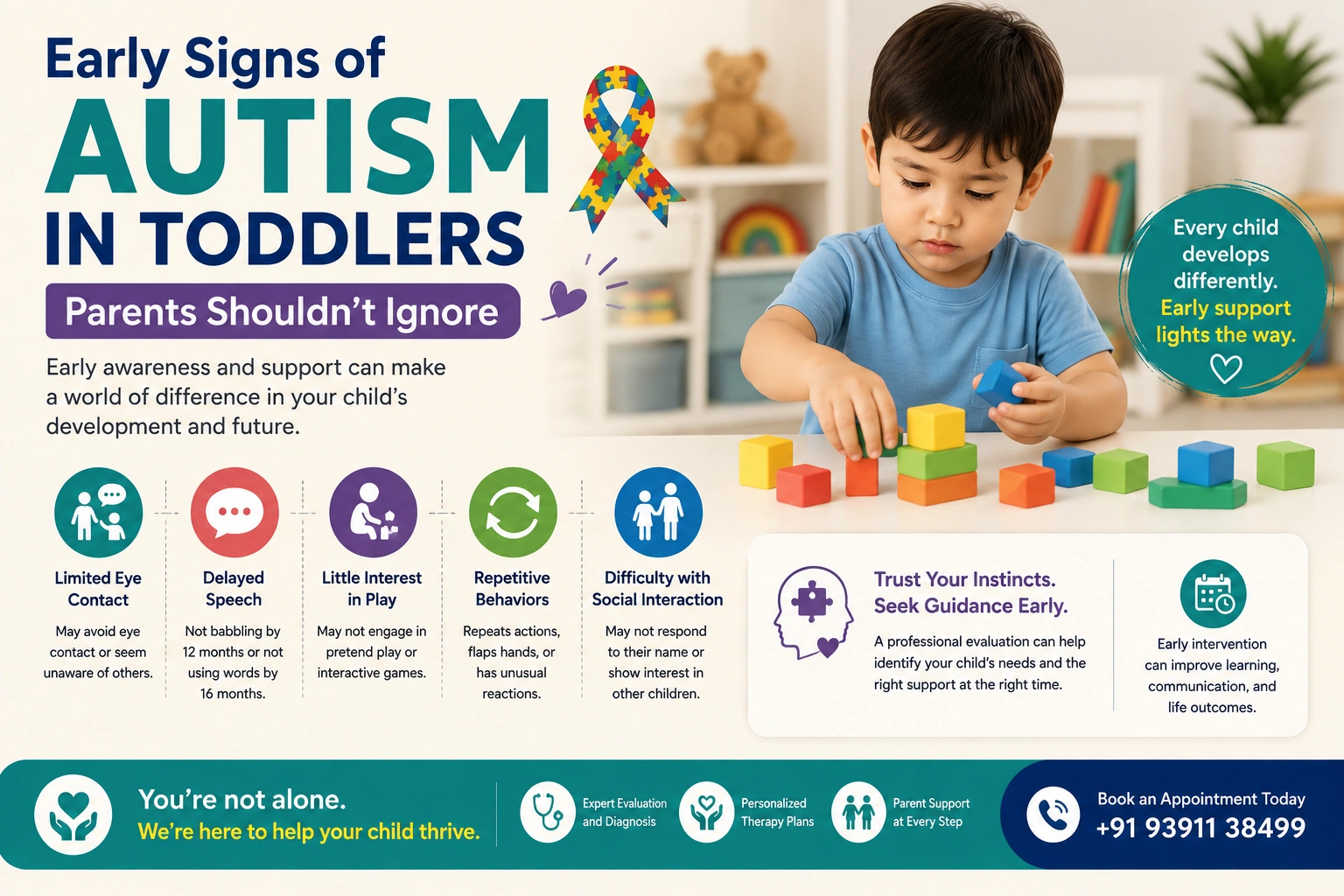
You’ve probably heard the phrase “trust your gut” as a parent — and when it comes to your toddler’s social and communication development, that instinct matters more than you might think. Many parents of children later diagnosed with autism describe noticing something different well before anyone else pointed it out. This guide walks through the early signs of autism in toddlers that are genuinely worth paying attention to, and what a next step actually looks like.
Quick Answer
Early signs of autism in toddlers often include limited eye contact, not responding consistently to their name, delayed or absent language, repetitive movements (like hand-flapping or rocking), intense reactions to sensory input, and limited interest in shared play with others. No single sign confirms autism — but a cluster of these signs, especially before age 2, is a reasonable reason to seek a specialist evaluation.
Key Takeaways
- Autism signs often emerge between 12–24 months, though some are noticeable earlier.
- Reduced eye contact and inconsistent response to name are among the earliest, most cited signs.
- Repetitive behaviors and intense sensory reactions are common alongside social-communication differences.
- Regression — losing previously used words or gestures — is a significant warning sign at any age.
- Early evaluation does not equal an automatic diagnosis; it opens the door to clarity and, if needed, support.
- Autism looks different in every child — this checklist is a starting point, not a checklist for self-diagnosis.
- Dr. Habib’s Foster CDC offers autism evaluations across Tolichowki, Malakpet, and Sun City in Hyderabad.
What Is Autism, Briefly
Autism spectrum disorder (ASD) is a neurodevelopmental condition that affects how a person communicates, interacts socially, and processes sensory information. It’s called a “spectrum” because it presents very differently from one child to another — some children have significant support needs, while others are highly verbal with more subtle social differences. Autism is not caused by parenting style, and it is not something a child will simply “grow out of,” though early support can meaningfully change a child’s developmental trajectory.
Quick Summary
Autism is a spectrum condition affecting communication, social interaction, and sensory processing — presenting uniquely in every child.
Early Signs of Autism in Toddlers by Category
| Category | What It May Look Like |
| Social & Eye Contact | Limited or fleeting eye contact, doesn’t smile back consistently, prefers to play alone |
| Communication | Delayed babbling or words, doesn’t point to show interest, doesn’t respond consistently to name |
| Repetitive Behavior | Hand-flapping, rocking, spinning objects, lining up toys instead of pretend play |
| Sensory Response | Strong reactions to sounds, textures, or lights; seeks or avoids certain sensations |
| Social Play | Limited interest in peek-a-boo or shared attention, doesn’t show objects to caregivers |
| Regression | Loses previously used words or gestures at any age |
Quick Summary
Early signs cluster around social interaction, communication, repetitive behavior, and sensory response — no single item on its own is diagnostic.
Age-by-Age: What to Watch For
By 12 months: Limited babbling, doesn’t respond to name, minimal gesturing (waving, pointing). By 18 months: No single words, doesn’t point to show interest, limited eye contact during interaction. By 24 months: No two-word phrases, little interest in other children, repetitive play patterns dominate. Any age: Loss of previously acquired language or social skills should never be dismissed as “a phase.”
Quick Summary
Certain communication and social milestones by 12, 18, and 24 months offer useful checkpoints — but regression at any age is always worth a closer look.
Common Causes and Contributing Factors
Autism’s exact cause isn’t fully understood, but current understanding points to a combination of genetic and neurological factors influencing early brain development. It is not caused by vaccines, parenting approach, or diet — a myth that’s been repeatedly and thoroughly disproven in the medical literature. A family history of autism or related neurodevelopmental conditions can increase likelihood, which is one reason a thorough family history is part of any proper evaluation.
Quick Summary
Autism arises from genetic and neurodevelopmental factors — not parenting, diet, or vaccines — and family history can be a relevant factor in evaluation.
How Autism Is Diagnosed in Toddlers
There is no single medical test (like a blood test or scan) that diagnoses autism. Instead, diagnosis relies on structured behavioral observation, developmental history from parents, and standardized screening tools used by trained specialists. At Dr. Habib’s Foster CDC, this typically involves:
- A detailed conversation about developmental history and specific concerns
- Structured observation of the child during play and social interaction
- Standardized screening tools appropriate for toddler age
- A clear discussion of findings and, if needed, a personalized next-step plan
Quick Summary
Autism diagnosis in toddlers combines parent history, structured observation, and standardized tools — not a single lab test.
Why Early Evaluation Matters
A toddler’s brain is undergoing rapid development, which is exactly why early identification tends to lead to stronger outcomes. Children who begin appropriate support earlier often make faster gains in communication and social skills than those who start later. Early evaluation isn’t about rushing to a label — it’s about giving a child access to support during the window when it can help the most.
Quick Summary
The earlier autism-related support begins, the more a child’s developing brain can benefit — making early evaluation a meaningful head start, not a rushed judgment.
What Autism Is Not: Common Myths
- Myth: “He’ll grow out of it.” Fact: Autism is a lifelong neurodevelopmental difference; early signs don’t resolve on their own, though skills can improve significantly with support.
- Myth: “She makes eye contact sometimes, so it’s not autism.” Fact: Eye contact patterns vary widely; inconsistent eye contact doesn’t rule autism in or out on its own.
- Myth: “Only boys get autism.” Fact: Autism affects both boys and girls, though it’s sometimes under-recognized in girls due to differing presentation.
- Myth: “Vaccines cause autism.” Fact: This claim has been repeatedly and thoroughly disproven by large-scale medical research.
Quick Summary
Common assumptions about autism — that it resolves on its own, only affects boys, or that eye contact rules it out — don’t hold up against current medical understanding.
Home Tips While You Wait for an Evaluation
- Continue talking, singing, and playing with your child as you normally would
- Keep a simple log of specific behaviors and when you notice them — this helps the specialist
- Avoid excessive screen time, which can reduce opportunities for social interaction
- Don’t blame yourself or your parenting — autism is neurological, not caused by caregiving style
- Connect with other parents or local support groups for perspective while you wait
Quick Summary
Simple observation, continued engagement, and connecting with support resources can help while you wait for a formal evaluation.
When to Book an Evaluation
Consider booking a specialist evaluation if your toddler shows several signs from the categories above — particularly reduced eye contact combined with delayed language or limited social interest — especially if these have been consistent for a few months rather than a brief phase. Regression of any previously gained skill warrants prompt evaluation regardless of age.
Quick Summary
A cluster of consistent signs, or any regression, are the clearest reasons to book an evaluation rather than wait and see.
How Dr. Habib’s Foster CDC Supports Families in Hyderabad
Dr. Habib G. Pathan, Consultant Pediatric Neurologist with over 19 years of experience, leads autism evaluations at Foster CDC’s Tolichowki, Malakpet, and Sun City locations. Every evaluation combines neurological expertise with structured developmental assessment, giving families a clear, medically grounded starting point — along with direct access to therapy services (occupational therapy, speech therapy, and behaviour therapy) if a diagnosis is confirmed.
Quick Summary
Foster CDC combines pediatric neurology expertise with structured autism assessment and a direct path to therapy services, all in one place.
Frequently Asked Questions
- At what age can autism first be identified? Some signs can appear as early as 12 months, though many children are formally evaluated between 18 months and 3 years.
- Does my toddler need to show every sign on this list to have autism? No. Autism presents differently in every child; a cluster of consistent signs matters more than checking every box.
- Can a toddler “grow out of” early autism signs? Autism itself doesn’t resolve on its own, though many children make significant developmental progress with early support.
- Is eye contact avoidance always a sign of autism? Not necessarily — eye contact patterns vary. It’s one factor considered alongside several others, not a standalone indicator.
- What causes autism in toddlers? Current understanding points to genetic and neurodevelopmental factors; it is not caused by parenting, diet, or vaccines.
- What happens during an autism evaluation? The specialist gathers developmental history, observes the child during play and interaction, and uses standardized screening tools.
- Is autism more common in boys than girls? Autism is diagnosed more often in boys, but it affects girls too — sometimes with less typical, more easily missed presentation.
- Can early intervention change a child’s outcome? Yes. Starting appropriate support earlier is generally associated with stronger gains in communication and social skills.
- Should I wait to see if things improve before booking a visit? If signs have been consistent for a few months, or if your child has lost a previously gained skill, it’s reasonable to book an evaluation rather than wait further.
- Where can I get an autism evaluation for my toddler in Hyderabad? Dr. Habib’s Foster CDC offers autism evaluations at its Tolichowki, Malakpet, and Sun City locations.
Conclusion
Trusting your instincts as a parent is not the same as jumping to conclusions — it’s the first, most important step toward getting your child real answers. If you’ve recognized several of the early signs of autism in toddlers described here, an evaluation with a pediatric specialist can offer clarity and, if needed, a clear path forward. Book an evaluation with Dr. Habib’s Foster CDC to take that next step with confidence.
Medical Reviewer: Dr. Habib G. Pathan Consultant Pediatric Neurologist Child Development Center, Hyderabad
Medical Disclaimer: This article is intended for educational purposes only and should not replace professional medical evaluation or diagnosis.

Recent Comments