
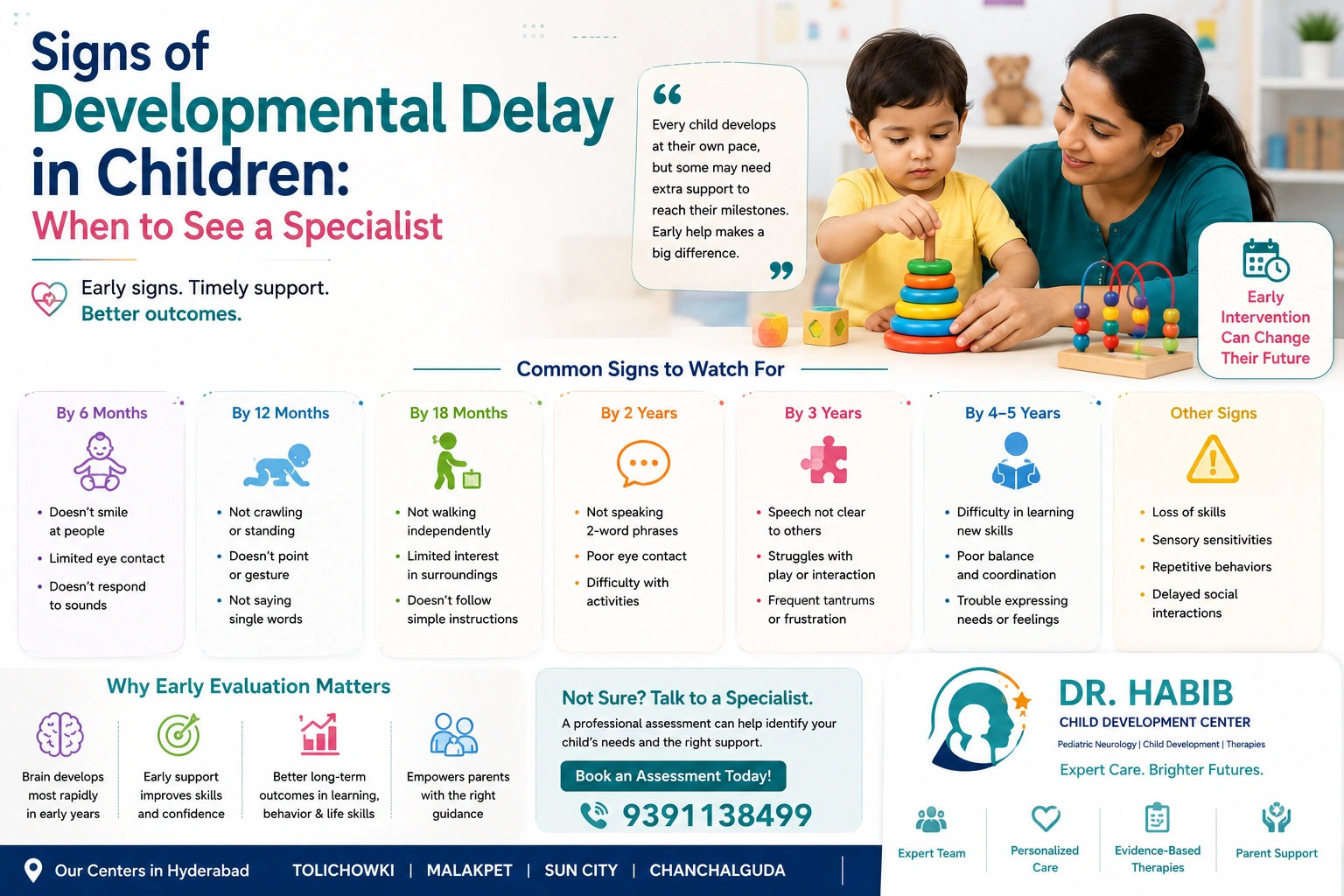
“Is this normal, or should I be worried?” It’s one of the most common questions parents ask themselves — and one of the hardest to answer alone. Developmental delay in children doesn’t always look dramatic; often it’s a quiet, nagging sense that something is a little “off.” This guide isn’t a general overview of developmental delay; it’s a focused, practical answer to one question: when does it make sense to actually book a specialist visit?
Quick Answer
For developmental delay in children, see a specialist if your child misses two or more milestones for their age, loses a skill they’d already gained, or shows delay across more than one area (motor, speech, social, or cognitive) at once. A single late milestone, on its own, is usually not urgent — but a pattern of several is worth a professional opinion sooner rather than later.
Key Takeaways
- One late milestone rarely means much; a pattern across multiple areas is the real signal.
- Losing a previously gained skill (regression) should always prompt a visit, regardless of age.
- Trust your instinct as a parent — you see your child more than anyone else does.
- Waiting “to see if they grow out of it” can delay support during the years it matters most.
- A specialist visit is a conversation and an assessment, not an automatic diagnosis.
- For background on causes, risk factors, and treatment, see our related guides below — this article focuses specifically on the “should I go?” decision.
- Dr. Habib’s Foster CDC offers specialist evaluations across Tolichowki, Malakpet, and Sun City in Hyderabad.
Developmental Delay in Children: Pattern Matters More Than a Single Milestone
Nearly every parent can point to one thing their child does “later than the other kids.” That, by itself, is rarely a reason for concern — children vary widely within a normal range. What matters more is whether delay shows up in more than one area at once, and whether it’s persistent rather than a temporary lag that closes on its own within a few months.
For a full breakdown of what typical milestones look like by age, and the underlying causes of delay, see our companion articles: Causes of Developmental Delay in Children and Recognizing Developmental Delay in Children.
Quick Summary
A single late skill is usually not urgent. A pattern across multiple developmental areas, or a delay that isn’t closing over time, is what actually warrants a specialist visit.
Five Signs That Mean “See a Specialist Now”
- Regression — your child loses a skill they previously had (words, walking, social response), at any age
- Multi-area delay — noticeable lag in two or more of: motor, speech/language, social-emotional, or cognitive skills
- No meaningful words by 16–18 months, or no two-word phrases by age 2
- Not walking independently by 18 months, or significant asymmetry in movement
- Withdrawal from social interaction — little eye contact, no response to name, no interest in shared attention
If even one of these describes your child, it’s reasonable to book an evaluation rather than wait. For a deeper checklist of symptoms by category, see Signs and Symptoms of Developmental Delay in Children.
Quick Summary
Regression, delay across multiple areas, and specific missed language/motor/social markers are the clearest signals that it’s time to book a visit.
What Pediatric Guidelines Recommend
Major pediatric bodies, including the American Academy of Pediatrics, recommend structured developmental screening at set checkpoints — typically around 9, 18, and 30 months — in addition to any time a parent raises a specific concern. This is a useful reminder: you don’t need to wait for a scheduled screening if you’re already noticing warning signs. A concern raised between checkpoints is just as valid as one raised at a routine visit.
Quick Summary
Routine screening happens at set ages, but a parent’s concern is a valid enough reason to seek an evaluation at any time in between.
“But What If It’s Nothing?” — Why Parents Hesitate
Many parents delay booking an assessment out of hope that their child will “catch up,” fear of a diagnosis, or simply not knowing what a visit even involves. It’s worth knowing that a specialist visit is not the same as a diagnosis — it’s an evaluation. In many cases, it either reassures parents that development is on track, or catches something early enough that support has maximum impact.
Quick Summary
Hesitation is natural, but a specialist visit is a fact-finding step, not an automatic label — and early clarity benefits both the child and the parent’s peace of mind.
What a Specialist Visit Actually Involves
At Dr. Habib’s Foster CDC, a first visit for developmental concerns typically includes:
| Step |
What Happens |
| History | The pediatric neurologist asks about pregnancy, birth, and milestone history |
| Observation | Your child is observed during play and simple tasks |
| Screening tools | Standardized checklists help compare progress to expected ranges |
| Discussion | Findings are explained in plain language, with a clear next-step plan |
This is a short, low-pressure process — most parents describe it as far less intimidating than they expected. For the full clinical picture on causes and treatment paths, see Developmental Delay in Children: Causes, Diagnosis & Treatment Options.
Quick Summary
An evaluation is a structured but low-pressure conversation and observation session — not a single test with an immediate label attached.
Why Timing Matters
A child’s brain is most adaptable in the first few years of life. Addressing a genuine delay earlier tends to require less intensive intervention over time than addressing the same delay later. This doesn’t mean panicking over every late milestone — it means not delaying a conversation once a real pattern is visible. Our guide on preventing developmental delay covers what’s within a parent’s control versus what isn’t.
Quick Summary
Earlier evaluation generally means a shorter, less intensive path to support — timing is one of the few factors parents can influence directly.
When It’s Probably Fine to Wait and Watch
Not every concern needs an immediate visit. It’s usually reasonable to observe a bit longer if:
- Your child is behind in just one area, with steady (even if slow) progress
- There’s a known reason for temporary lag (recent illness, family relocation, bilingual household)
- Your pediatrician has already reviewed the concern at a recent check-up and wasn’t worried
Even so, if the concern keeps nagging at you, a specialist visit is never the wrong call.
Quick Summary
Mild, single-area, steadily-progressing delays can often be watched a bit longer — but persistent parental concern is itself a valid reason to seek an opinion.
How Dr. Habib’s Foster CDC Supports Families in Hyderabad
Dr. Habib G. Pathan, Consultant Pediatric Neurologist with over 19 years of experience, leads developmental evaluations at Foster CDC’s Tolichowki, Malakpet, and Sun City locations. Assessments are designed to give parents clarity quickly — either reassurance, or a clear, personalized next-step plan — rather than a long wait for answers.
Quick Summary
Foster CDC’s evaluation process is built around giving parents fast, clear answers, backed by 19+ years of pediatric neurology experience.
Frequently Asked Questions
- Is one late milestone a reason to see a specialist? Not usually. A single late skill, with otherwise steady progress, is common and often falls within normal variation.
- What is the single biggest warning sign parents should watch for? Regression — losing a previously gained skill — is one of the clearest signs that warrants a prompt evaluation, regardless of the child’s age.
- Can a pediatrician handle this instead of a specialist? A pediatrician is a good first step and can refer you onward; a pediatric neurologist or developmental specialist provides a more focused evaluation when delay is suspected across multiple areas.
- Will my child be “labeled” after one visit? No. A first visit is an evaluation, not an automatic diagnosis — many children are simply reassessed later or referred to age-appropriate support.
- How long does a first evaluation take? Most initial developmental evaluations take about 45–60 minutes, including history, observation, and discussion.
- What if my child was premature? Premature birth is commonly factored in using an adjusted age; mention this at your visit so it’s accounted for correctly.
- Does bilingualism cause speech delay? Growing up bilingual does not typically cause a true speech delay, though it can affect vocabulary size in each individual language.
- Can developmental delay be reversed? Many delays respond well to timely therapy and support; outcomes depend on the underlying cause, which is why an accurate evaluation matters.
- What happens after the first visit if a delay is confirmed? You’ll typically receive a personalized plan, which may include referrals to therapy services such as speech, occupational, or behavioural therapy.
- Where can I book a developmental evaluation in Hyderabad? You can book directly with Dr. Habib’s Foster CDC at its Tolichowki, Malakpet, or Sun City locations.
Conclusion
If you’ve found yourself re-reading this checklist and recognizing your own child in it, that’s usually answer enough: it’s time to book a visit. When it comes to developmental delay in children, a specialist evaluation won’t waste your time either way — it either puts your mind at ease or opens the door to support while it can help the most. Book a consultation with Dr. Habib’s Foster CDC to get clarity.
Medical Reviewer: Dr. Habib G. Pathan Consultant Pediatric Neurologist Child Development Center, Hyderabad
Medical Disclaimer: This article is intended for educational purposes only and should not replace professional medical advice, diagnosis, or treatment.

Recent Comments