
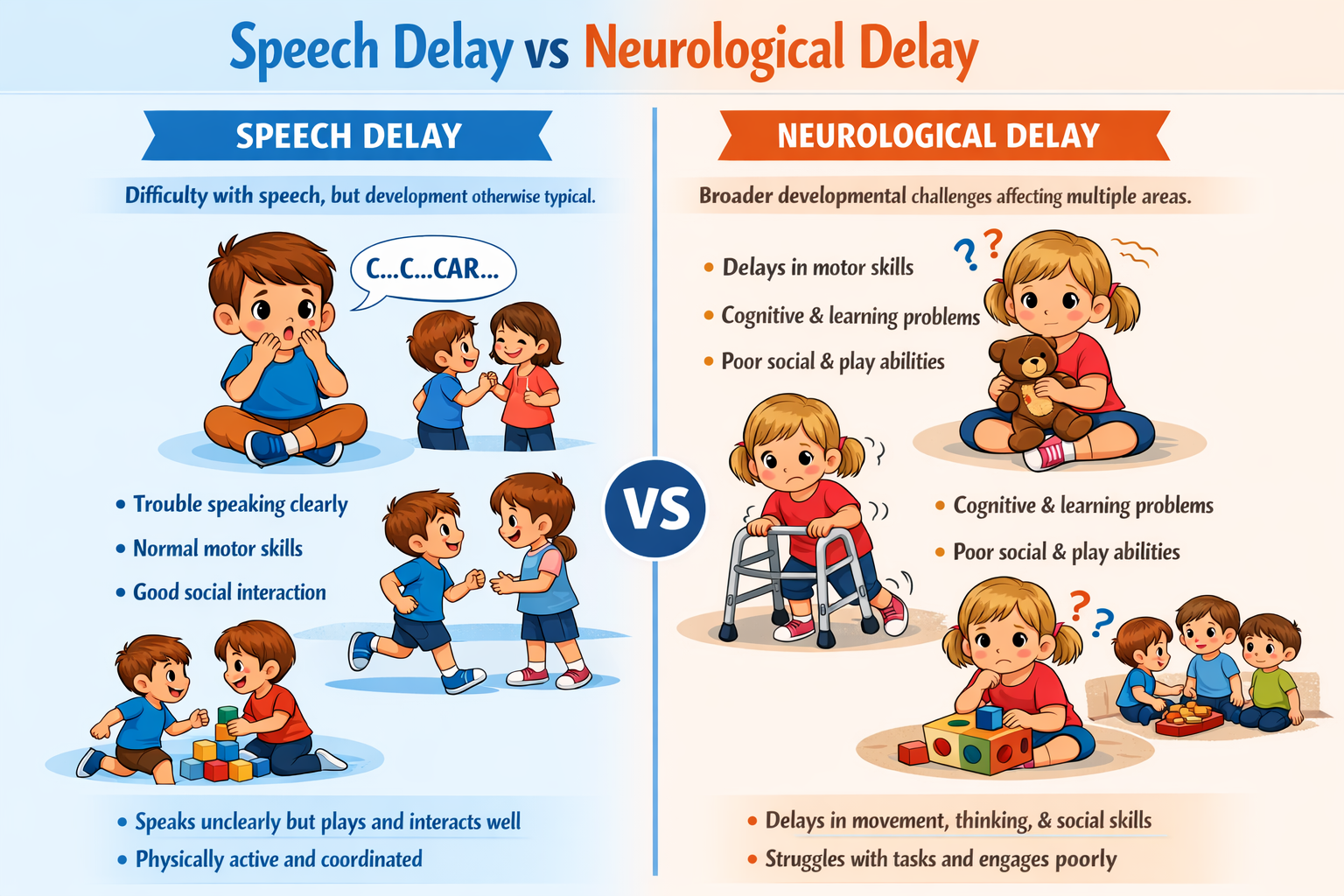
Speech Delay vs Neurological Delay in Children
When a child does not meet communication milestones, parents often wonder:
Is this just a speech delay, or something more serious like a neurological delay?
Although these conditions can overlap, they are not the same. Understanding the difference helps you get the right support early.
What Is a Speech Delay?
A speech delay means a child has difficulty producing sounds, words, or sentences at the expected age.
However, other areas—such as thinking, learning, motor skills, and social interaction—are usually developing normally.
Signs of Speech Delay in Children:
- Smaller vocabulary than peers
- Difficulty pronouncing words clearly
- Not combining words into short phrases
- Speech is hard to understand, even for familiar people
- Understands language but struggles to express it
What Speech Delay Usually Doesn’t Affect:
- Intelligence
- Motor skills (walking, grasping)
- Social engagement (eye contact, play, curiosity)
Children with speech delays often use gestures, pointing, or facial expressions to communicate. They want to connect—they just lack the words.
What Is a Neurological Delay?
A neurological delay is broader. It affects how the brain develops and functions.
Speech problems may be present, but they are usually part of a larger developmental issue.
Signs of Neurological Delay in Children:
- Delays in multiple areas (speech, motor, cognition)
- Poor muscle tone or clumsy coordination
- Limited eye contact or social interaction
- Difficulty understanding language
- Repetitive behaviors or unusual sensory reactions
- Slower learning and problem-solving skills
In this case, speech delay is just one part of a bigger concern.
Red Flags That Suggest a Neurological Delay
Every child develops at their own pace. However, these signs may indicate something more serious:
- No babbling by 12 months
- No words by 18 months
- Loss of previously learned skills
- Lack of eye contact or response to name
- Not pointing, waving, or using gestures
- Delayed walking or poor coordination
- Difficulty following simple instructions
If delays appear in more than one area, a developmental assessment is important.
Why This Distinction Matters
- Speech delays often improve with speech therapy alone
- Neurological delays usually require a team approach, including speech, occupational, and physical therapy
Early intervention is critical. Delayed action can affect long-term development.
Common Causes
Speech Delay Causes:
- Hearing problems
- Limited language exposure
- Oral-motor difficulties
- Being a late talker
Neurological Delay Causes:
- Genetic conditions
- Birth complications
- Brain injury or developmental disorders
- Conditions like autism or cerebral palsy
What Parents Can Do
- Track developmental milestones
- Consult a pediatrician
- Request a developmental assessment
- Check hearing, as hearing loss can mimic speech delay
- Start early intervention as soon as possible
Early support can significantly improve outcomes.
FAQs
1. Is speech or neurological delay a disease?
No. These are developmental disorders, not diseases. Many improve with proper therapy.
2. Can this be managed at home?
Home strategies can help, but professional guidance is strongly recommended.
3. How long does therapy take?
It varies. Therapy duration depends on the child’s progress.
4. Can this be prevented?
Not always. It depends on the child’s development and neurological factors.
Final Thoughts
Not every speech delay means a neurological issue. However, if delays affect motor skills, learning, or social interaction, it’s important to look deeper.
Think of it this way:
- A child who points but cannot say “cookie” may have a speech delay
- A child who doesn’t point, avoids eye contact, and doesn’t respond to their name may have a neurological concern
When in doubt, act early. Early support can make a big difference.
Think of it this way:
- A toddler who points at the cookie jar but can’t say “cookie” is likely experiencing a speech delay.
- A toddler who doesn’t point, avoids eye contact, and doesn’t respond to their name may be showing signs of a neurological delay.
When in doubt, act early. Waiting rarely clears things up—but early action often does.

Recent Comments